01
Morally neutral
Care tasks are about function. They do not make you good when done or bad when undone.
A compassionate reset for people who need their home to function before they need it to impress anyone.
core idea
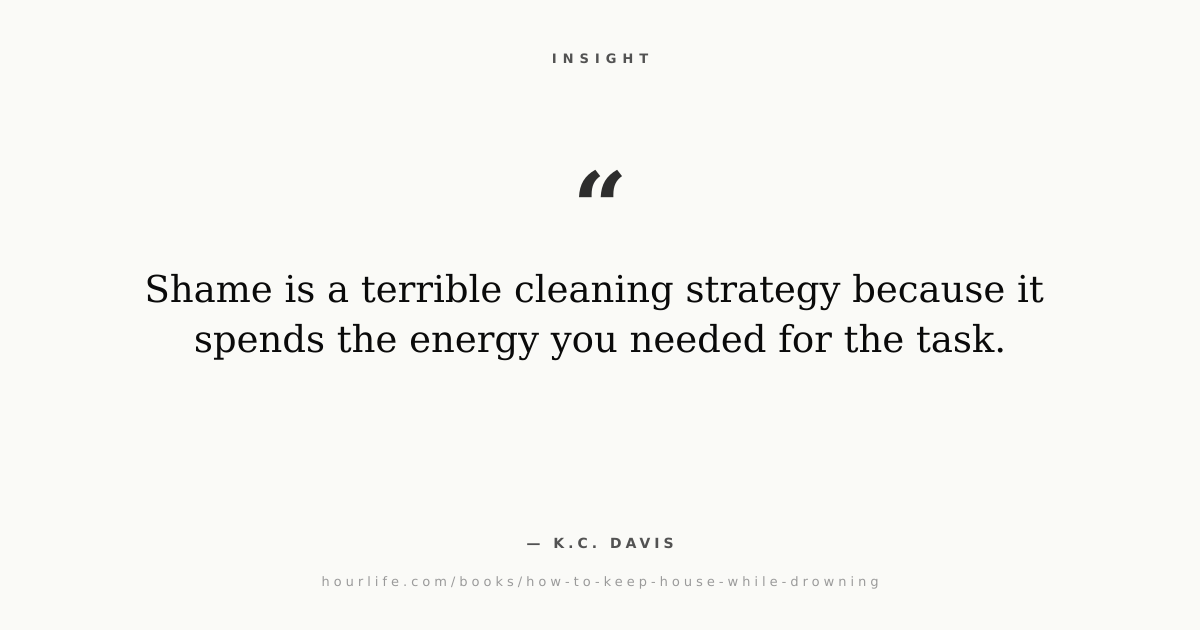
Davis reframes domestic work away from shame. A sink full of dishes is not proof that you are lazy, broken, or irresponsible. It is information: your current systems, capacity, support, or mental health are not matching the load.
The practical move is to stop designing for an imaginary person with endless executive function. Build a home around use, kindness, accessibility, and reset points that work on your worst days.
01
Care tasks are about function. They do not make you good when done or bad when undone.
02
A home can be useful before it is beautiful, sorted, folded, or company-ready.
03
Change the container, label, location, or expectation before you blame the person.
interactive tool
Pick one task, name your capacity, and turn shame into the smallest useful next step.
1 / choose the care task
2 / capacity today
3 / kind-enough rule
care anatomy
Remove health hazards first. This is not aesthetic work.
Make eating possible before making the kitchen beautiful.
Make clothing visible and usable before sorting perfectly.
Give frequently used objects low-friction homes.
Stop while the system still feels kind enough to repeat.
community insights
Vote for the reframes that make care feel possible again.
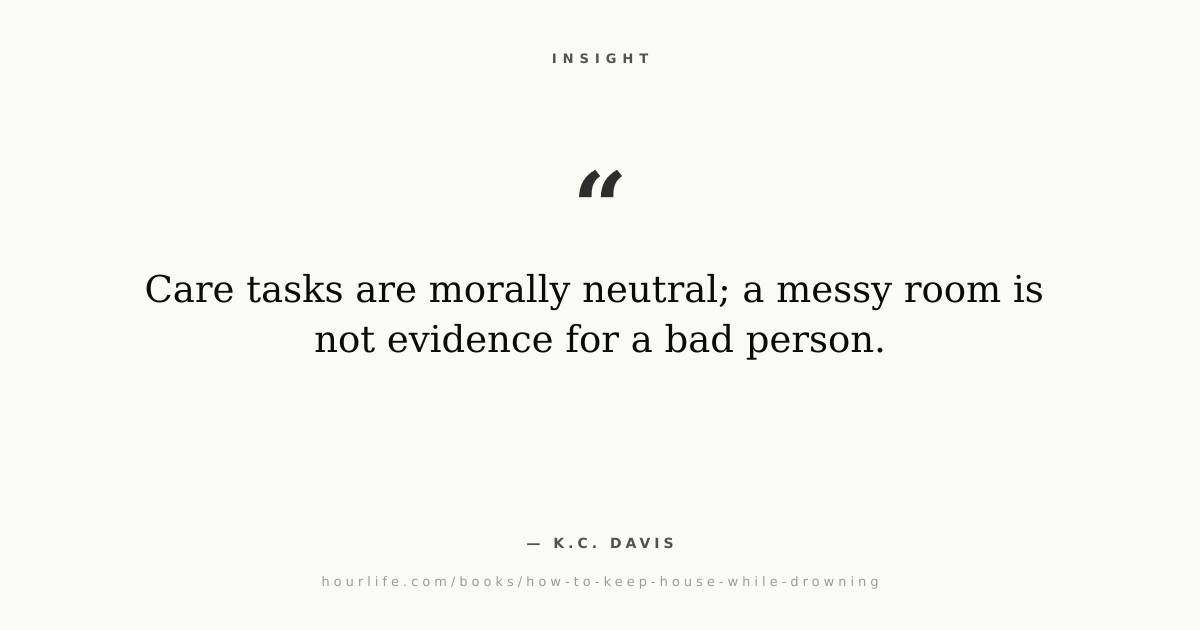
"Care tasks are morally neutral; a messy room is not evidence for a bad person."
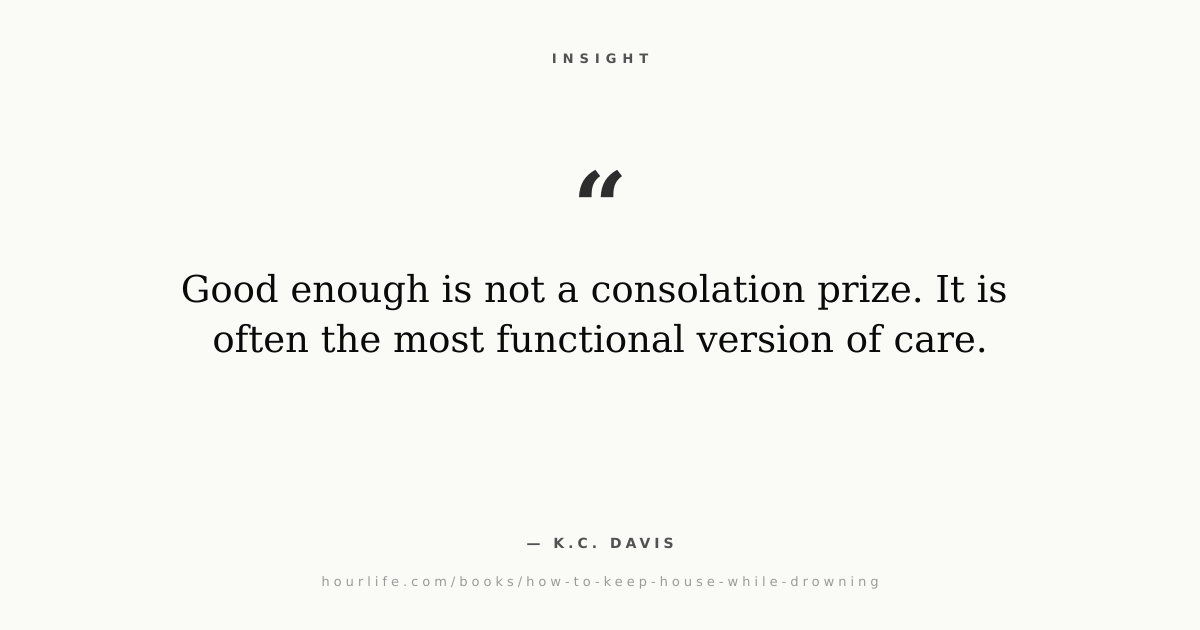
"Good enough is not a consolation prize. It is often the most functional version of care."
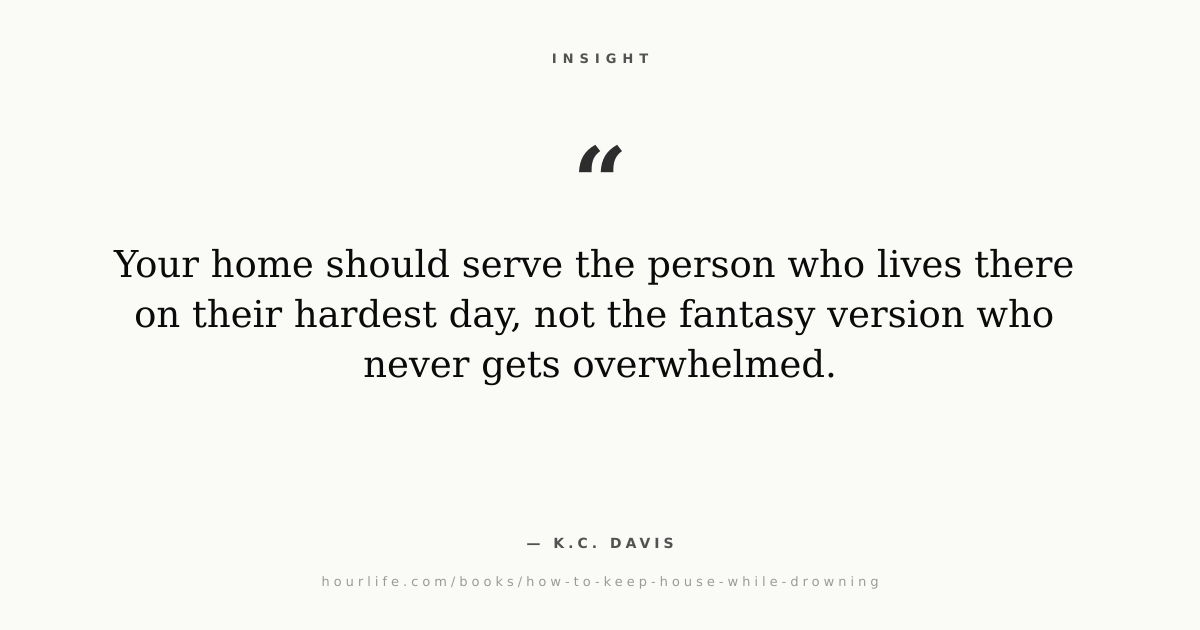
"Your home should serve the person who lives there on their hardest day, not the fantasy version who never gets overwhelmed."
action steps
Spend ten minutes touching only trash, dishes, laundry, things with a place, and things without a place. Stop when function improves.
Choose the chore that carries the most shame and rewrite it as a service: future eating, future dressing, future comfort, or future safety.
For one recurring care task, design the smallest acceptable version: paper plates, a visible hamper, a chair shower, or a snack basket.
Before you stop, create one obvious next step so tomorrow starts with an invitation instead of a wall.
Instead of asking why you cannot keep up, ask what tool, placement, body-double, reminder, or permission would make the task easier.
"Care tasks are morally neutral. They exist to serve you, not to measure you."
K.C. Davis
Back to libraryPick setup actions and daily habits from How to Keep House While Drowning, choose a start date, and download a printable checklist with real calendar pages.
A compassionate, practical guide to care tasks for people whose homes, bodies, or executive function are overwhelmed.
Readers on HourLife most often highlight ideas such as: “Care tasks are morally neutral; a messy room is not evidence for a bad person.” “Good enough is not a consolation prize. It is often the most functional version of care.” “Your home should serve the person who lives there on their hardest day, not the fantasy version who never gets overwhelmed.”
It's a strong pick for readers exploring Home & Minimalism, Stress Less, and Therapy & Mental Health. HourLife distills its core idea into community-voted insights and one practical action worth trying.
Run a five-things reset — Spend ten minutes touching only trash, dishes, laundry, things with a place, and things without a place. Stop when function improves.
About five minutes. The HourLife summary distills How to Keep House While Drowning into its core idea, 5 community insights, and 5 practical actions you can apply right away.
Print it, pin it, post it. Ways to take How to Keep House While Drowning off the screen and into the world.
The core idea, key takeaways, and how to apply How to Keep House While Drowning, as one clean, readable page.
Read summaryEvery action from this page as a printable to-do list, with a 7-day tracker.
Download PDFA shareable card with the book and its top-voted insight, for saving or posting.
The summary card and every quote card in six sizes: Instagram feed, Story, Pinterest, YouTube thumbnail, phone wallpaper, and link preview.
Save the insights that land, build the habits that stick, and keep what you learn from How to Keep House While Drowning working long after you close the page — inside HourLife.