The Arbinger Institute · 2000 · relational leadership
Leadership and Self-Deception
The Arbinger lens is simple and uncomfortable: when people become objects in your story, your leadership is already inside the box.
Core idea.
Self-deception hides in righteousness. The practical move is to recover the other person's reality: their pressures, needs, hopes, and humanity before you try to fix their behavior.
interactive tool
Out-of-the-Box Reframe
human view
Choose the relationship.
Move from accusation to curiosity.
Ask: what might this person be carrying that my story ignores?
Reader notes.
"Self-deception starts when your story makes you innocent and everyone else smaller."
Lead outside the box.
Map the box
Write the accusation you are carrying about one person.
Name your contribution
List one way your behavior may be helping the pattern continue.
Recover their reality
Write three pressures or needs the other person may be managing.
Choose a humane aim
Decide what would help the relationship, not just your case.
Pause the verdict
Before responding, ask what your story is leaving out.
Ask one real question
Invite information that could complicate your certainty.
Make one repair
Acknowledge a contribution without turning it into self-defense.
Treat them as a person
Do one action that serves their legitimate need.
Review the story
End the day by checking where you made someone smaller.
Build your mini action book.
Pick setup actions and daily habits from Leadership and Self-Deception: Getting Out of the Box, choose a start date, and download a printable checklist with real calendar pages.
Frequently asked
What is Leadership and Self-Deception: Getting Out of the Box about?
A relational leadership book about seeing people as people instead of obstacles, threats, or tools.
What are the key takeaways from Leadership and Self-Deception: Getting Out of the Box?
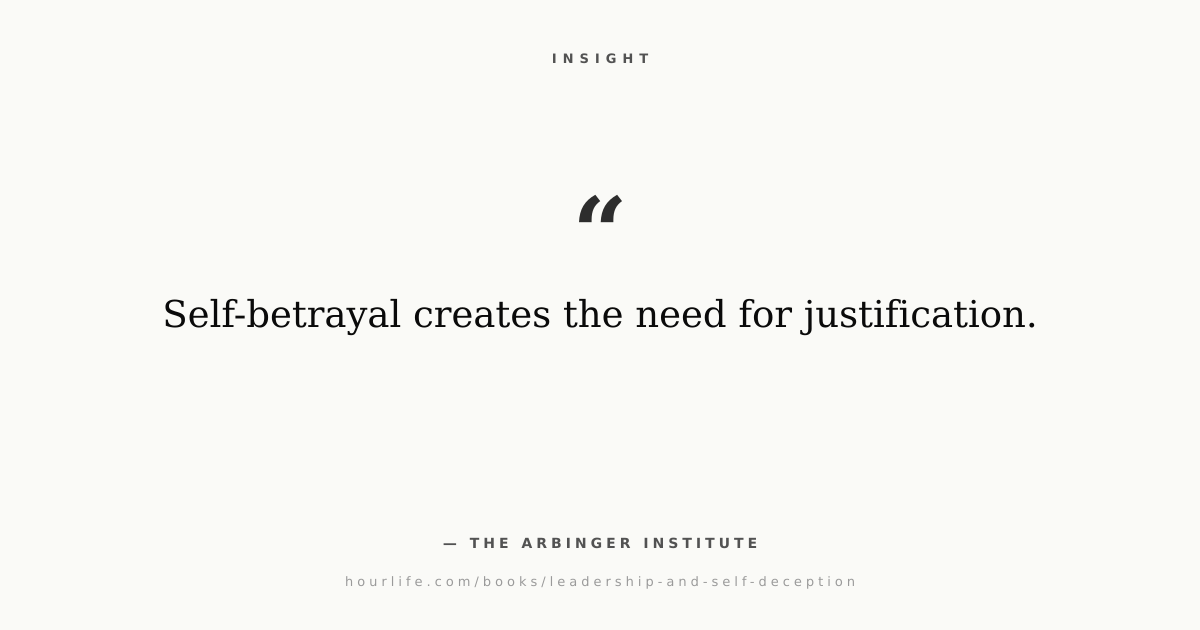
Readers on HourLife most often highlight ideas such as: “Self-deception starts when your story makes you innocent and everyone else smaller.” “Seeing people as objects corrupts leadership at the source.” “Blame often protects an image of yourself.”
Who should read Leadership and Self-Deception: Getting Out of the Box?
It's a strong pick for readers exploring Character & Integrity, Leadership & Management, and Relationship Repair. HourLife distills its core idea into community-voted insights and one practical action worth trying.
What's one thing I can do after reading Leadership and Self-Deception: Getting Out of the Box?
Map the box — Write the accusation you are carrying about one person.
How long does it take to read the Leadership and Self-Deception: Getting Out of the Box summary?
About five minutes. The HourLife summary distills Leadership and Self-Deception: Getting Out of the Box into its core idea, 7 community insights, and 9 practical actions you can apply right away.
Downloads & shareables
Print it, pin it, post it. Ways to take Leadership and Self-Deception: Getting Out of the Box off the screen and into the world.
-
Read the text summary
The core idea, key takeaways, and how to apply Leadership and Self-Deception: Getting Out of the Box, as one clean, readable page.
Read summary -
Action checklist
Every action from this page as a printable to-do list, with a 7-day tracker.
Download PDF -
Book summary card
A shareable card with the book and its top-voted insight, for saving or posting.
Resource library
The summary card and every quote card in six sizes: Instagram feed, Story, Pinterest, YouTube thumbnail, phone wallpaper, and link preview.
Turn this book into a daily practice.
Save the insights that land, build the habits that stick, and keep what you learn from Leadership and Self-Deception: Getting Out of the Box working long after you close the page — inside HourLife.