Keep this author quotes for later
Sign in to save

Annie Jacobsen

The most-loved lines from Annie Jacobsen, drawn from 1 book in the library.

Lines labelled “HourLife takeaway” are our wording of the book’s ideas and may paraphrase it. Only lines in quotation marks are the author’s own words, with where they appear. Check the book for exact wording before you quote it. Spot an error?

A biological war does not need an attacker; an accident can start one.

Biological War Annie Jacobsen HourLife takeaway

Jacobsen's scenario opens with an explosion at a high-containment lab in Siberia, not with a strike. Her point is that a release does not have to be deliberate to be catastrophic. A pathogen does not care whether anyone meant to let it out.


The first hours are the only real window, and they are spent not knowing.

Biological War Annie Jacobsen HourLife takeaway

In the scenario, the blast is seen almost at once, yet no agency can say whether anything escaped. Containment works best before anyone can confirm there is something to contain. By the time the answer arrives, the window has closed.

Air travel turns a local accident into everyone’s problem within days.

Biological War Annie Jacobsen HourLife takeaway

Disease once moved at the pace of people on foot and by ship. In the book it moves at the pace of an airline schedule, carried from Russia to the United States by ordinary travellers who have no idea they are sick.

A crisis that depends on a rival’s honesty will not get the facts in time.

Biological War Annie Jacobsen HourLife takeaway

American officials in the scenario press Moscow for information about what happened at the lab and get nothing useful back. Without shared facts, every later decision about borders, flights and hospitals is made half blind.

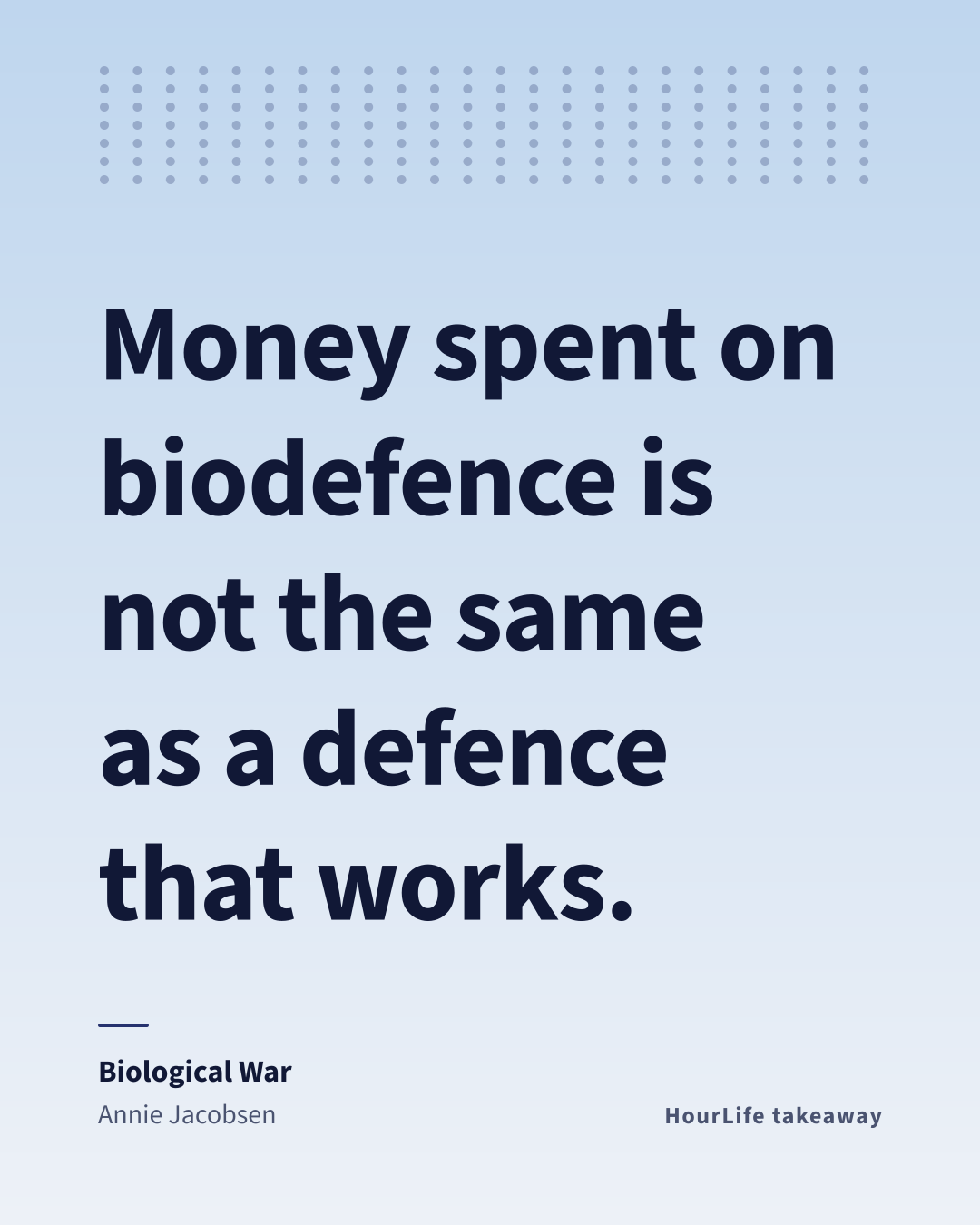
Money spent on biodefence is not the same as a defence that works.

Biological War Annie Jacobsen HourLife takeaway

Jacobsen argues that large biodefence budgets have not produced systems that perform when tested, and she points to the testing and coordination problems of the Covid years. Her question is less how much is spent than what actually works on the day.

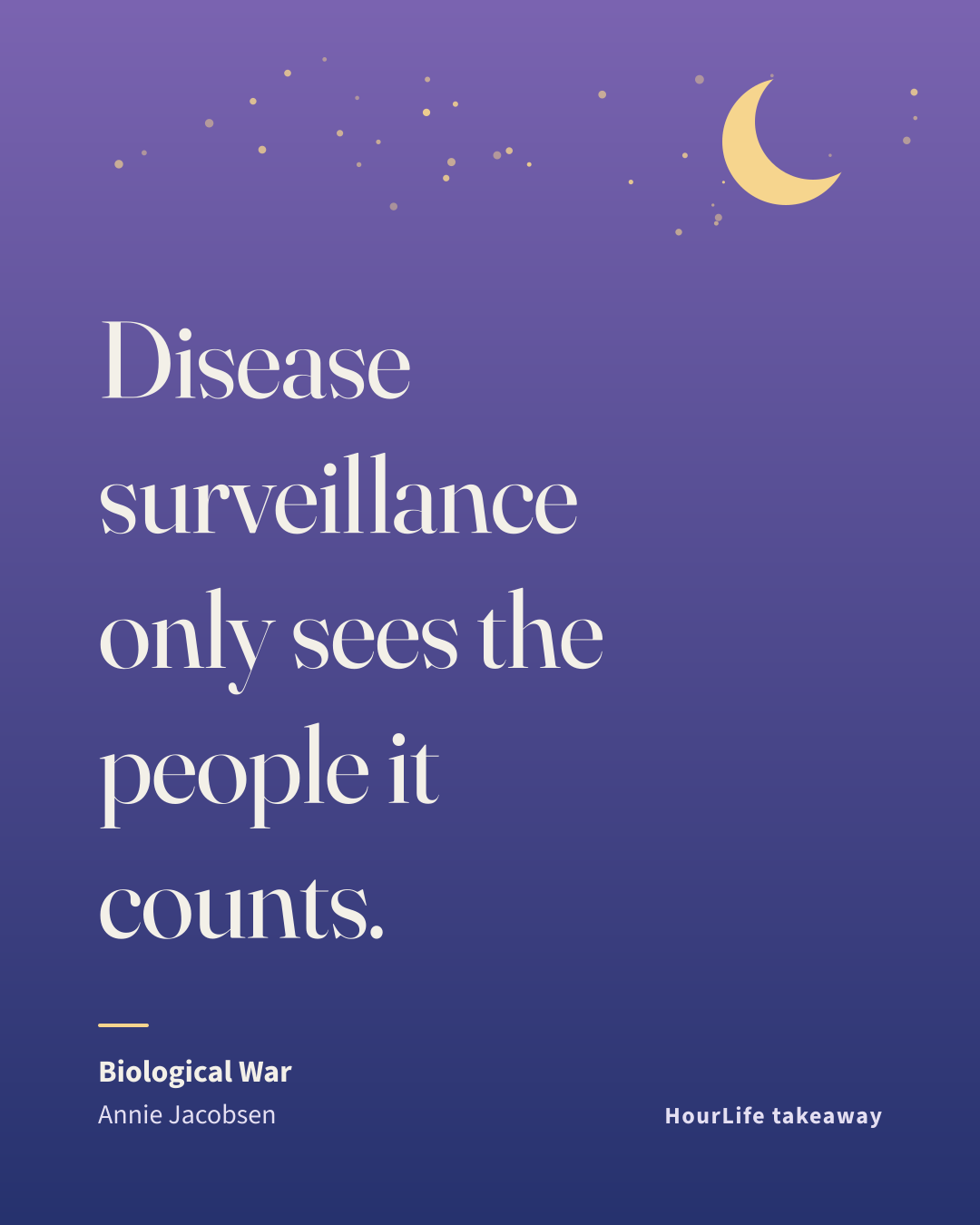
Disease surveillance only sees the people it counts.

Biological War Annie Jacobsen HourLife takeaway

In interviews about the book, Jacobsen names gaps such as people without a fixed address who never appear in the data, and tests that pile up faster than labs can process them. An early warning system is only as early as its blind spots allow.

Read the book as a stress test, not a forecast.

Biological War Annie Jacobsen HourLife takeaway

The scenario stacks worst cases on purpose to show where institutions break. Critics writing in the Bulletin of the Atomic Scientists argue that this makes it a poor map of real biological risk, and that outbreaks can be bent by behaviour and response in a way a missile cannot. Both readings are useful.

Knowing a little biology is what keeps fear from turning into panic.

Biological War Annie Jacobsen HourLife takeaway

Jacobsen has said she wants the book to create pressure rather than panic. Understanding in plain terms how infections spread and how dangerous they are helps people make calm, proportionate choices for their families.

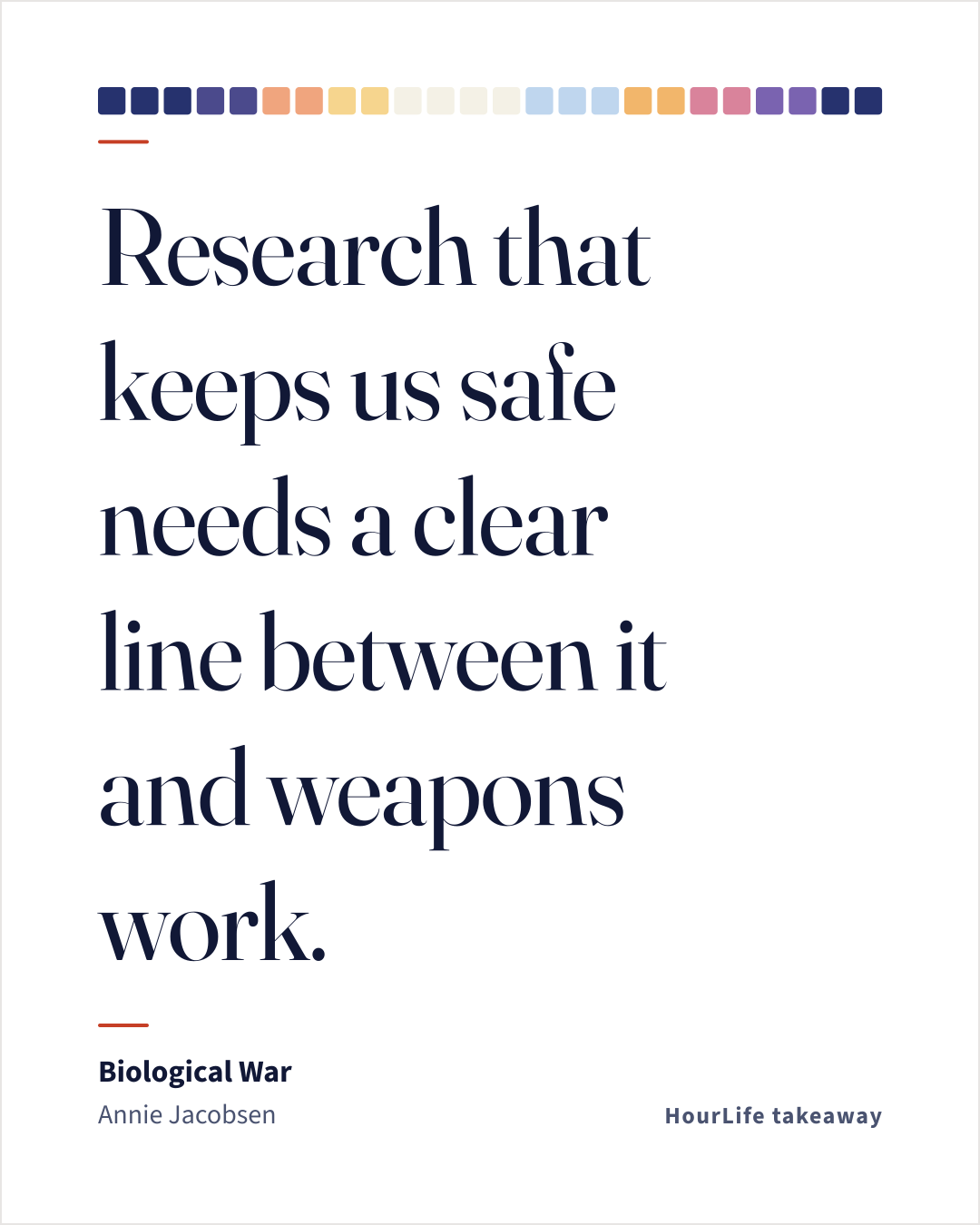
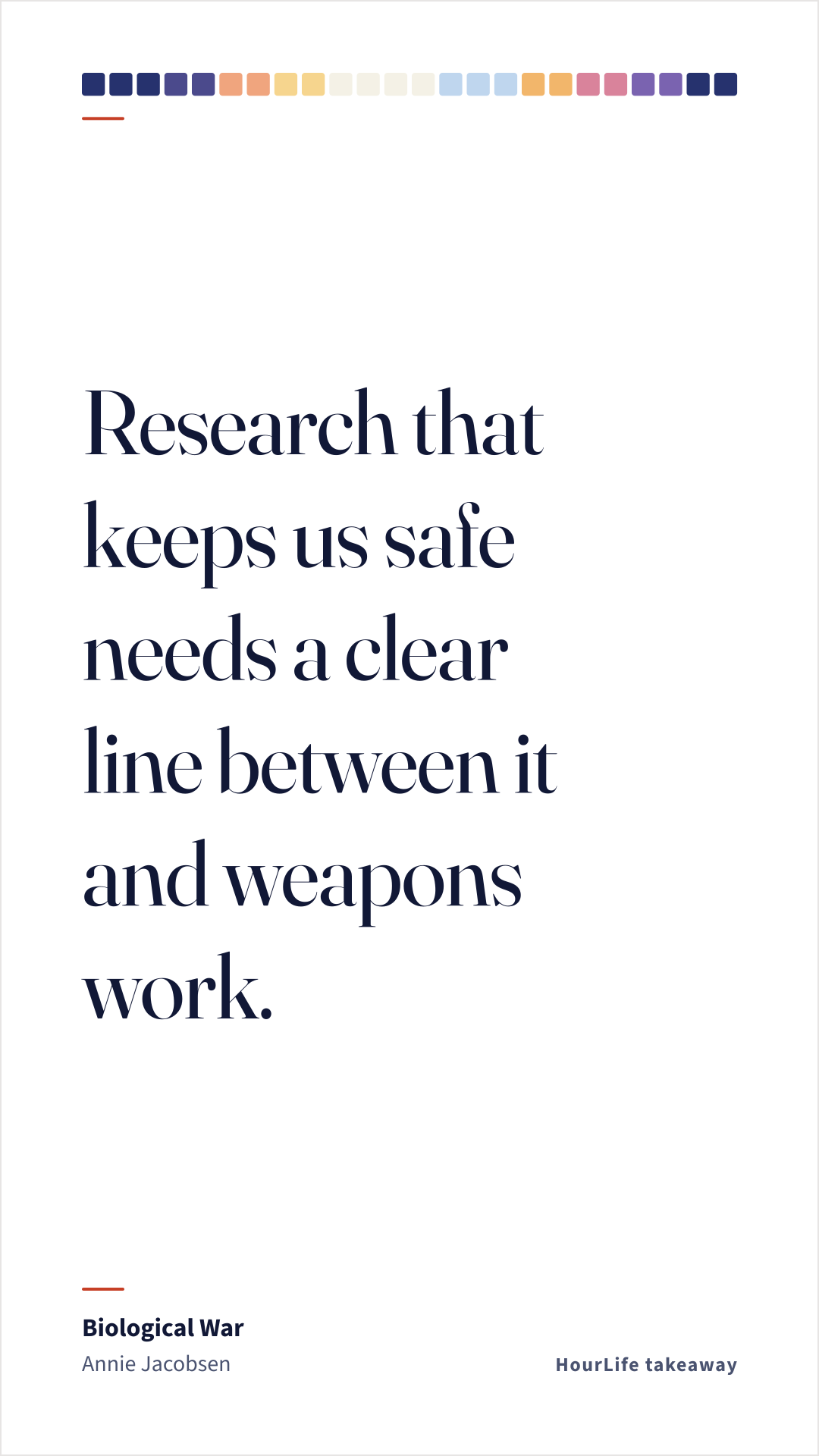
Research that keeps us safe needs a clear line between it and weapons work.

Biological War Annie Jacobsen HourLife takeaway

Jacobsen argues that protective research and weapons engineering should run in separate lanes. Her critics warn that treating whole fields of legitimate science as suspect could weaken the defences we need. Both sides agree the line has to be drawn clearly.

Keep this going in the app.

HourLife turns these ideas into a daily system — goals, habits, focus, and reflection in one private place.