Keep this author quotes for later
Sign in to save

Barbara Mor

The most-loved lines from Barbara Mor, drawn from 1 book in the library.

Lines labelled “HourLife takeaway” are our wording of the book’s ideas and may paraphrase it. Only lines in quotation marks are the author’s own words, with where they appear. Check the book for exact wording before you quote it. Spot an error?

The authors argue that the first image of the sacred was a mother giving birth, not a father giving orders.

The Great Cosmic Mother Monica Sjöö and Barbara Mor HourLife takeaway

Sjöö and Mor read prehistoric female figurines, cave art and burial customs as traces of a religion centred on a Great Mother from whom all life comes. In their account, people first understood the divine through birth, death and return. Many archaeologists read the same objects in other ways, so this is the book's case rather than settled history.


In the book’s telling, people first kept time by the moon.

The Great Cosmic Mother Monica Sjöö and Barbara Mor HourLife takeaway

The authors give long stretches of the early religion section to moon time and lunar calendars. They argue that the waxing and waning moon gave early people their first sense of a repeating cycle, and that it was tied in myth to women's bodies. Whatever you make of the history, the moon is still the easiest clock in the sky to read.

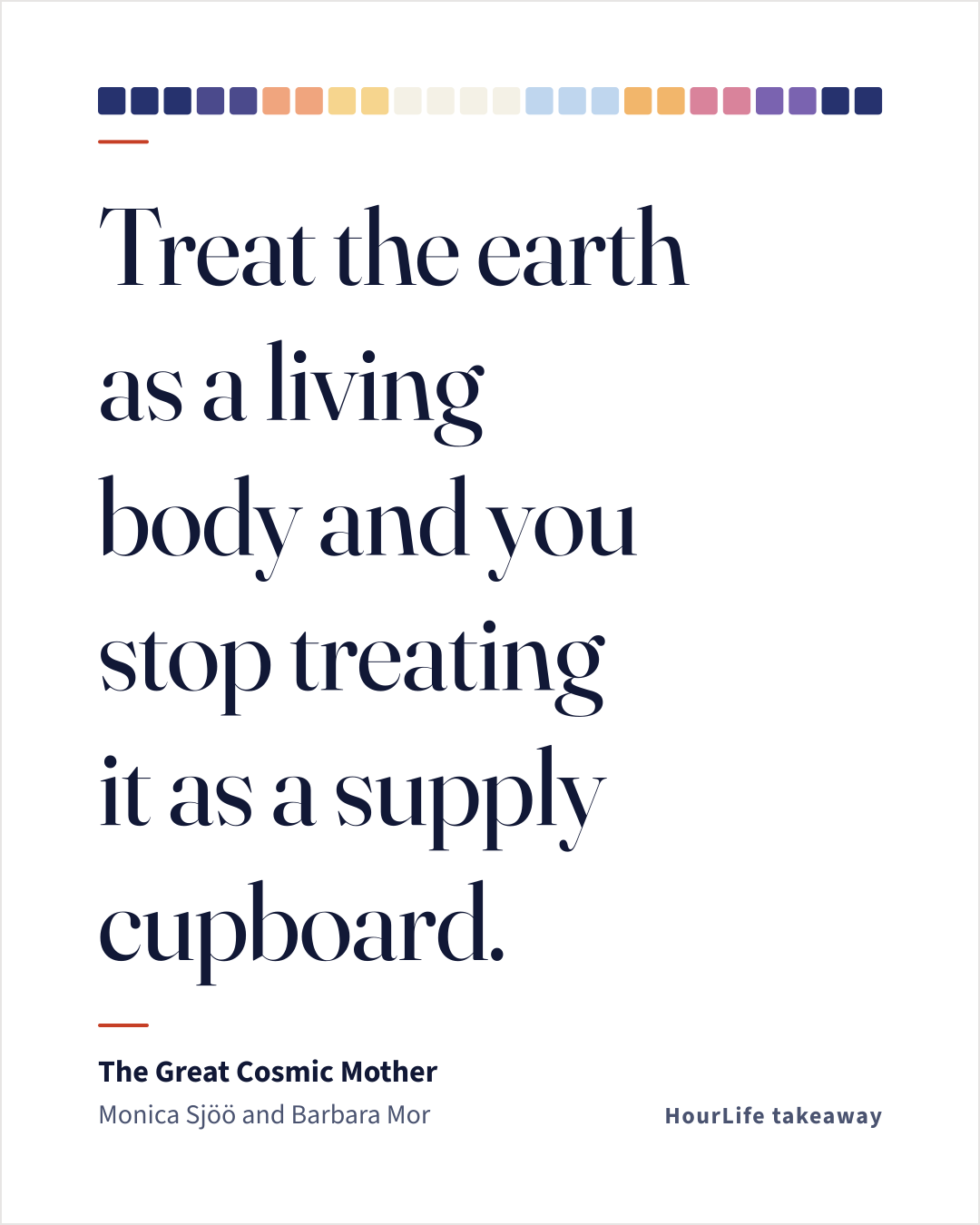
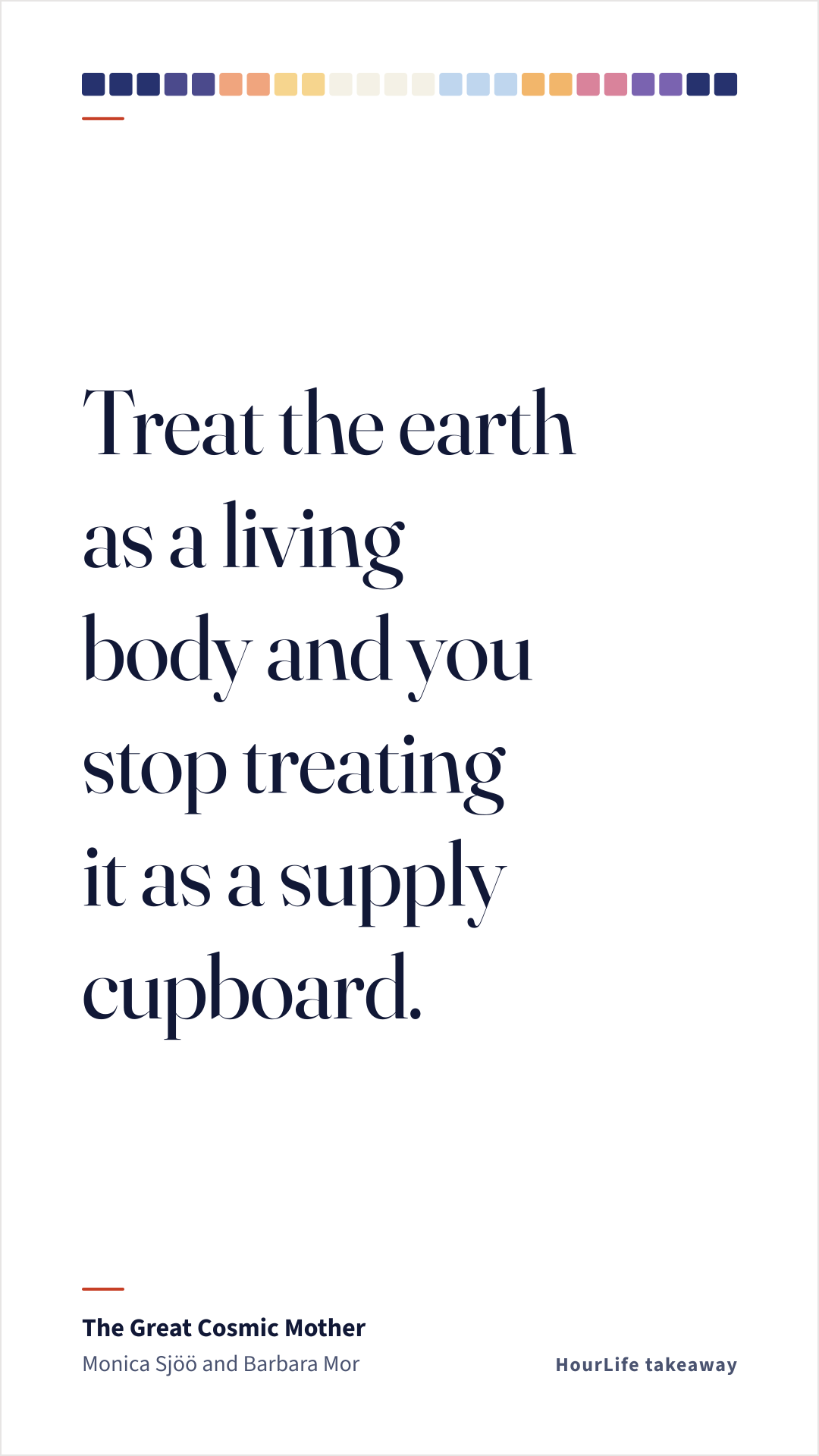
Treat the earth as a living body and you stop treating it as a supply cupboard.

The Great Cosmic Mother Monica Sjöö and Barbara Mor HourLife takeaway

The book's subtitle is its programme: rediscovering a religion of the earth. Sjöö and Mor argue that seeing land, water and seasons as sacred kept people careful with them, and that losing that view made it easier to use them up. It is an ethical claim as much as a historical one, and it is why the book still speaks to ecological writers.

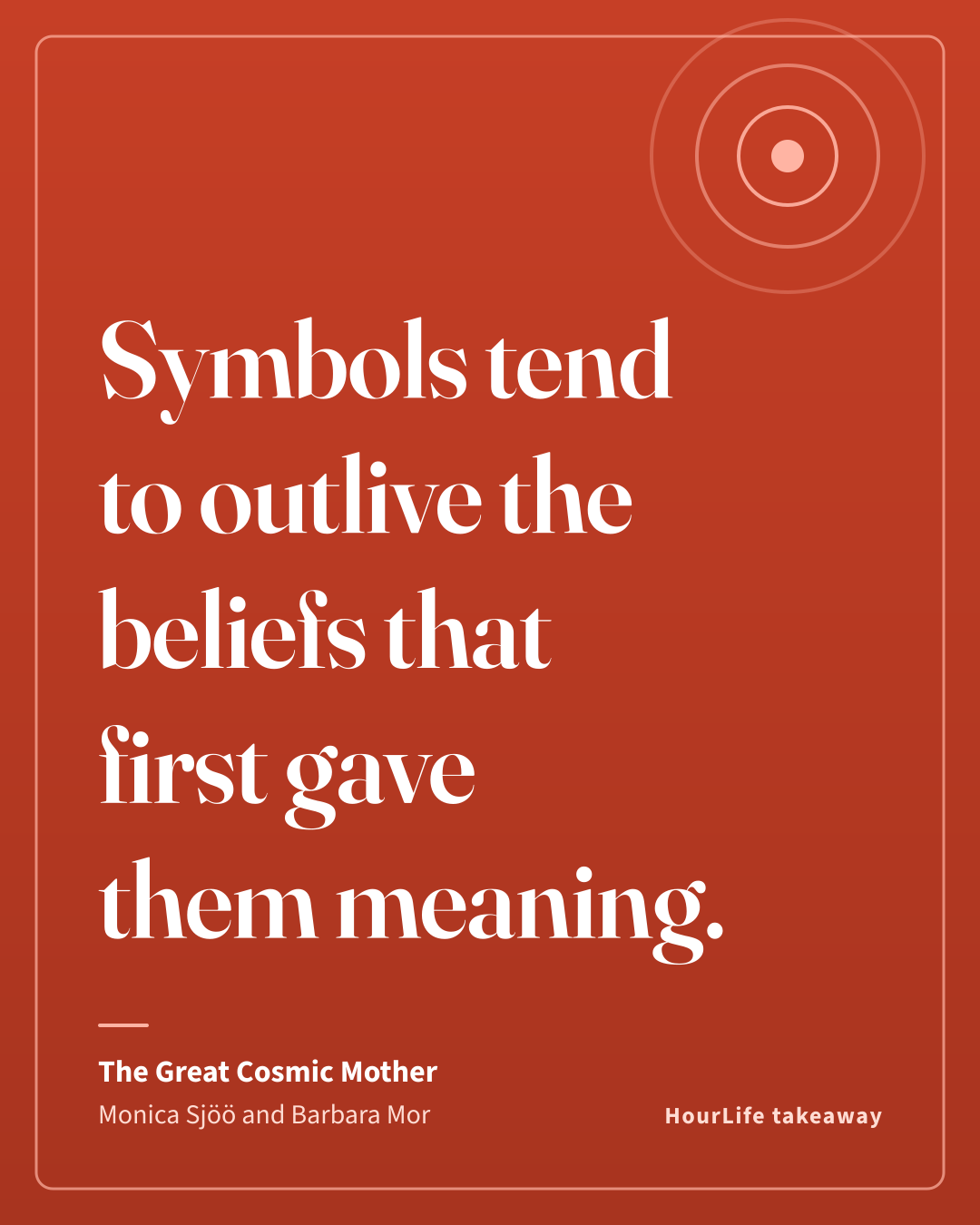
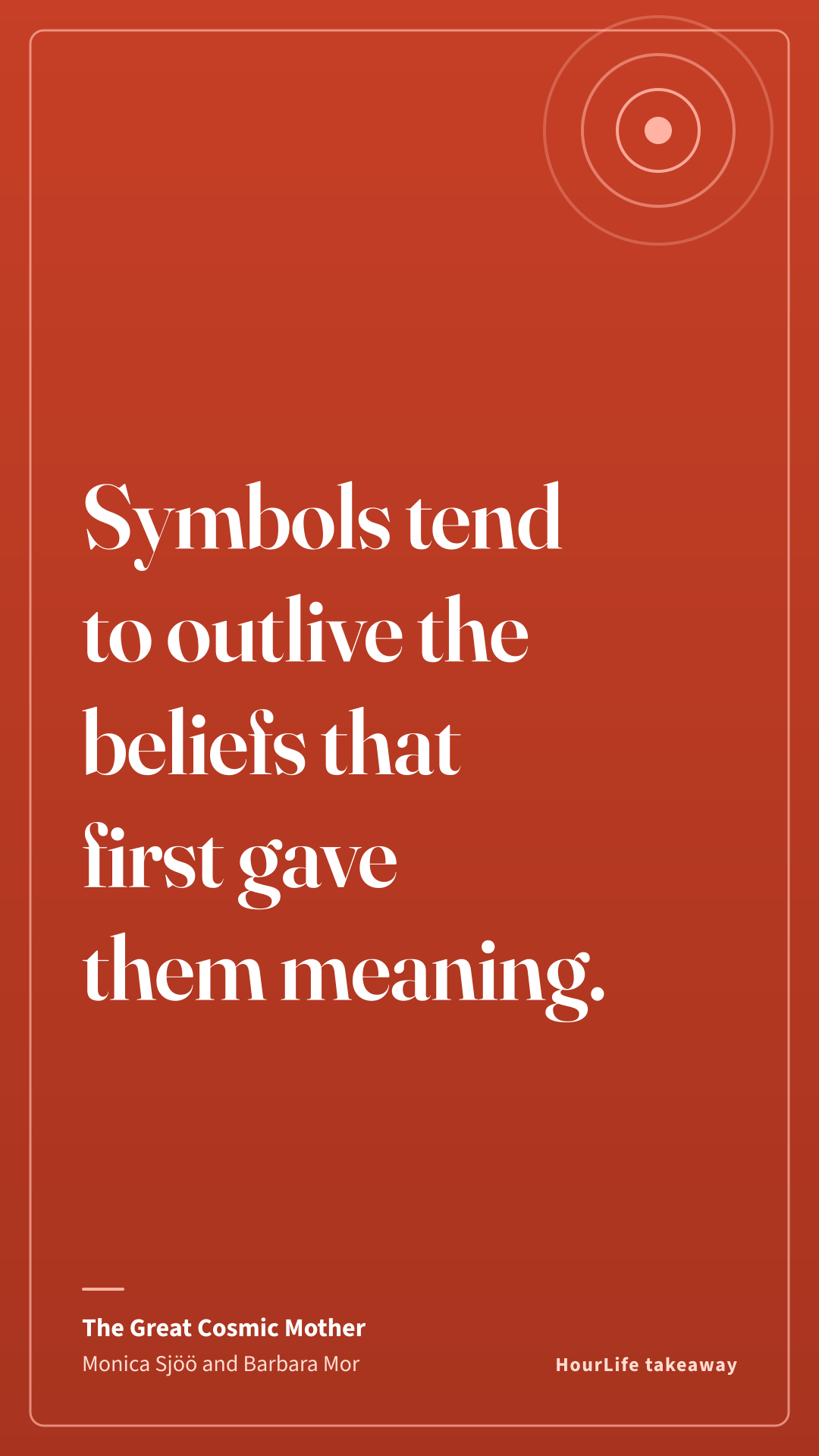
Symbols tend to outlive the beliefs that first gave them meaning.

The Great Cosmic Mother Monica Sjöö and Barbara Mor HourLife takeaway

The authors follow images such as the spiral, the egg and the serpent across cultures. They read the serpent as an early sign of renewal, because it sheds its skin, and argue that later myths recast it as a figure of temptation and danger. You can test the method yourself by tracing one symbol through a museum or a book of myths.

The book treats the rise of patriarchy as a long shift over millennia, not a single event.

The Great Cosmic Mother Monica Sjöö and Barbara Mor HourLife takeaway

Its last part covers patriarchal culture and religion over roughly the past four thousand years. In the authors' account, sky gods and warrior societies gradually displaced earth-centred worship, and women lost religious and social standing along the way. Historians debate how, when and whether this happened in the form the book describes.

The authors read the European witch hunts as a war on women and on what was left of older folk belief.

The Great Cosmic Mother Monica Sjöö and Barbara Mor HourLife takeaway

The book takes up the witch hunts of early modern Europe in its account of the patriarchal era. Historians agree the persecution was real and killed many thousands of people, most of them women. Most of them reject the idea that the accused belonged to a surviving pagan religion, so read this part alongside a recent history of the trials.

When the sacred is moved out of the body and the land, both are easier to exploit.

The Great Cosmic Mother Monica Sjöö and Barbara Mor HourLife takeaway

A thread through the later chapters is the split between spirit and matter. Sjöö and Mor argue that religions which placed the holy far above the physical world taught people to look down on bodies, women and nature together. They carry the same critique into modern industrial society.

A story can give people meaning even while its history is argued over.

The Great Cosmic Mother Monica Sjöö and Barbara Mor HourLife takeaway

The book's lasting influence is in the goddess movement and feminist spirituality, where it has been read as a source of imagery and belonging. Reading it well means holding two questions apart: what does this vision ask of me, and what does the evidence about the past actually show? Both are worth asking.

For Sjöö, painting and argument came from the same conviction.

The Great Cosmic Mother Monica Sjöö and Barbara Mor HourLife takeaway

Sjöö was a painter before this was a book. Her 1968 painting God Giving Birth, inspired by the birth of her second son, drew a blasphemy complaint when it was shown in London in the 1970s. The 1991 second edition added colour plates, so the images sit beside the argument they were made for.

Keep this going in the app.

HourLife turns these ideas into a daily system — goals, habits, focus, and reflection in one private place.