Keep this author quotes for later
Sign in to save

Christine A. Padesky

The most-loved lines from Christine A. Padesky, drawn from 1 book in the library.

Lines labelled “HourLife takeaway” are our wording of the book’s ideas and may paraphrase it. Only lines in quotation marks are the author’s own words, with where they appear. Check the book for exact wording before you quote it. Spot an error?

A mood is usually one word; a thought is a whole sentence, and mixing them up hides what you can work on.

Mind Over Mood Dennis Greenberger and Christine A. Padesky HourLife takeaway

The book has readers name moods in a single word, such as sad, nervous or angry, and rate how strong each one is from 0 to 100. Thoughts are the words and pictures that go with the mood. Once you separate the two, the thought becomes something you can look at instead of something you simply feel.


Your situation, thoughts, moods, actions and body all push on each other, so you can start a change at any of the five.

Mind Over Mood Dennis Greenberger and Christine A. Padesky HourLife takeaway

This five-part model is the book's map. A hard week at work can bring worried thoughts, a tight chest, low mood and skipped plans, and each of those feeds the others. Seeing the loop drawn out tells you there is more than one place to step in.

Find the hot thought, the one carrying the most feeling, and test that one first.

Mind Over Mood Dennis Greenberger and Christine A. Padesky HourLife takeaway

A bad moment often comes with a crowd of thoughts. The Thought Record asks you to list them and then mark the one most connected to the strongest mood. Testing that single thought does more than arguing with all of them at once.

Evidence means facts that would stand up in front of other people, not your reading of what those facts mean.

Mind Over Mood Dennis Greenberger and Christine A. Padesky HourLife takeaway

The two evidence columns are where most people get stuck. Writing 'she thinks I'm useless' is an interpretation; 'she didn't reply to my message for two days' is a fact. Keeping to facts on both sides makes the weighing fair.

A balanced thought is not a cheerful thought; it has to fit all the evidence, including the parts that hurt.

Mind Over Mood Dennis Greenberger and Christine A. Padesky HourLife takeaway

The book is clear that this is not positive thinking. A good alternative thought often keeps the true, painful part and adds what the hot thought left out. You then rate how much you believe it and re-rate your moods, and a drop from 90 to 60 counts as progress.

When the evidence says the thought is true, stop arguing with it and make a plan.

Mind Over Mood Dennis Greenberger and Christine A. Padesky HourLife takeaway

Sometimes the problem is real: the bill is overdue, the relationship is in trouble. For those moments the book swaps the Thought Record for an action plan, with steps, a start time, likely obstacles and how you will handle them.

Some beliefs are easier to test by doing something than by thinking about it.

Mind Over Mood Dennis Greenberger and Christine A. Padesky HourLife takeaway

Underlying assumptions often take the form of an if-then rule, such as if I say no, people will reject me. The book turns rules like that into behavioural experiments: predict what will happen, try it, and write down what actually did.

Core beliefs change slowly, one small piece of evidence at a time.

Mind Over Mood Dennis Greenberger and Christine A. Padesky HourLife takeaway

Deeper beliefs about yourself, other people and the world sit under many automatic thoughts. The later chapters suggest naming a new belief you would like to hold and collecting small daily signs that it is true. The point is weeks and months of noticing, not a single insight.

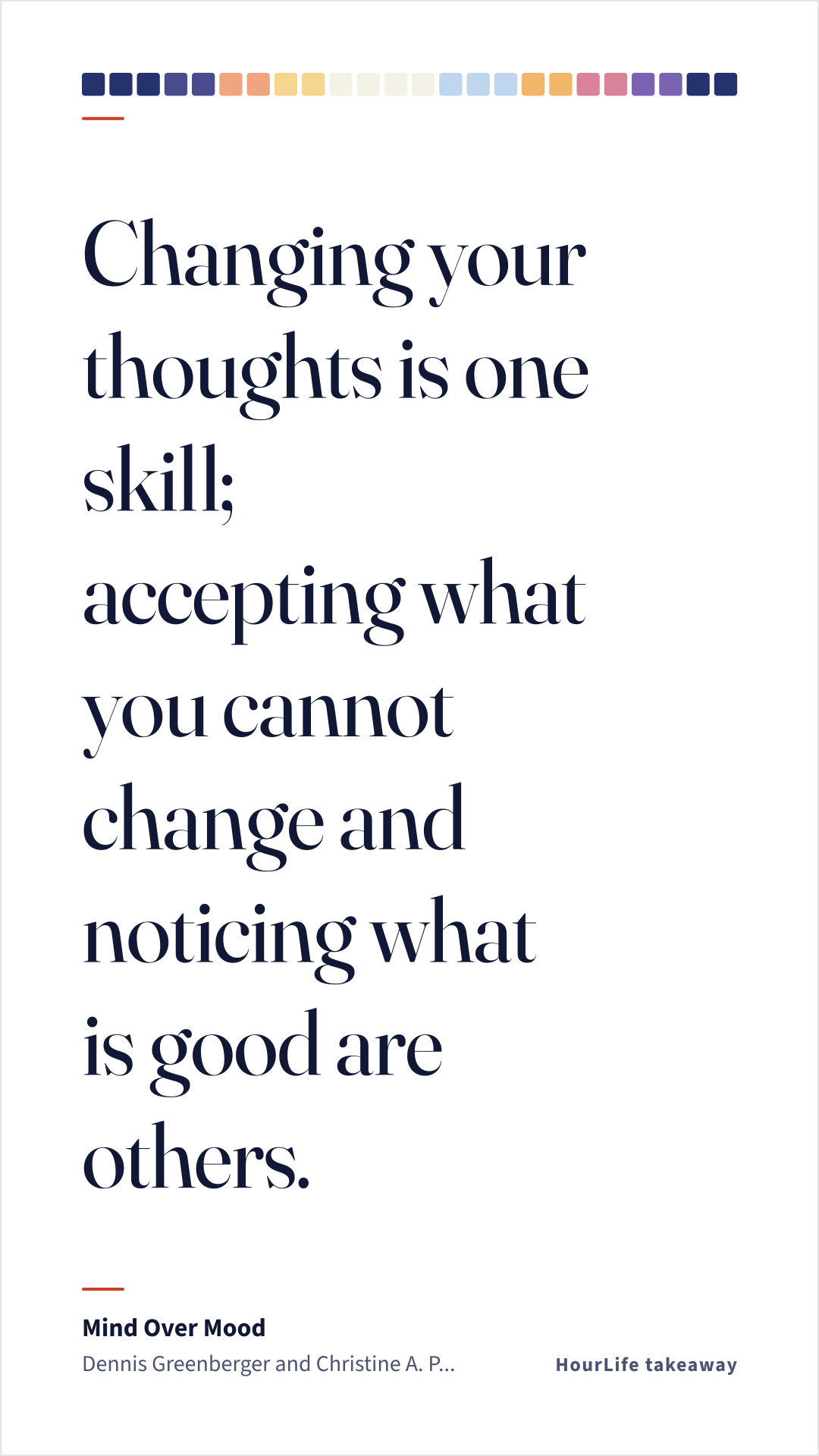
Changing your thoughts is one skill; accepting what you cannot change and noticing what is good are others.

Mind Over Mood Dennis Greenberger and Christine A. Padesky HourLife takeaway

The second edition adds acceptance and gratitude to the toolkit. Not every hard feeling needs to be argued away, and paying regular attention to what is going well can lift mood alongside the thought work.

Keep this going in the app.

HourLife turns these ideas into a daily system — goals, habits, focus, and reflection in one private place.