Keep this author quotes for later
Sign in to save

Ethan Mollick

The most-loved lines from Ethan Mollick, drawn from 2 books in the library.

Lines labelled “HourLife takeaway” are our wording of the book’s ideas and may paraphrase it. Only lines in quotation marks are the author’s own words, with where they appear. Check the book for exact wording before you quote it. Spot an error?

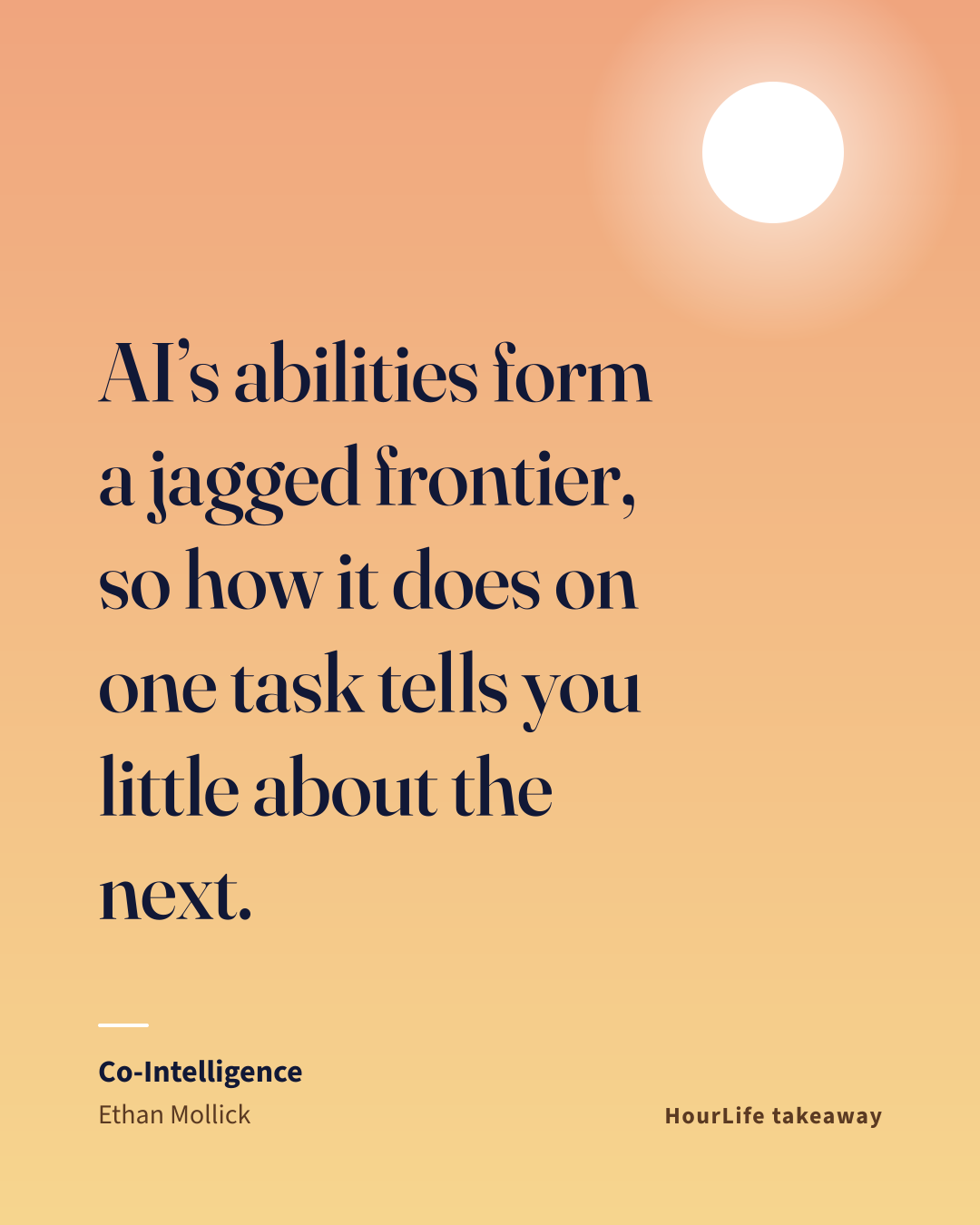
AI’s abilities form a jagged frontier, so how it does on one task tells you little about the next.

Co-Intelligence Ethan Mollick HourLife takeaway

The line between what AI does well and what it does badly is uneven, and tasks that feel equally hard to us can land on opposite sides of it. Mollick describes a study with Boston Consulting Group consultants: on tasks inside the frontier, those using GPT-4 did better work, and on a task chosen to sit just outside it, they did worse than colleagues working without it.


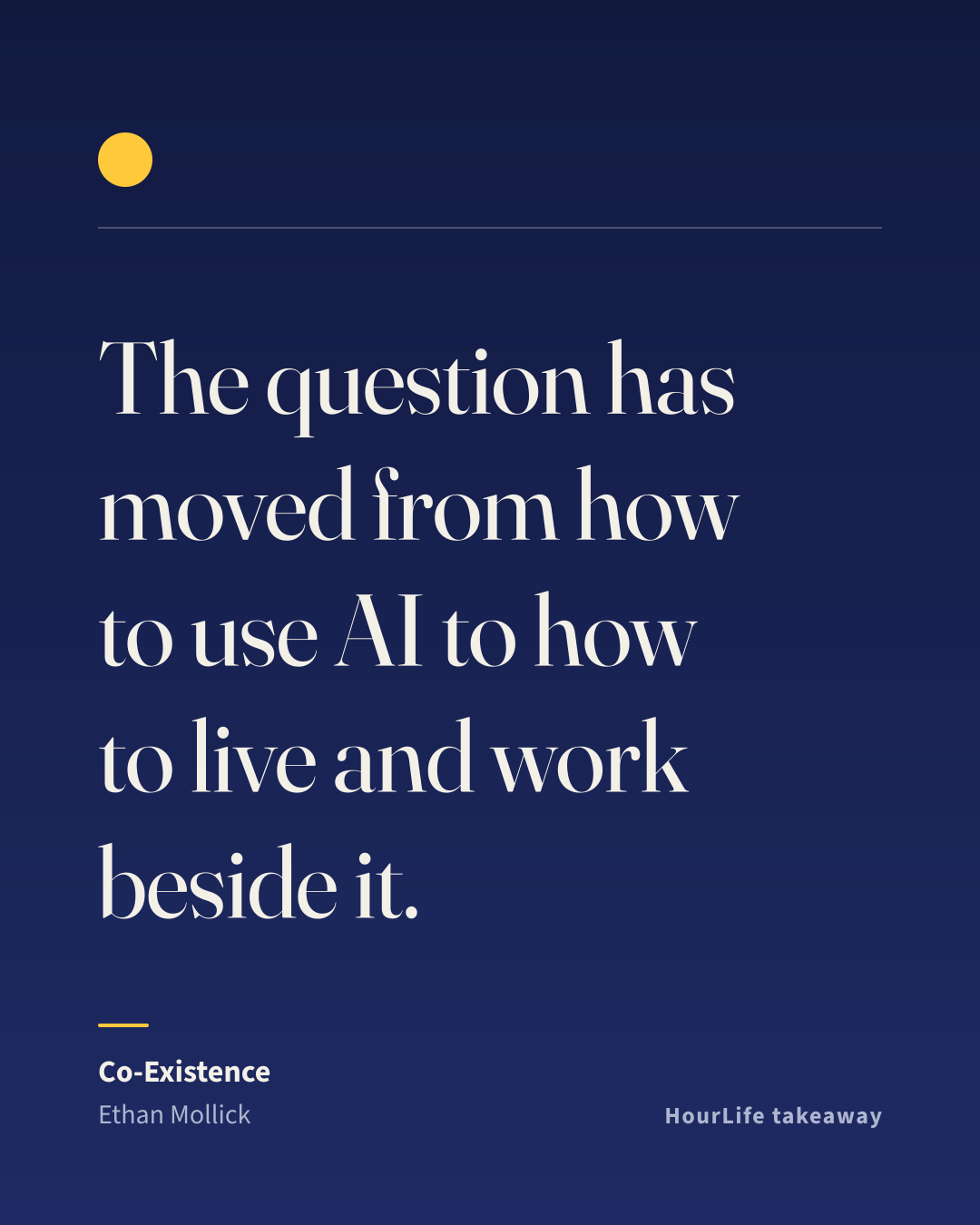
The question has moved from how to use AI to how to live and work beside it.
Co-Existence Ethan Mollick HourLife takeaway

In Co-Intelligence, AI was a partner you sat down and thought with. Here Mollick describes systems that act on their own: they run tasks, read and filter information, and come back with finished work. The title marks that change, from thinking together to sharing the same space.

The only way to learn where the frontier runs through your work is to use AI on your work.

Co-Intelligence Ethan Mollick HourLife takeaway

Nobody has a manual for this, and the people who build these systems are often surprised by what they can do. That is the reason for the first rule, always invite AI to the table. Try it on the tasks you actually do, within your legal and ethical limits, and notice where it helps and where it fails.

AI is brilliant at some tasks and poor at others that look easier, so you find the edge by testing, not guessing.

Co-Existence Ethan Mollick HourLife takeaway

This is the jagged frontier, carried over from the first book. In a field experiment Mollick co-ran with Boston Consulting Group, consultants using AI did better on tasks inside its abilities and worse on a task outside them, and they could not reliably tell which was which. The edge also moves with every new model, so an old verdict goes stale.

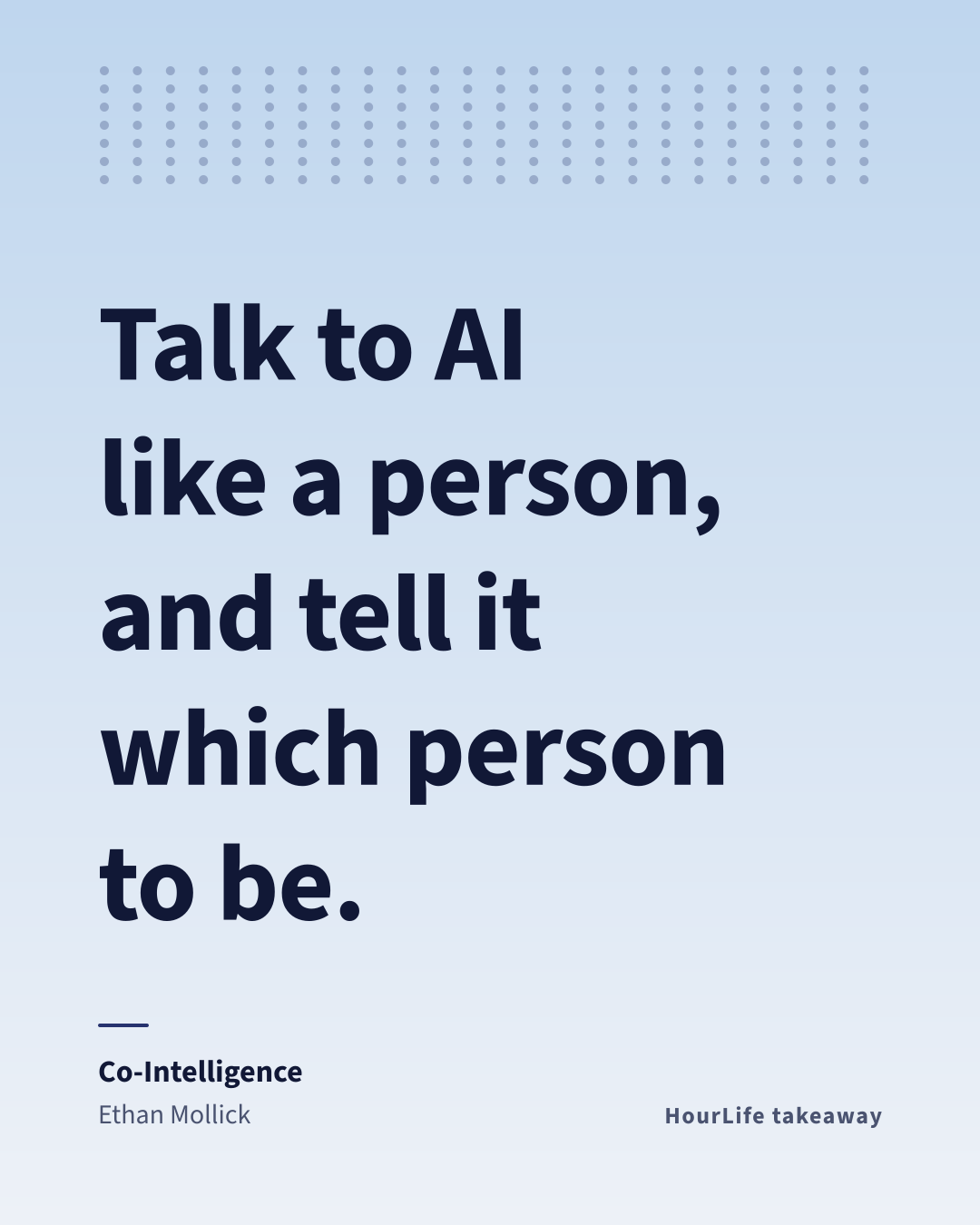
Talk to AI like a person, and tell it which person to be.

Co-Intelligence Ethan Mollick HourLife takeaway

Mollick knows AI is software, not a person, but finds it works better when you give it a role and some context: an editor, a sceptical critic, a teacher for a particular audience. A persona moves the answer from generic to specific. He also warns against forgetting what it really is.

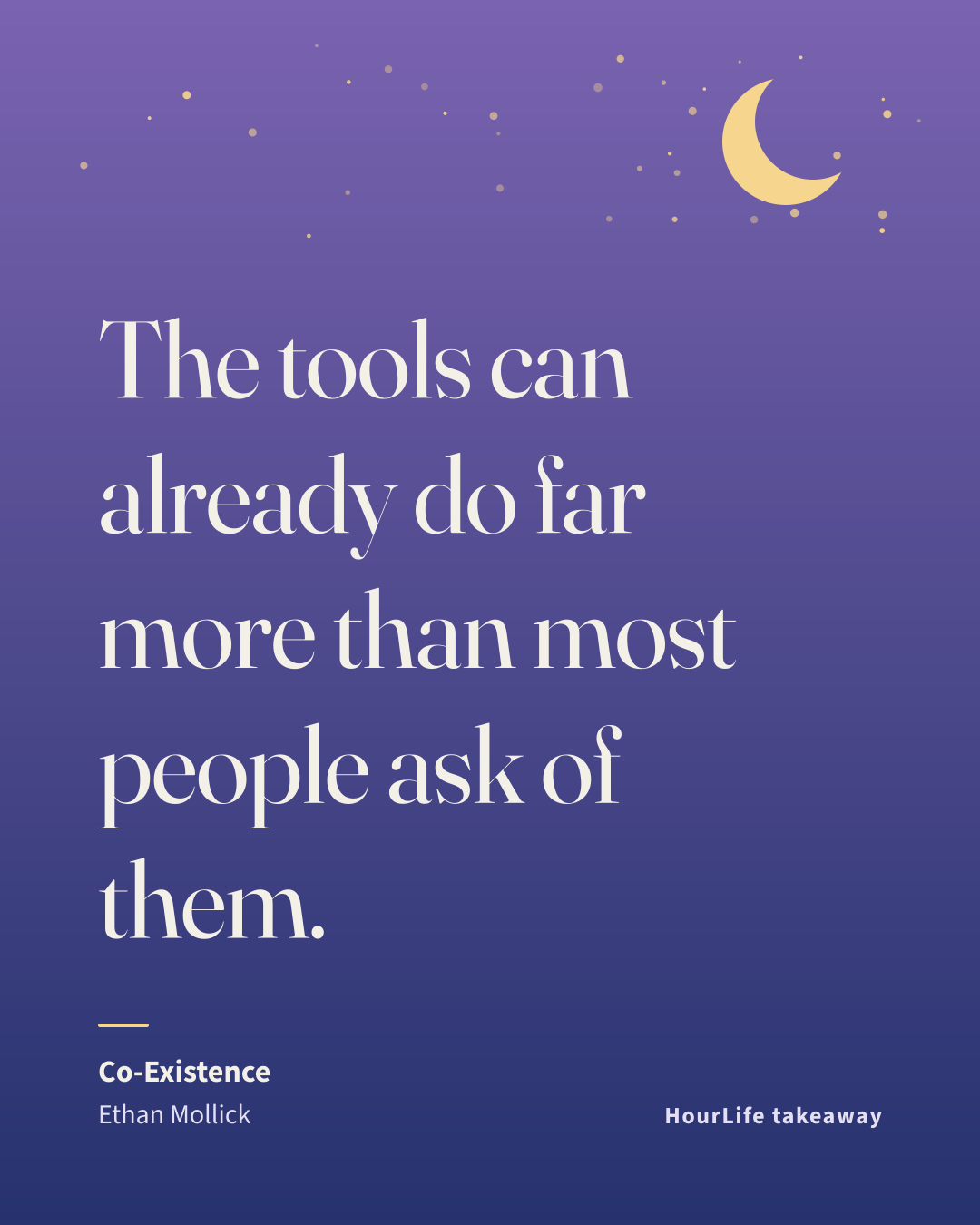
The tools can already do far more than most people ask of them.

Co-Existence Ethan Mollick HourLife takeaway

Mollick calls this gap the capability overhang. Models have improved faster than our habits, our jobs and our organisations have changed around them. The gap is also an opening for anyone willing to explore it.
The work stays yours, so stay the human in the loop.

Co-Intelligence Ethan Mollick HourLife takeaway

AI can state invented facts with total confidence, and it cannot reliably tell you when it is wrong. Being the human in the loop means checking, judging and owning what goes out. It also means keeping your own skill sharp, because you can only catch a mistake you know how to spot.
When an agent can do the whole task, your part shrinks to the start and the end, and both matter more.

Co-Existence Ethan Mollick HourLife takeaway

The book adds a third way of working to the centaur and the cyborg from Co-Intelligence: the conjurer. You set the direction, summon an agent to do the work, then judge what comes back. It is closer to managing than to doing, and it fails when nobody sets a clear goal or checks the result.

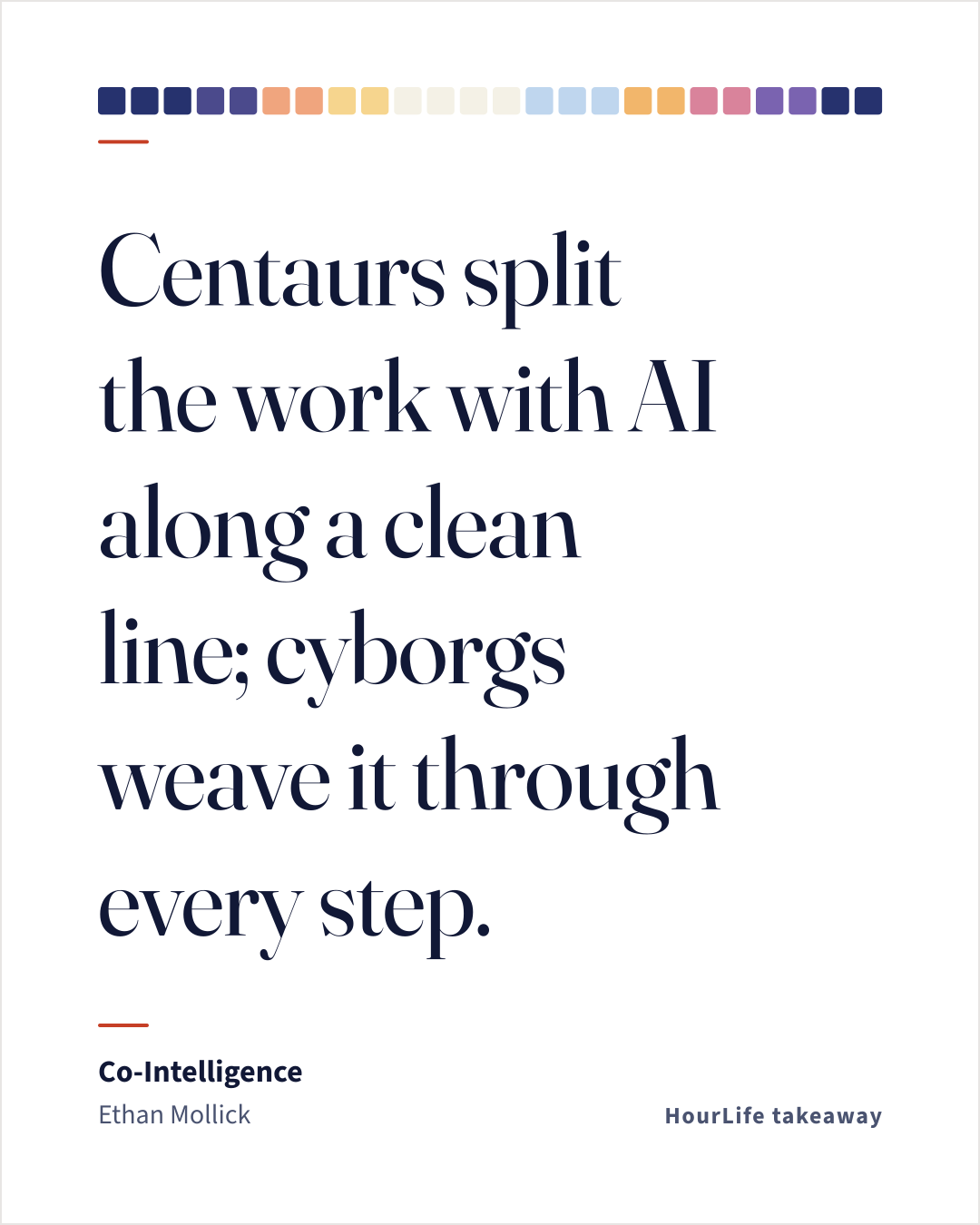
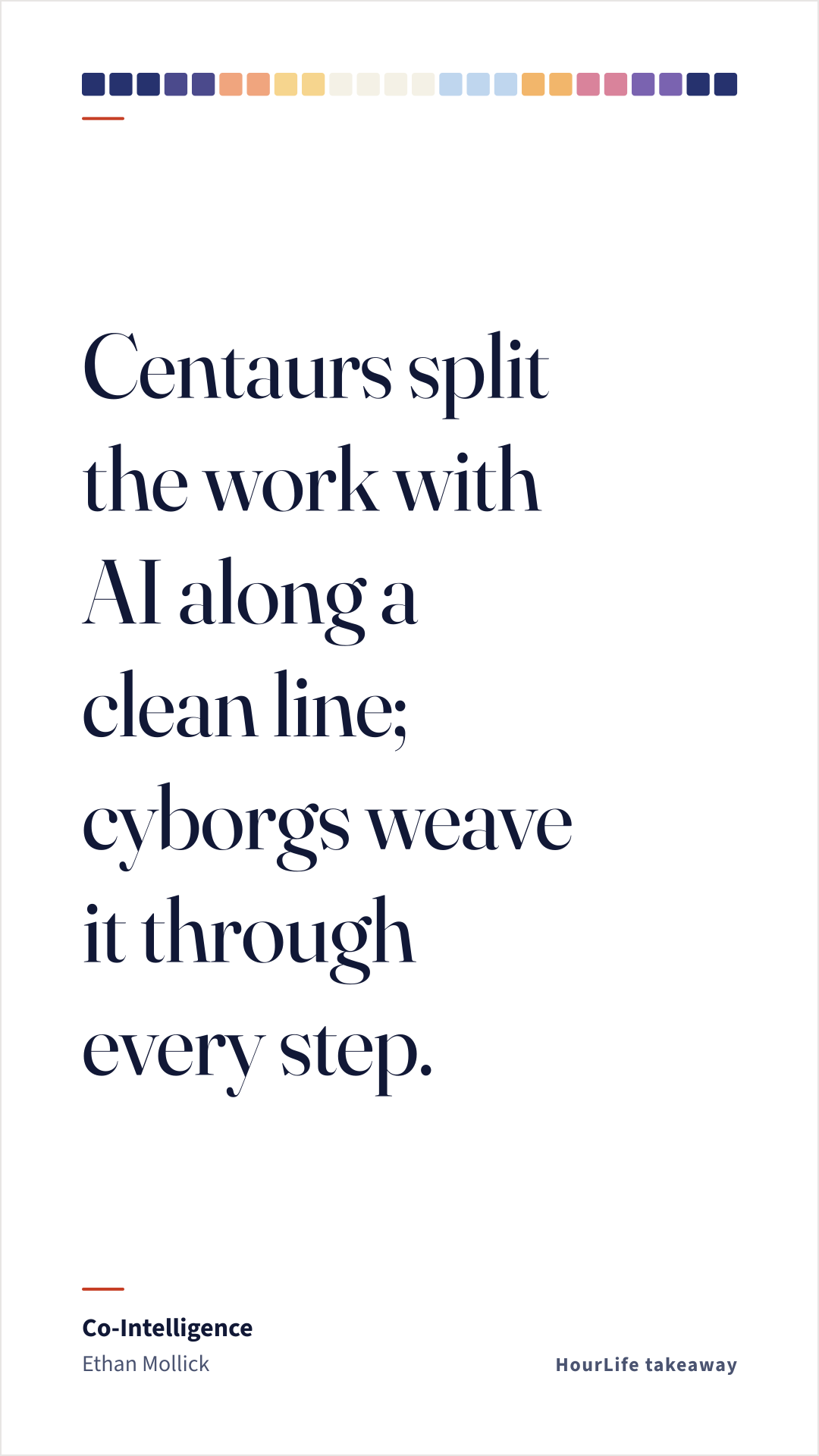
Centaurs split the work with AI along a clean line; cyborgs weave it through every step.

Co-Intelligence Ethan Mollick HourLife takeaway

A centaur divides a job: you choose the argument, the AI drafts the chart. A cyborg works back and forth inside the task, handing over a sentence and taking it back rewritten. Mollick treats both as good ways to work. What matters is choosing the split on purpose.

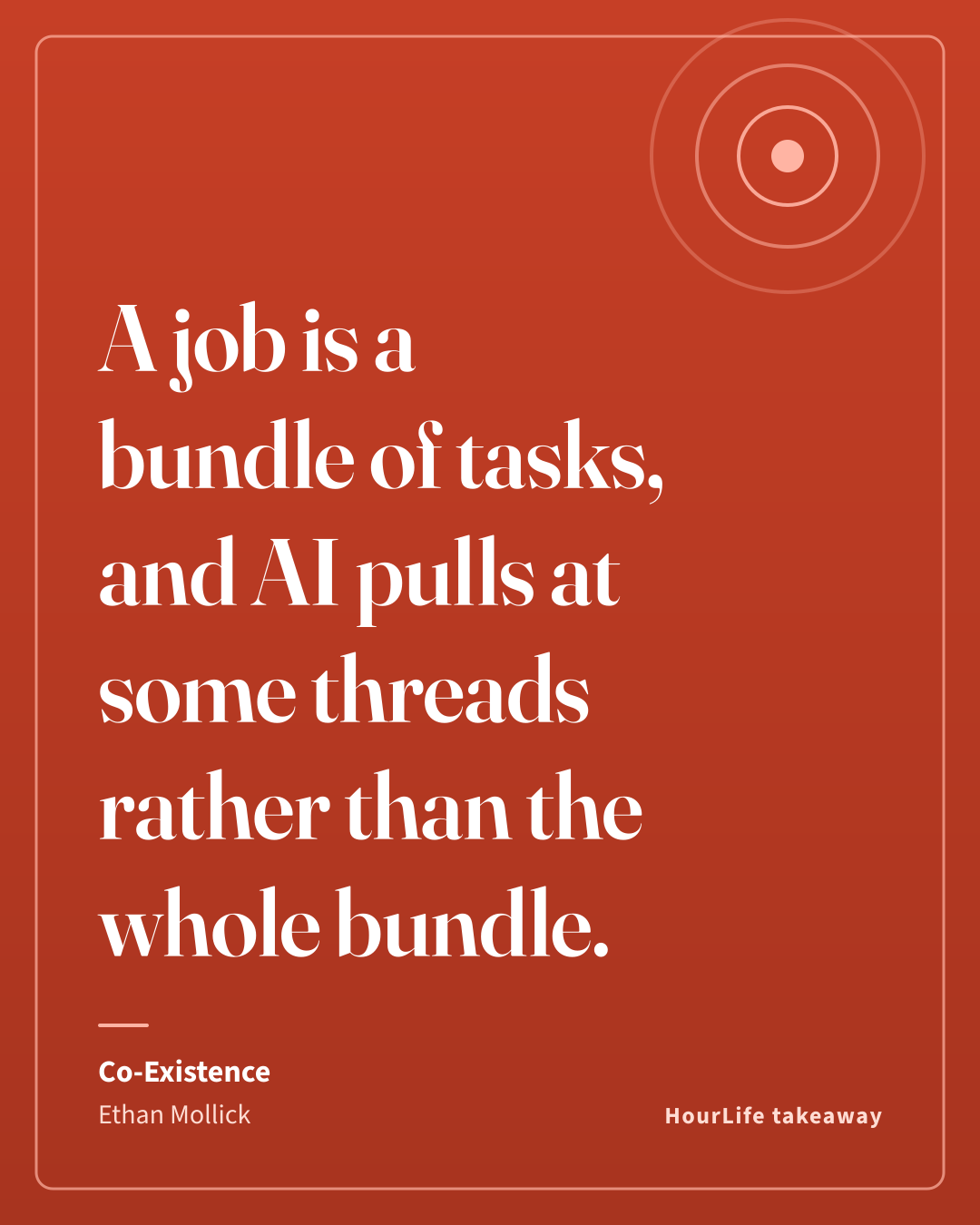
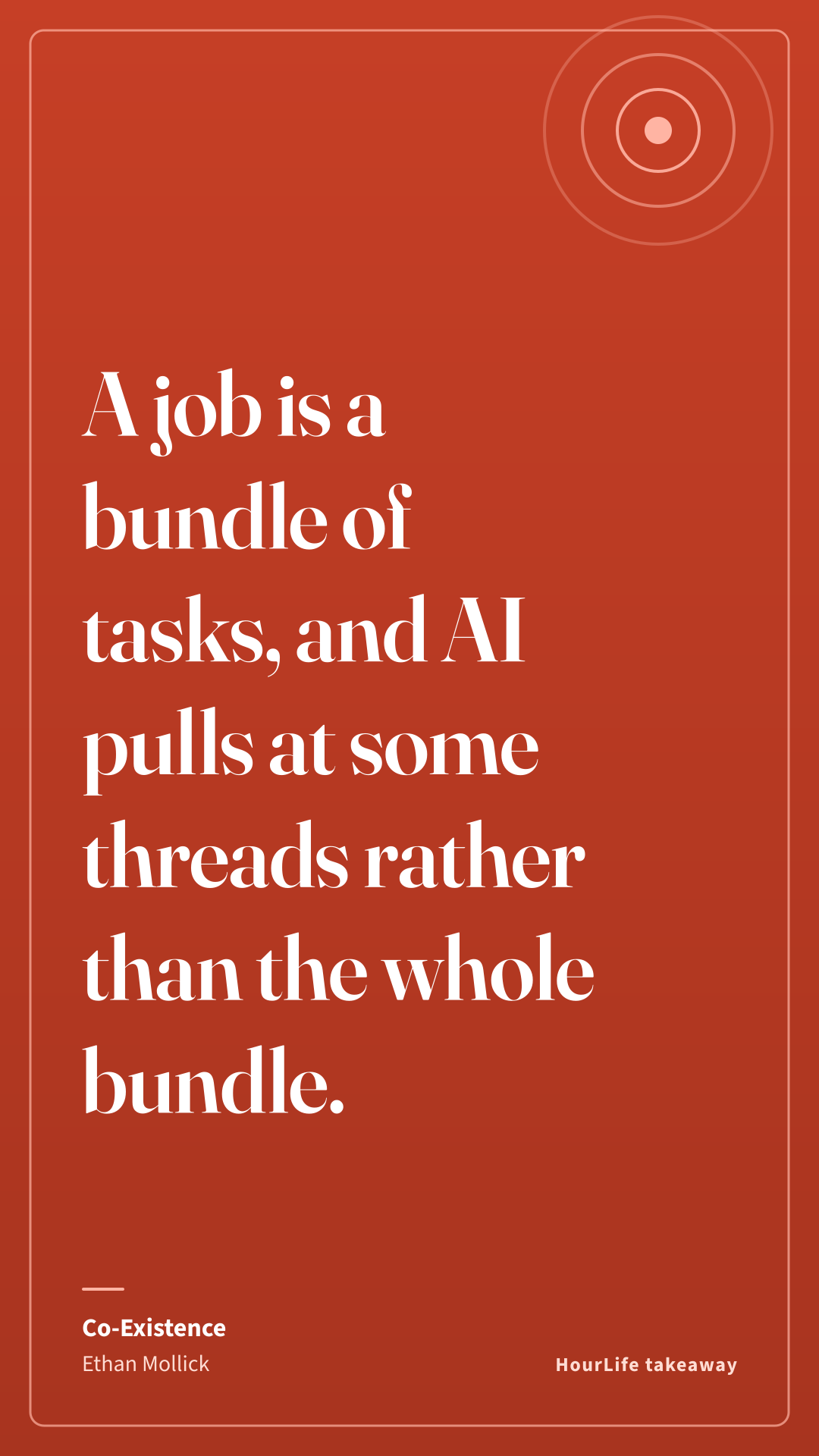
A job is a bundle of tasks, and AI pulls at some threads rather than the whole bundle.

Co-Existence Ethan Mollick HourLife takeaway

Mollick looks at work task by task instead of asking whether a whole job survives. Some tasks go to the machine, some stay with you, and the mix changes what the job is. Seeing your own work this way makes the change easier to plan for.

Sort your tasks into Just Me, Delegated and Automated, and expect the sort to change.

Co-Intelligence Ethan Mollick HourLife takeaway

Just Me tasks stay with you, because AI cannot do them well or because you want them to be yours. Delegated tasks go to AI and come back to you to check. Automated tasks can run on their own. As the tools improve, tasks move from one pile to the next.

You can only judge an answer in a field you know well, and only ask good questions across fields you know a little.

Co-Existence Ethan Mollick HourLife takeaway

These are the first two of the book's four human advantages: deep knowledge and wide knowledge. Deep knowledge lets you direct the work and catch the errors. Wide knowledge lets you see where AI could help in the first place, because you cannot ask for what you have never heard of.

Assume today’s AI is the worst you will ever use.

Co-Intelligence Ethan Mollick HourLife takeaway

The fourth rule is a warning against settling your opinion early. Something AI fails at this year may be easy for it next year. Write down the tasks you have ruled out, and test them again when a new model arrives.

Taste is a standard you hold, and nobody can hold it for you.

Co-Existence Ethan Mollick HourLife takeaway

The third advantage is taste: knowing what good looks like and why one draft beats another. When generating options becomes cheap, choosing well between them becomes the scarce part of the work.

AI can tutor and coach you, but it cannot do the learning for you.

Co-Intelligence Ethan Mollick HourLife takeaway

In the chapters on AI as a tutor and a coach, Mollick sees real promise in explanation and feedback pitched at your level. The effort of learning still has to happen in your own head, though. Using AI to skip the struggle means skipping the skill, and the skill is what lets you judge the AI.

Agency means stepping into the gap between what the tools can do and what anyone is doing with them.

Co-Existence Ethan Mollick HourLife takeaway

The fourth advantage is agency, in Mollick's sense: the nerve to try things, explore what the tools make possible and act on it before anyone tells you to. It ties back to the capability overhang. Somebody has to go first.

Where AI goes next is not settled, and the book sketches four possible futures.

Co-Intelligence Ethan Mollick HourLife takeaway

The last chapter lays out four scenarios: AI stays about as good as it is, it keeps improving slowly, it improves exponentially, or it reaches something like a machine god. Mollick's point is that people and organisations still choose how AI is used at work, whichever future arrives.

A fluent, agreeable answer is not the same as a right one.

Co-Existence Ethan Mollick HourLife takeaway

The book warns against leaning too hard on systems that are persuasive and good at imitation. Treat a confident reply as a draft to check, and keep doing enough of the work yourself that you can still tell the difference.

Keep this going in the app.

HourLife turns these ideas into a daily system — goals, habits, focus, and reflection in one private place.