Keep this author quotes for later
Sign in to save

Gil Durán

The most-loved lines from Gil Durán, drawn from 1 book in the library.

Lines labelled “HourLife takeaway” are our wording of the book’s ideas and may paraphrase it. Only lines in quotation marks are the author’s own words, with where they appear. Check the book for exact wording before you quote it. Spot an error?

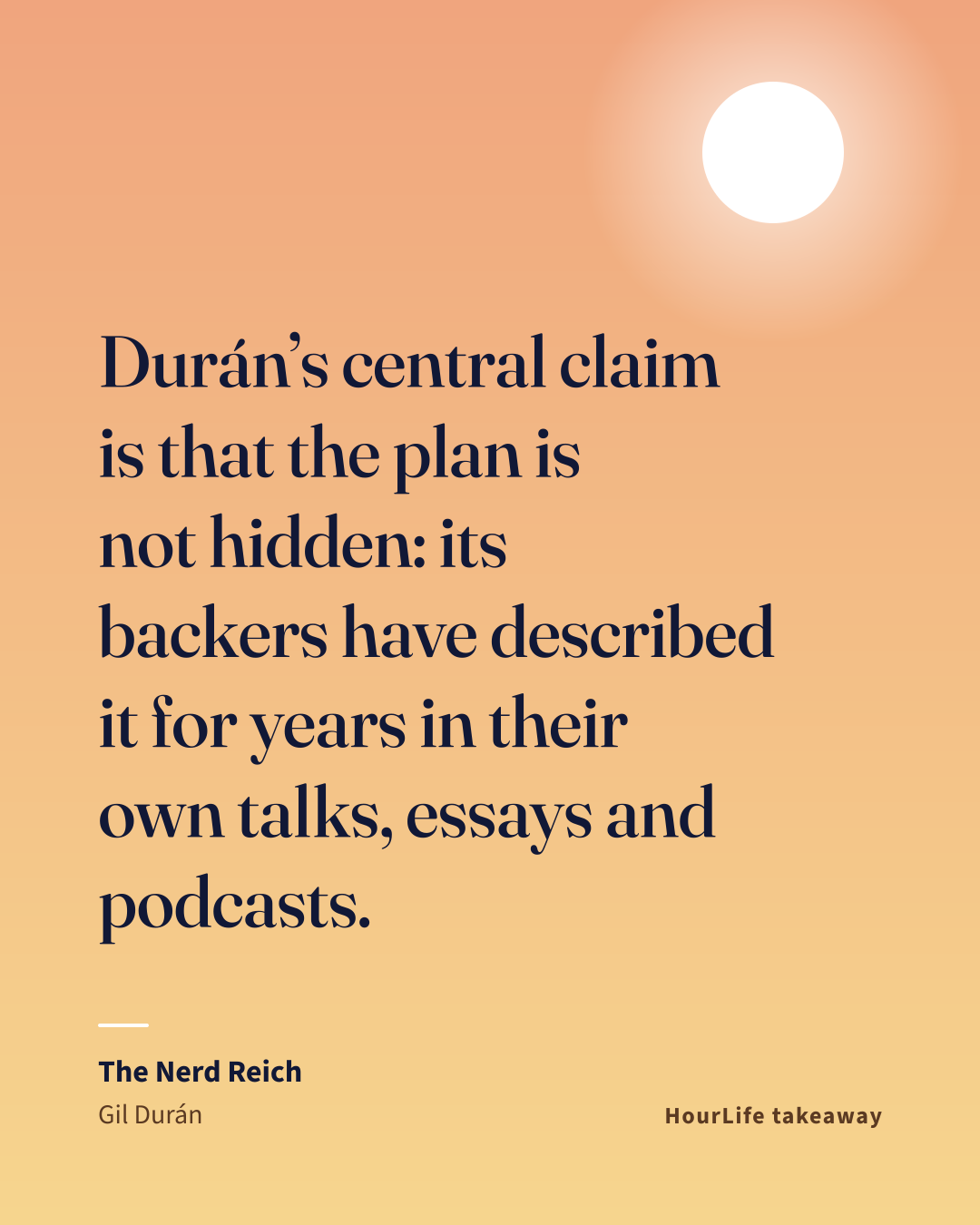
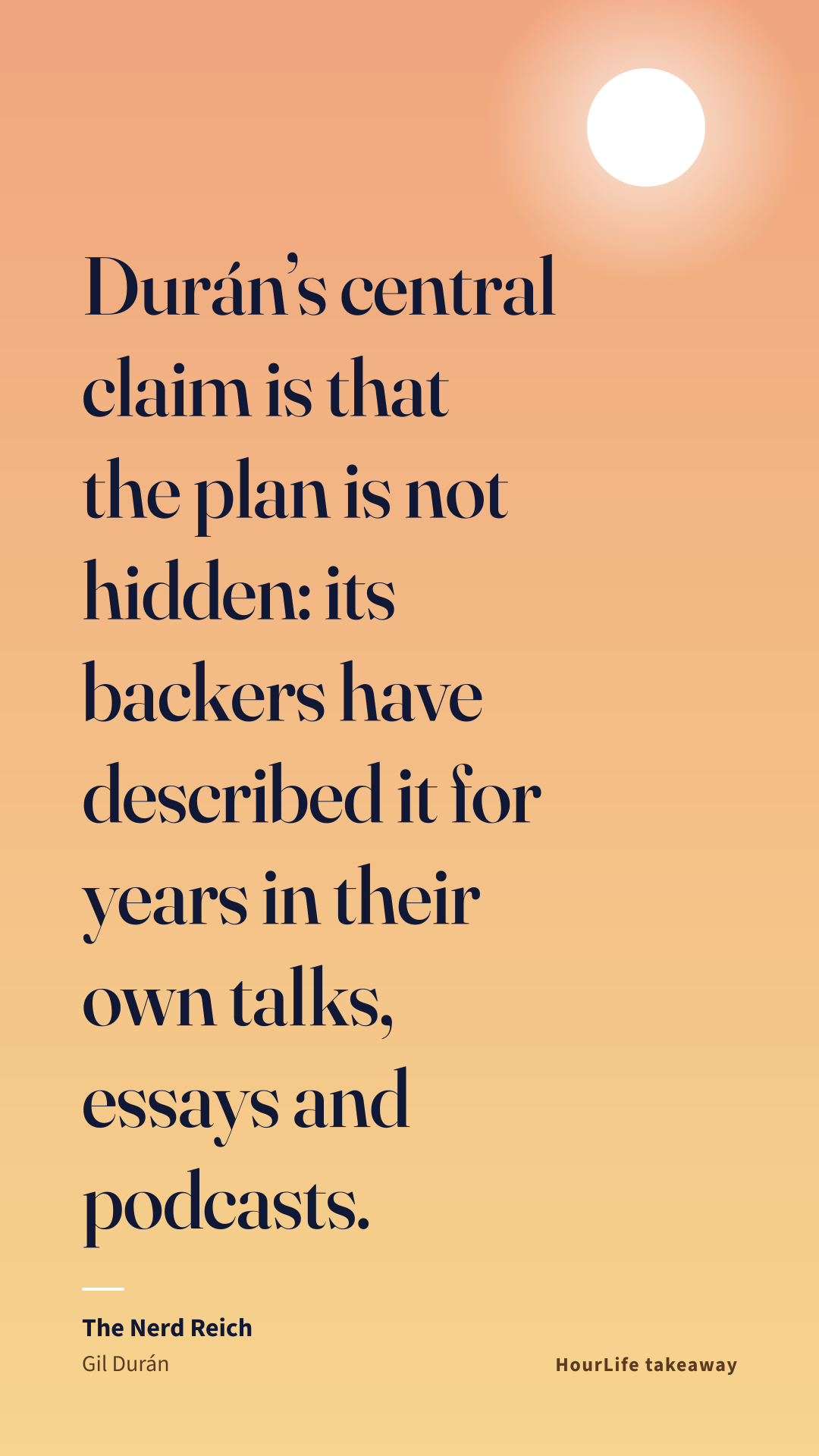
Durán’s central claim is that the plan is not hidden: its backers have described it for years in their own talks, essays and podcasts.

The Nerd Reich Gil Durán HourLife takeaway

The book is built largely from public statements, not leaks. Durán argues that commentators kept treating these ideas as eccentric talk long after they had money and political allies behind them. His case is that reading the source material closely is the first defence.


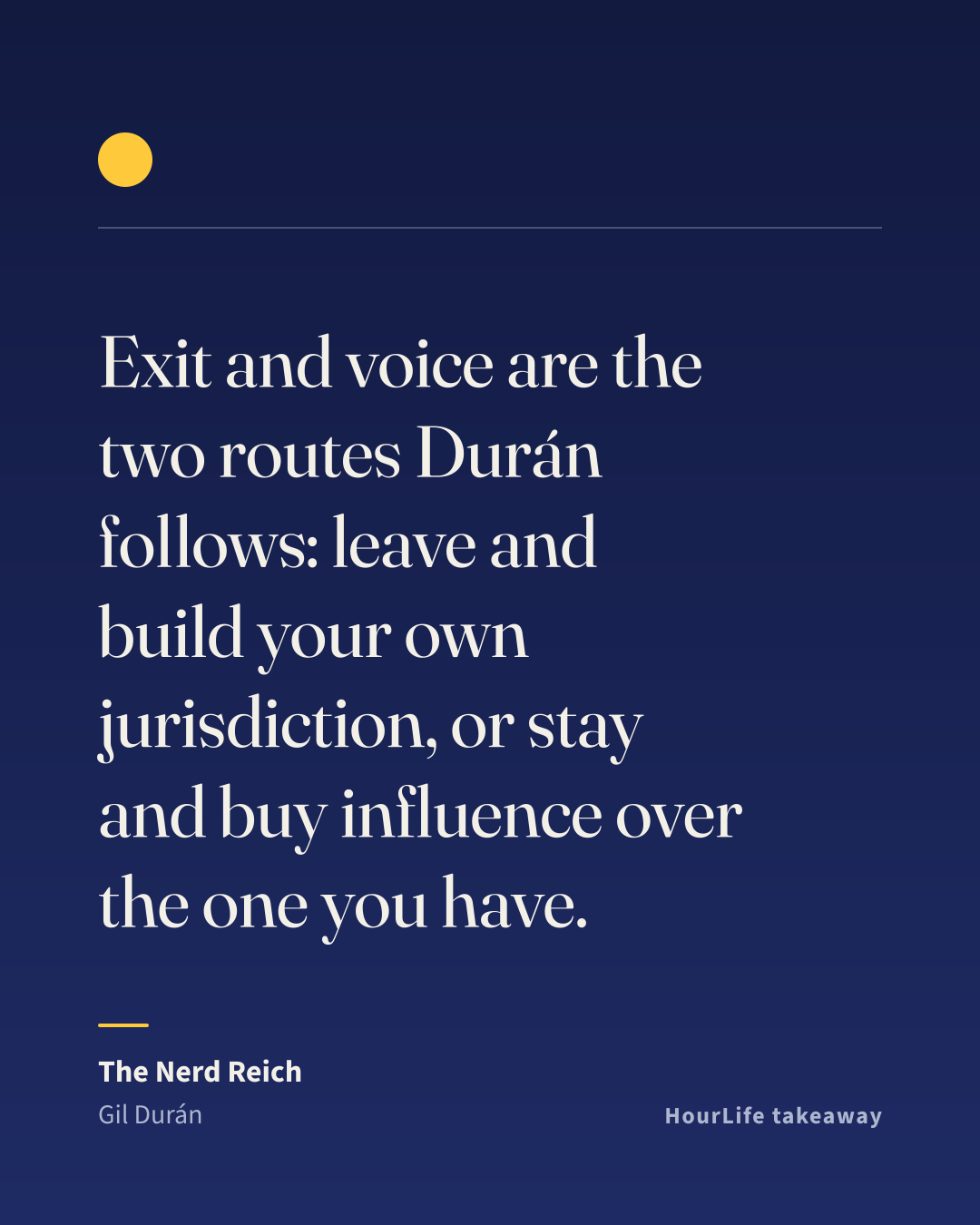
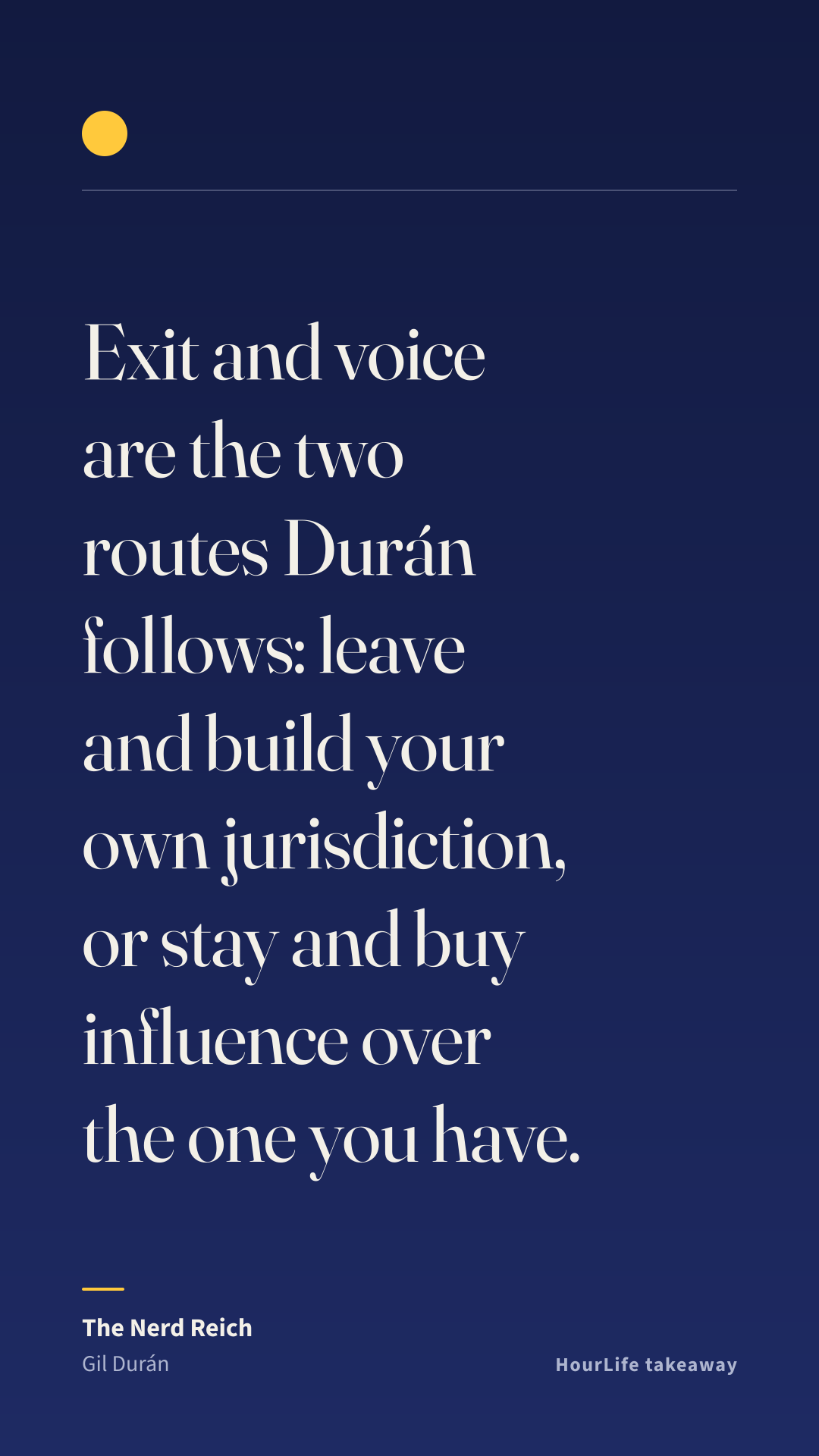
Exit and voice are the two routes Durán follows: leave and build your own jurisdiction, or stay and buy influence over the one you have.

The Nerd Reich Gil Durán HourLife takeaway

The terms come from Albert Hirschman's 1970 book Exit, Voice, and Loyalty, by way of Balaji Srinivasan, who favours exit. Durán argues the movement uses both at once. Exit shows up as private cities and network states; voice shows up as political spending, media ownership and placing allies in government.

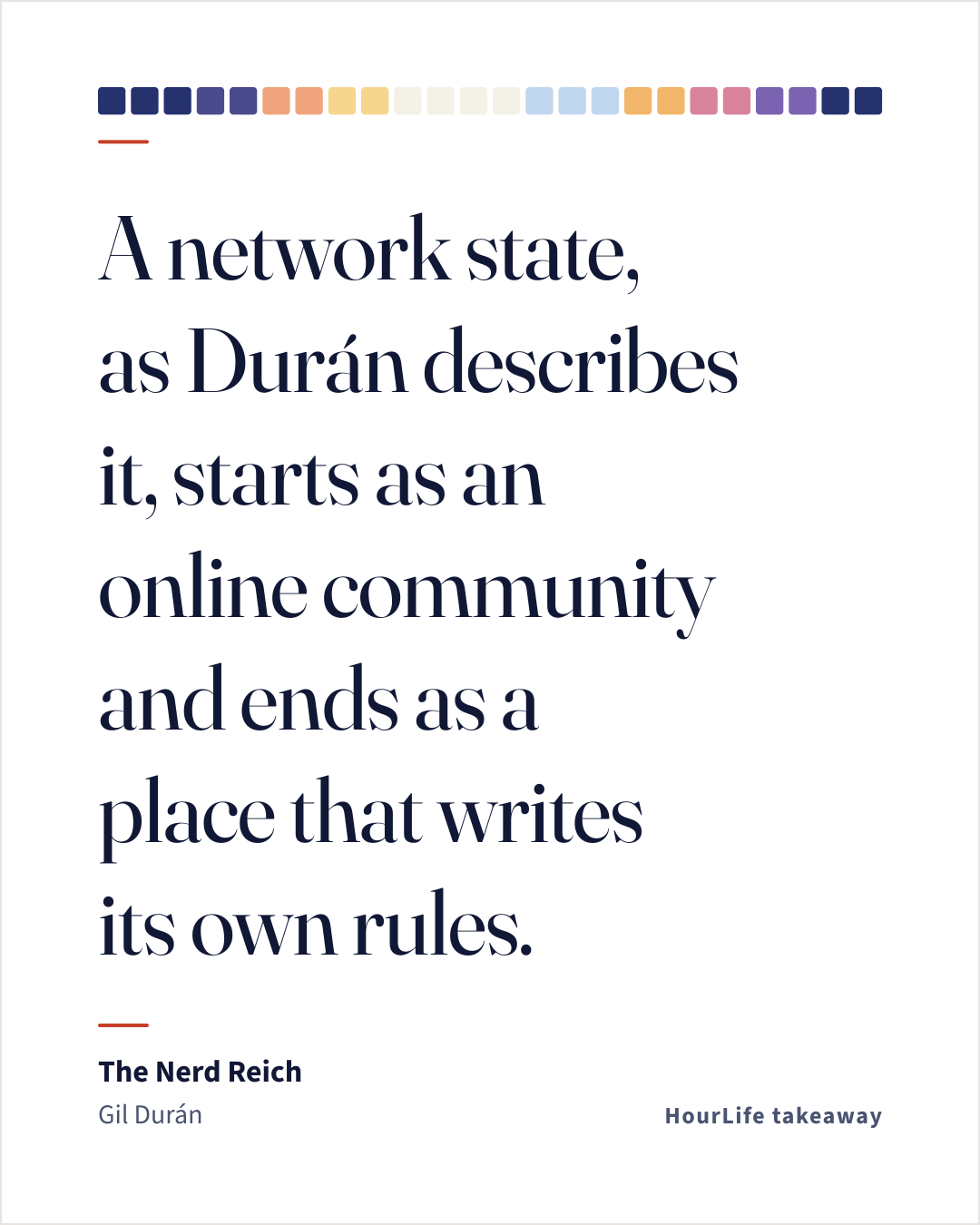
A network state, as Durán describes it, starts as an online community and ends as a place that writes its own rules.

The Nerd Reich Gil Durán HourLife takeaway

Srinivasan's idea is for groups that organise online to buy land, gather people and seek recognition as a new kind of state. Durán reads it as a way to step outside democratic accountability. He points to projects such as Próspera in Honduras and California Forever in Solano County, both of which met strong local opposition.

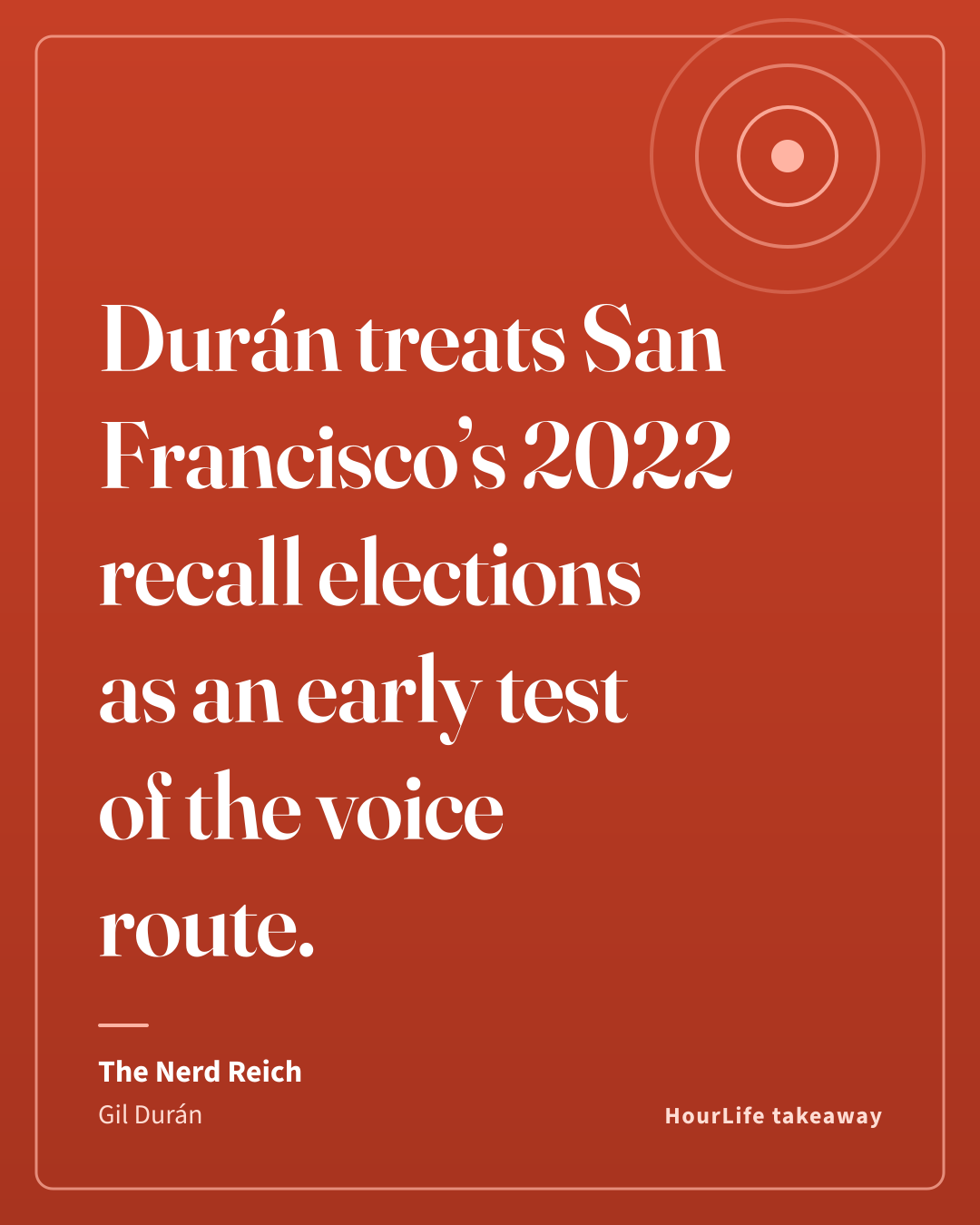
Durán treats San Francisco’s 2022 recall elections as an early test of the voice route.

The Nerd Reich Gil Durán HourLife takeaway

He describes the school board and district attorney recalls as heavily funded by wealthy donors and venture investors. He also grants that the recalls drew on real frustrations from the lockdown years. His point is that local politics is where these tactics were tried first.

The ideas have a reading list, and Durán follows it back decades.

The Nerd Reich Gil Durán HourLife takeaway

He traces part of the worldview to The Sovereign Individual, a 1997 book by James Dale Davidson and William Rees-Mogg that predicted the decline of the nation-state and the rise of a mobile elite. Peter Thiel wrote a preface for its 2020 reissue. Durán also follows a line through Curtis Yarvin's blog writing, which argued for running a country more like a company.

Durán argues this movement sells a mythical future rather than a lost past.

The Nerd Reich Gil Durán HourLife takeaway

Older authoritarian movements promised a return to former glory. Durán says this one promises abundance, space travel and longer lives. He links it to early 20th-century Italian Futurism, which Marc Andreessen's 2023 Techno-Optimist Manifesto names among its inspirations.

In Durán’s telling, influence runs through people as much as through money.

The Nerd Reich Gil Durán HourLife takeaway

He presents Peter Thiel as a quiet centre of the network, partly through people he backed. Thiel was the main financial backer of JD Vance's 2022 Senate run, and Durán traces some of Vance's ideas about government back to Yarvin. Readers should take the wider web of links as the author's argument, built from public records and statements.

Durán uses the phrase apocalypse capitalism for selling end-of-the-world stories alongside world-changing products.

The Nerd Reich Gil Durán HourLife takeaway

He argues that venture capital, short of new industries to disrupt, has leaned on AI and apocalyptic narratives to justify enormous valuations. The book's final chapter turns to Peter Thiel's public talks about the Antichrist, which Durán uses to tie that religious language back to the political project.

Durán’s answer is ordinary civic work: attention, local organising and independent journalism.

The Nerd Reich Gil Durán HourLife takeaway

In the book and in interviews about it, he argues that the public funds much of this power with its attention and money on platforms owned by the people involved. He has pointed to local campaigns, such as opposition to new data centres, as signs that ordinary people can still push back. The tools he names are old ones: reading closely, showing up and paying for reporting.

Keep this going in the app.

HourLife turns these ideas into a daily system — goals, habits, focus, and reflection in one private place.