Keep this author quotes for later
Sign in to save

Jerry Hicks

The most-loved lines from Jerry Hicks, drawn from 1 book in the library.

Lines labelled “HourLife takeaway” are our wording of the book’s ideas and may paraphrase it. Only lines in quotation marks are the author’s own words, with where they appear. Check the book for exact wording before you quote it. Spot an error?

The book treats every emotion as guidance: a signal of how far your current thoughts are from what you want.

Ask and It Is Given Esther Hicks and Jerry Hicks HourLife takeaway

This is its central claim, delivered through Abraham, the non-physical teachers Esther Hicks says she channels. Good feelings mean alignment; bad ones mean your focus is pulling against your desire. You don't need the metaphysics to use the practical part: a bad feeling is a cue to check what you are focusing on.


Contrast creates desire. Living through what you don’t want is how you find out what you do.

Ask and It Is Given Esther Hicks and Jerry Hicks HourLife takeaway

The book calls this the first of its three steps: you ask. In its view the asking happens on its own whenever life disappoints you, so a bad stretch is not wasted. Its habit for this is pivoting, process 16: when you catch yourself on the unwanted thing, say what you want instead.

Move up the Emotional Guidance Scale one rung at a time. A slightly better feeling counts as progress.

Ask and It Is Given Esther Hicks and Jerry Hicks HourLife takeaway

The scale runs from joy and appreciation at 1 down to fear, grief and powerlessness at 22. The book says a leap from despair to joy rarely holds, but reaching for the next feeling up does, which is why it ranks anger above despair. Anger is relief from powerlessness in this scheme, a place to pass through rather than stay.

Relief is the test. Between two thoughts about the same thing, choose the one that feels a little lighter.

Ask and It Is Given Esther Hicks and Jerry Hicks HourLife takeaway

Process 13, Which Thought Feels Better?, turns this into a drill. The thought has to be one you can believe today, or it brings no relief. Psychologists study something close to it under the name reappraisal, though the book frames it as alignment.

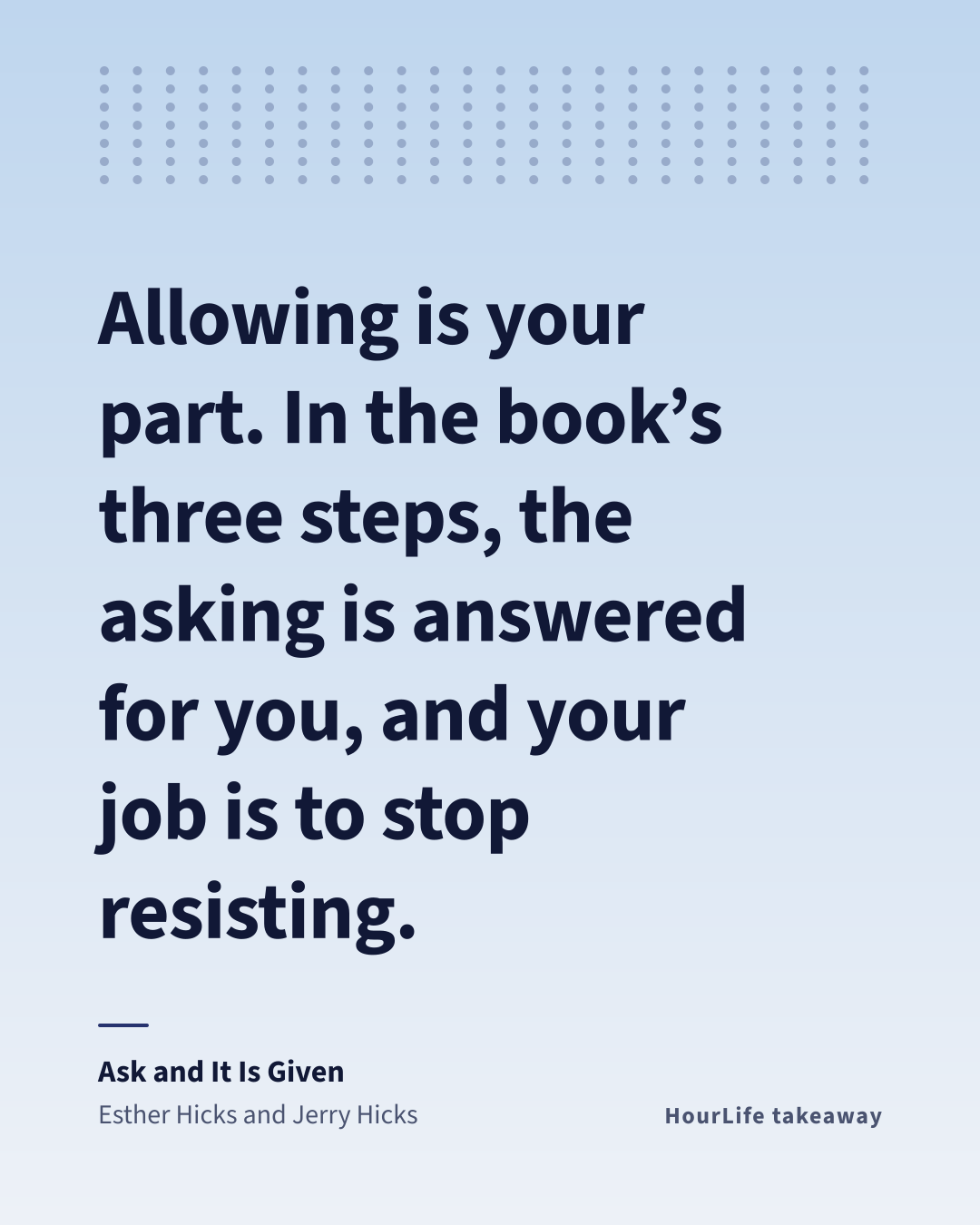
Allowing is your part. In the book’s three steps, the asking is answered for you, and your job is to stop resisting.

Ask and It Is Given Esther Hicks and Jerry Hicks HourLife takeaway

Step two, the answer, is done by Source in the book's telling. Step three is where people get stuck: wanting something while dwelling on its absence, which the book calls resistance. Most of the 22 processes are ways to ease that resistance. These are the book's claims, and they rest on its own metaphysics, not on evidence.

Appreciation is the book’s quickest route up the scale, and its first process is a rampage of it.

Ask and It Is Given Esther Hicks and Jerry Hicks HourLife takeaway

The Rampage of Appreciation asks you to look around and name things you appreciate, one after another, letting each make the next easier. Take away the theory and it is a gratitude exercise, a kind of practice with modest research support for lifting mood. It works best on an ordinary day, less well on a very low one.

Decide what you want from each part of the day before you walk into it.

Ask and It Is Given Esther Hicks and Jerry Hicks HourLife takeaway

Segment Intending, process 11, asks you to pause when one stretch of the day ends, such as getting into the car or opening email, and name what you want from the next. Of all the processes it asks the least belief: a few seconds of choosing where your attention goes.

Keep this going in the app.

HourLife turns these ideas into a daily system — goals, habits, focus, and reflection in one private place.