Keep this author quotes for later
Sign in to save

Merritt R. Turetsky

The most-loved lines from Merritt R. Turetsky, drawn from 1 book in the library.

Lines labelled “HourLife takeaway” are our wording of the book’s ideas and may paraphrase it. Only lines in quotation marks are the author’s own words, with where they appear. Check the book for exact wording before you quote it. Spot an error?

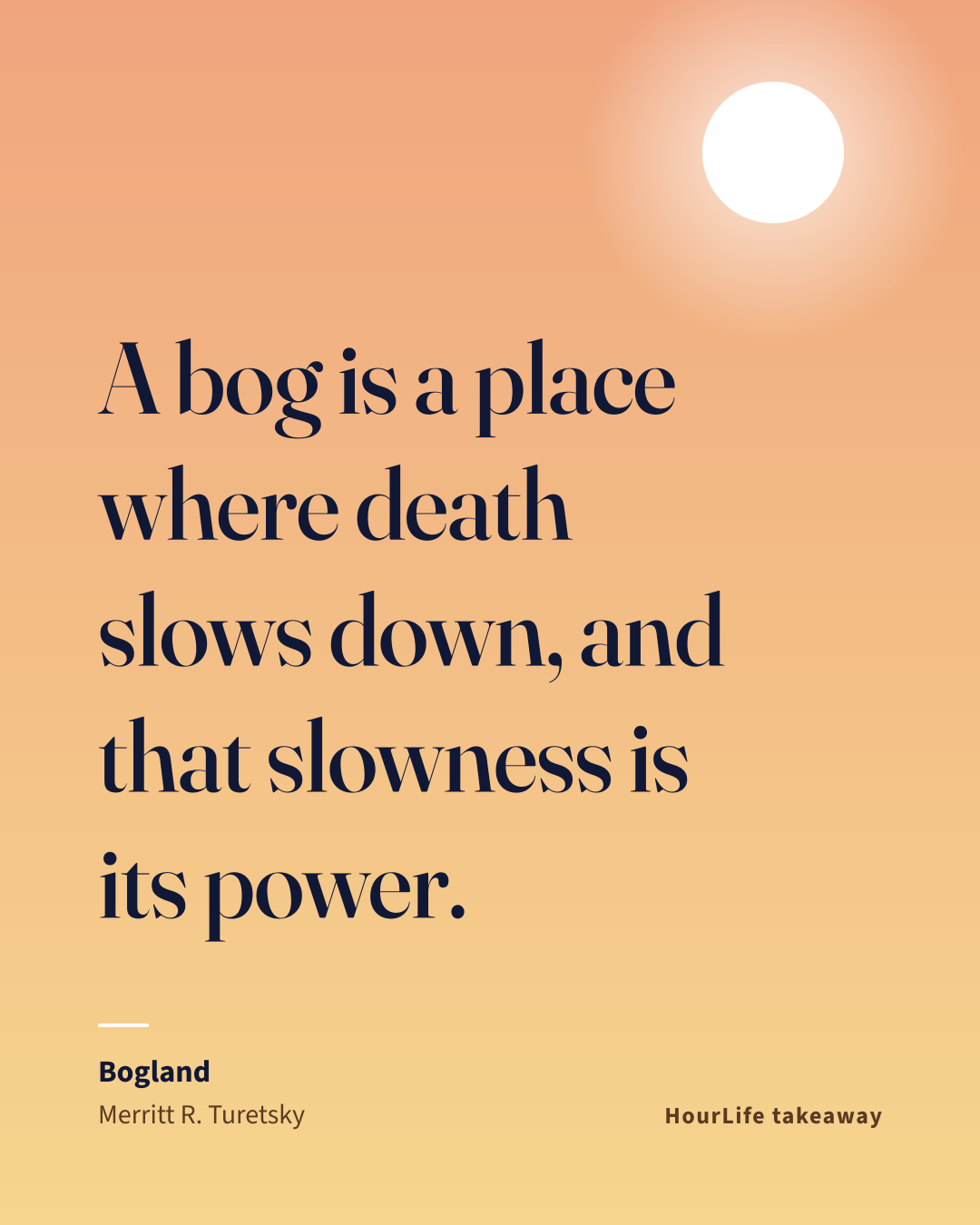
A bog is a place where death slows down, and that slowness is its power.

Bogland Merritt R. Turetsky HourLife takeaway

Bog water is cold, acidic and short of oxygen, so the microbes that normally rot dead plants barely work. Moss dies and is not fully broken down. It piles up, layer on layer, as peat. Everything else in the book follows from this one fact.


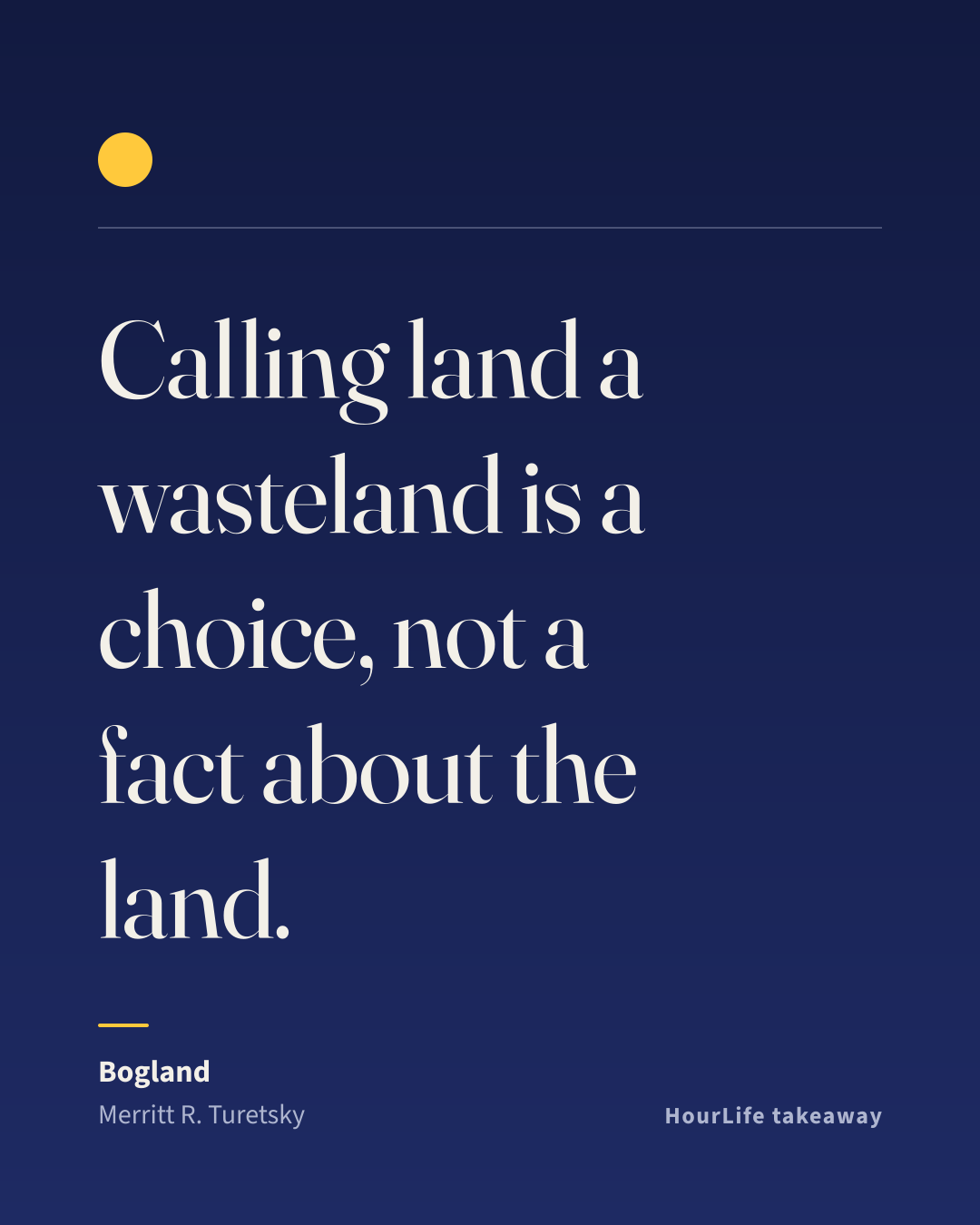
Calling land a wasteland is a choice, not a fact about the land.

Bogland Merritt R. Turetsky HourLife takeaway

For centuries bogs were judged too wet to farm, too dangerous to cross and too untidy to be beautiful. Turetsky's book is a case against that verdict. A place that looks empty can be doing some of the most important work on the planet.

Sphagnum moss builds the very bog it lives in.

Bogland Merritt R. Turetsky HourLife takeaway

Sphagnum holds water like a sponge and makes its surroundings more acidic. That creates conditions few rival plants and few decomposers can handle, so the moss keeps winning and the peat keeps building. The book treats it as the engineer behind the whole system.

A wet bog is a climate ally. A drained one becomes a climate foe.

Bogland Merritt R. Turetsky HourLife takeaway

As long as the peat stays waterlogged, its carbon stays locked away. Drain it and oxygen gets in, decay starts again and the stored carbon leaks out as greenhouse gas. Dry peat can also burn, sometimes for a long time below the surface.

Peat takes millennia to build and can be lost in a single season.

Bogland Merritt R. Turetsky HourLife takeaway

Peat grows by millimetres a year, so a deep bog holds thousands of years of growth. Digging, draining or burning can undo that far faster than any human lifetime could rebuild it. On the timescale that matters to us, peat does not grow back.

A bag of garden peat is a piece of a bog someone dug up.

Bogland Merritt R. Turetsky HourLife takeaway

Turetsky names the use of peat in gardening and landscaping as one of the big threats to bogs. Bogs are drained and stripped so that peat can be bagged and sold. Her first step is simple: buyers refusing it, and telling shops and governments why.

What a bog keeps, it keeps for thousands of years.

Bogland Merritt R. Turetsky HourLife takeaway

The same conditions that preserve moss preserve almost everything else: wood, cloth, food and the famous bog bodies. Layers of peat also work as an archive of the past, recording what grew nearby and what drifted in on the air.

Land nobody wanted has often sheltered people nobody protected.

Bogland Merritt R. Turetsky HourLife takeaway

Because bogs were hard to enter and hard to search, people fleeing oppression and groups resisting power have used them as refuges. The book tells this human history alongside the ecology, which makes bogs as much a story about people as about plants.

In the far north, frozen peat is a slow fuse.

Bogland Merritt R. Turetsky HourLife takeaway

Much northern peat sits in permafrost, frozen and stable. Turetsky, whose research covers permafrost, warns that as it thaws, decay restarts and carbon long held in the ground begins to escape. Protecting the bogs we still have matters more because of it.

Keep this going in the app.

HourLife turns these ideas into a daily system — goals, habits, focus, and reflection in one private place.