Keep this author quotes for later
Sign in to save

Neil deGrasse Tyson

The most-loved lines from Neil deGrasse Tyson, drawn from 2 books in the library.

Lines labelled “HourLife takeaway” are our wording of the book’s ideas and may paraphrase it. Only lines in quotation marks are the author’s own words, with where they appear. Check the book for exact wording before you quote it. Spot an error?

Everything you can touch is the cooled-down leftover of a universe that began about 13.8 billion years ago.

Astrophysics for People in a Hurry Neil deGrasse Tyson HourLife takeaway

The opening chapter runs through the first moments, when the universe was hotter and denser than anything we can make. The forces of nature split apart, particles formed, and matter slightly outnumbered antimatter, so something was left over once the two cancelled out. That remainder became the gas, stars and planets that followed.


A fact sticks when you tie it to something you already care about.

Lost in Space Neil deGrasse Tyson and Lindsey Nyx Walker HourLife takeaway

Tyson says the facts were picked by asking three things: is it tasty, does it make you smile, and does it connect to something the reader cared about before opening the book. That is why so many entries lean on films and pop culture. His favourite example in interviews is the Hulk: grow a person that big without adding mass and he would be about as dense as a beach ball.

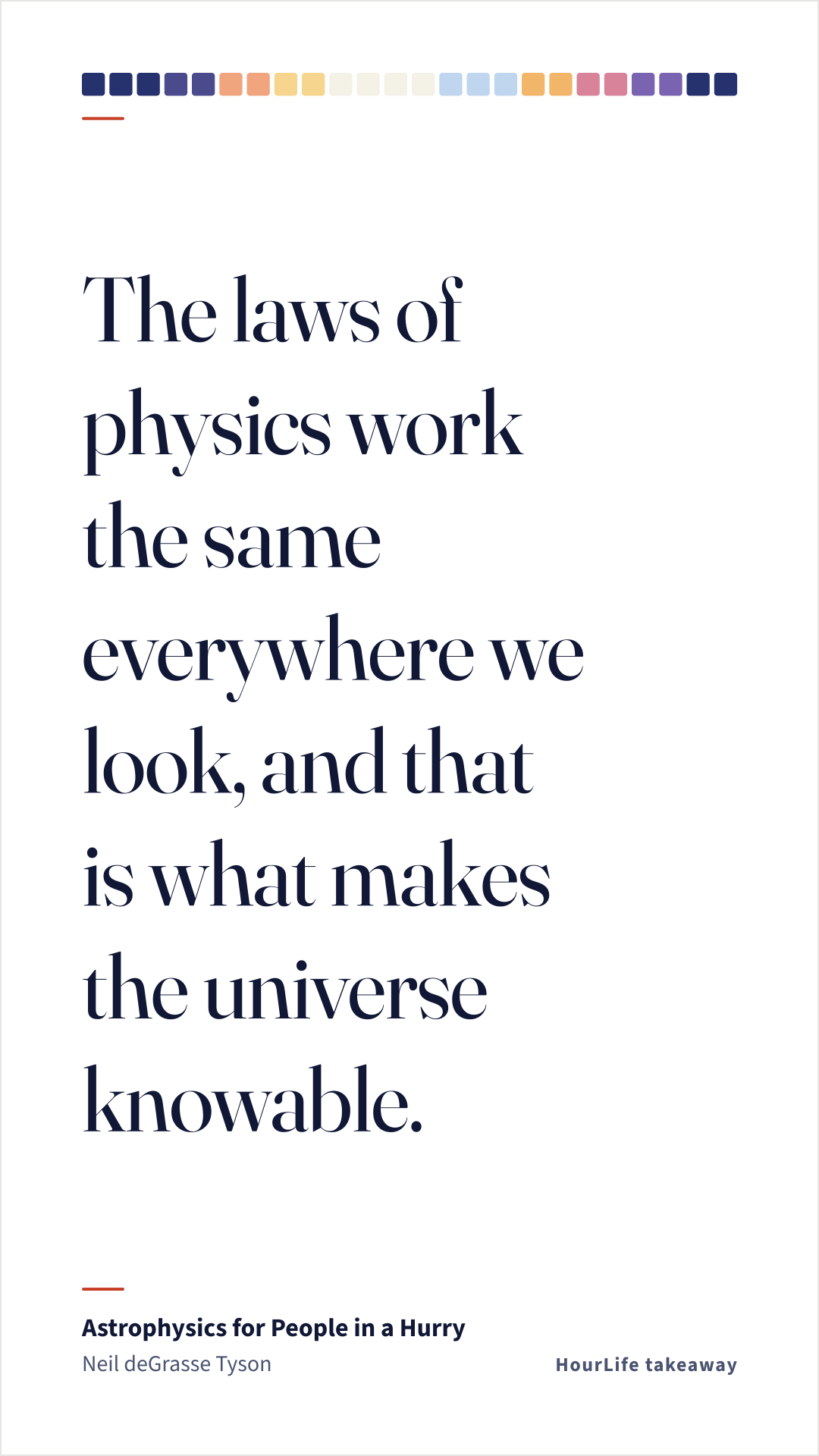
The laws of physics work the same everywhere we look, and that is what makes the universe knowable.

Astrophysics for People in a Hurry Neil deGrasse Tyson HourLife takeaway

Tyson treats this as the quiet discovery behind all of astrophysics. Newton showed that the gravity that drops an apple also keeps the Moon in orbit. Light from distant stars carries the fingerprints of the same elements we find on Earth, and helium was spotted in the Sun's light before anyone found it here.

A number means little until you stand it next to something familiar.

Lost in Space Neil deGrasse Tyson and Lindsey Nyx Walker HourLife takeaway

Saying the Sun is 1.39 million kilometres across gives you nothing to hold. Saying about 109 Earths would fit side by side across its face gives you a picture you can keep. The book puts cosmic sizes next to everyday ones again and again, because the comparison is what you remember.

Looking far away means looking back in time.

Astrophysics for People in a Hurry Neil deGrasse Tyson HourLife takeaway

Light travels at about 300,000 km a second, so it takes time to cross space. Sunlight is about eight minutes old when it reaches you. The oldest light we can catch, the cosmic microwave background, set out when the universe was a few hundred thousand years old, and it was first picked up as a stubborn hiss in a radio antenna.

Gravity changes what you weigh, not what you are.

Lost in Space Neil deGrasse Tyson and Lindsey Nyx Walker HourLife takeaway

Your mass is the same everywhere. What a scale reads depends on the pull of the world you stand on. Someone who weighs 150 pounds on Earth would read about 380 pounds at Jupiter's cloud tops and about 25 pounds on the Moon.

Most of the matter in the universe is something we cannot see.

Astrophysics for People in a Hurry Neil deGrasse Tyson HourLife takeaway

Galaxies and clusters of galaxies move as if they hold far more mass than their stars and gas. That extra gravity is called dark matter, and it outweighs ordinary matter by roughly five to one. Tyson is plain that no one yet knows what it is made of, and he treats that as an open question rather than an embarrassment.

Big does not mean heavy.

Lost in Space Neil deGrasse Tyson and Lindsey Nyx Walker HourLife takeaway

Saturn has about 95 times the mass of Earth, yet its average density is lower than water's. In a bathtub large enough to hold it, it would float. The book uses pictures like this to make an abstract word like density stick.

When you look up, you are looking back in time.

Lost in Space Neil deGrasse Tyson and Lindsey Nyx Walker HourLife takeaway

Light takes time to cross space, so the sky is never live. You see the Sun as it was about eight minutes ago and the Andromeda galaxy as it was about 2.5 million years ago. A guide to the sky is also a guide to the past.

The expansion of the universe is speeding up, and the cause has a name but no explanation.

Astrophysics for People in a Hurry Neil deGrasse Tyson HourLife takeaway

In 1998 two teams measuring distant exploding stars found that the expansion is accelerating. Whatever pushes it is called dark energy, and it makes up most of the universe's total budget of matter and energy. Einstein had once put a similar term into his equations and later dropped it.

You are made of the same stuff as the stars you are reading about.

Lost in Space Neil deGrasse Tyson and Lindsey Nyx Walker HourLife takeaway

Apart from hydrogen, most of the atoms in your body were made inside stars or thrown out when stars exploded or collided. The book gives the periodic table its own section. Read it with that in mind and a school chart becomes a record of where your carbon, oxygen and iron were made.
The atoms in your body were made in stars.

Astrophysics for People in a Hurry Neil deGrasse Tyson HourLife takeaway

Hydrogen and most of the helium came out of the Big Bang. Carbon, oxygen and much of the rest were built inside stars and scattered when those stars died. The chapter on the periodic table reads as a tour of where each element comes from and where it turns up in space.
You do not have to read it in order to learn from it.

Lost in Space Neil deGrasse Tyson and Lindsey Nyx Walker HourLife takeaway

Tyson describes the book as one you can open at any page and find something you had never thought about. Short entries make starting cheap. A few minutes a day with a book like this adds up faster than a long read you keep putting off.

Gravity makes anything big enough round.

Astrophysics for People in a Hurry Neil deGrasse Tyson HourLife takeaway

Past a certain size, an object's own gravity pulls it in on itself until it settles into a sphere. Spin flattens it a little, which is why Earth bulges at the equator. Small asteroids never get there and stay lumpy, so roundness is a clue to size.

Imagination and science have always borrowed from each other.

Lost in Space Neil deGrasse Tyson and Lindsey Nyx Walker HourLife takeaway

Frank Drake's Project Ozma, the first organised radio search for signals from other civilisations, ran in 1960 and took its name from the princess in L. Frank Baum's Oz books. Stories hand scientists names and questions, and science hands storytellers new worlds.

Most light is invisible to us, and each kind shows a different sky.

Astrophysics for People in a Hurry Neil deGrasse Tyson HourLife takeaway

Our eyes catch a narrow slice of the spectrum. In 1800 William Herschel found infrared when a thermometer warmed up past the red end of a prism's rainbow. Radio, microwave, X-ray and gamma-ray telescopes each reveal things that visible light would never show.

Every big fact about space began with someone building a better instrument.

Lost in Space Neil deGrasse Tyson and Lindsey Nyx Walker HourLife takeaway

The book covers telescopes and space missions alongside planets and galaxies, because what we know depends on what we can measure. Behind every space headline is a mirror, a detector or a probe that someone designed and launched.

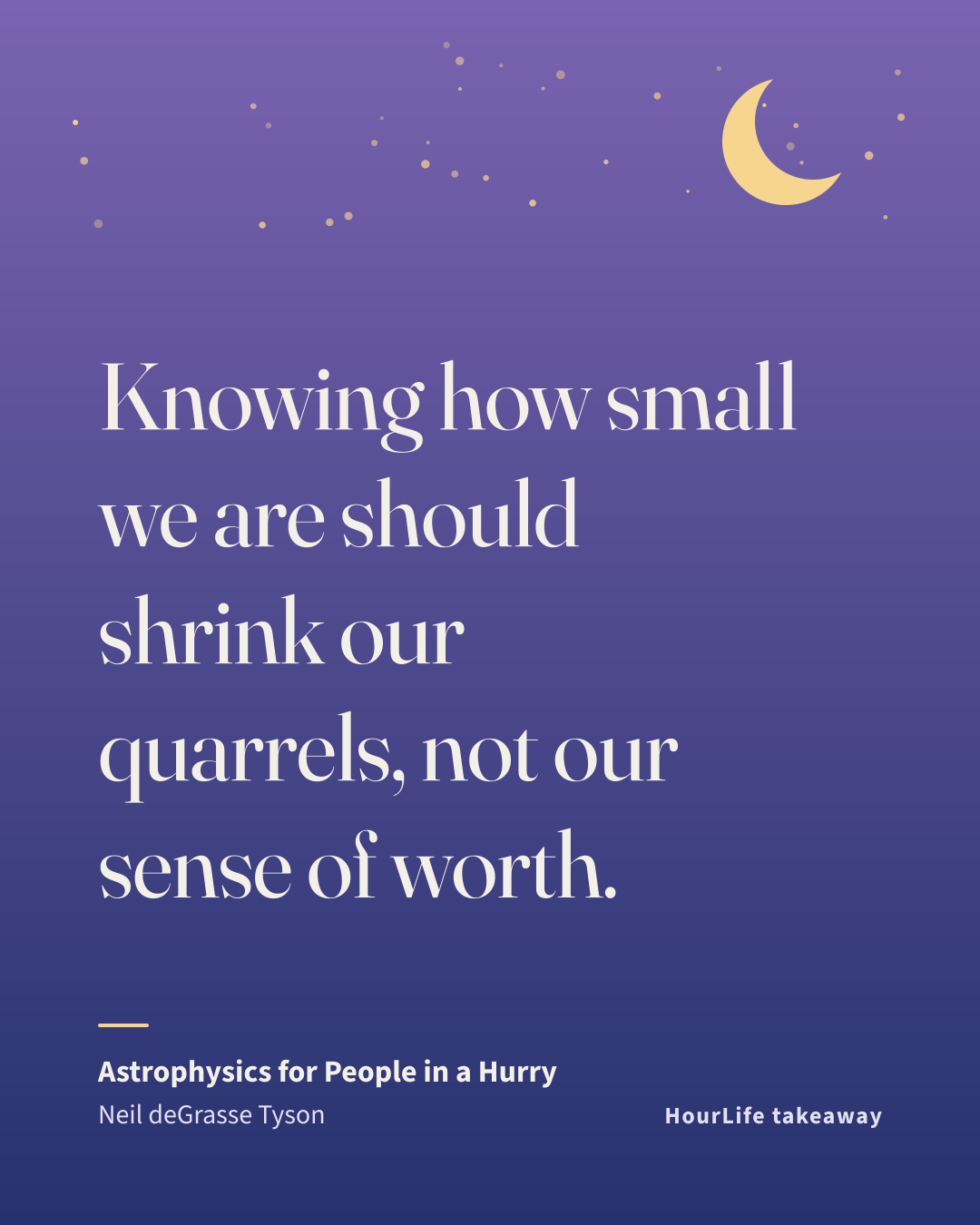
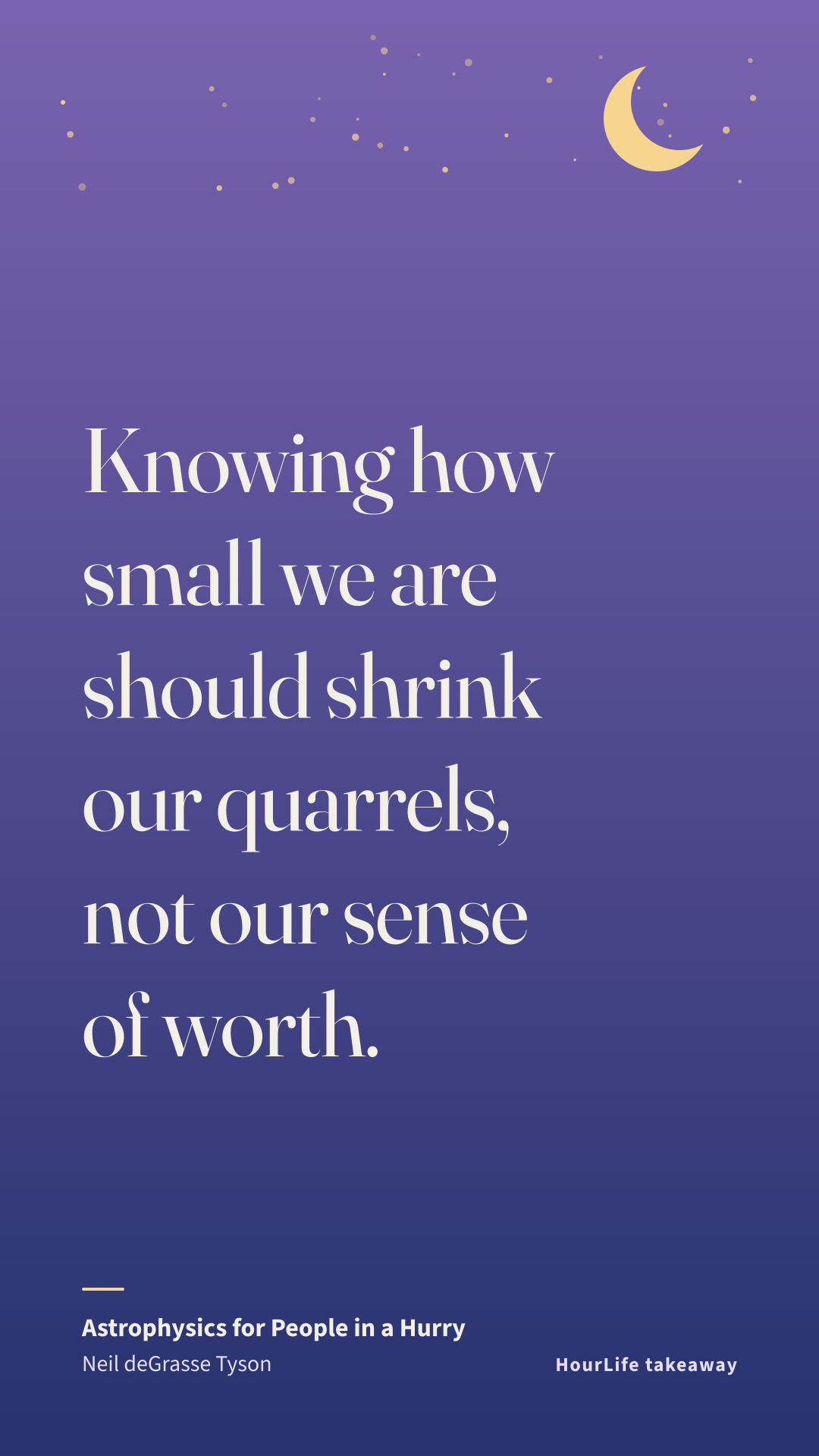
Knowing how small we are should shrink our quarrels, not our sense of worth.

Astrophysics for People in a Hurry Neil deGrasse Tyson HourLife takeaway

The last chapter makes the case for the cosmic perspective. We are tiny next to the universe, yet we come from the same history and the same elements as everything in it. Tyson sees that as a reason for curiosity, humility and care for each other and the planet.

Keep this going in the app.

HourLife turns these ideas into a daily system — goals, habits, focus, and reflection in one private place.