Keep this author quotes for later
Sign in to save

Olaf Fritsche

The most-loved lines from Olaf Fritsche, drawn from 1 book in the library.

Lines labelled “HourLife takeaway” are our wording of the book’s ideas and may paraphrase it. Only lines in quotation marks are the author’s own words, with where they appear. Check the book for exact wording before you quote it. Spot an error?

An ant colony makes more sense as one animal than as a crowd of many.

Planet of the Ants Susanne Foitzik and Olaf Fritsche HourLife takeaway

The book leans on the idea of the superorganism. The queen does the reproducing, the workers do the feeding, building and defending, and no single worker can carry on the colony's life alone. Selection works on the colony as a whole, much as it works on a body made of many cells.


No ant gives orders, not even the queen.

Planet of the Ants Susanne Foitzik and Olaf Fritsche HourLife takeaway

The queen is an egg layer, not a ruler. What the colony does comes out of thousands of small, local choices: each worker reacts to what it meets and smells nearby. Nobody holds the plan, and the colony still acts as if it had one.

Ants talk mostly in chemistry.

Planet of the Ants Susanne Foitzik and Olaf Fritsche HourLife takeaway

Scent marks a trail to food, raises an alarm and tells a nestmate from a stranger. Each colony carries its own smell on the body, which is why a foreign ant is spotted at once. Much of the book's drama, from raids to invasions, turns on who can read or fake that smell.

A trail is a decision the colony makes by walking it.

Planet of the Ants Susanne Foitzik and Olaf Fritsche HourLife takeaway

Ants that find food lay scent on the way home, others follow the strongest scent, and each trip strengthens the trail. Because the scent fades, routes that stop paying off are slowly forgotten. Feedback plus forgetting is enough to choose a route with no one choosing.

Ants were farmers and herders millions of years before people were.

Planet of the Ants Susanne Foitzik and Olaf Fritsche HourLife takeaway

Leafcutter ants do not eat the leaves they carry. They chew them into a bed for a fungus, and the fungus is their food. Other ants guard aphids and drink the sugary honeydew they give off, much as a farmer keeps a herd.

Army ants carry their home with them.

Planet of the Ants Susanne Foitzik and Olaf Fritsche HourLife takeaway

Army ant colonies do not keep a fixed nest. They move through the forest in huge raiding columns, and at rest the workers link their bodies into a living shelter around the queen and brood. It is the superorganism at its most literal.

An invasive ant wins by not fighting itself.

Planet of the Ants Susanne Foitzik and Olaf Fritsche HourLife takeaway

In its new range the Argentine ant forms supercolonies: nests spread over vast stretches of land that treat each other as family. Workers that would normally fight a neighbour cooperate instead, so their numbers overwhelm native ants. Southern Europe has one that runs along thousands of kilometres of coast.

Some ants live by stealing other ants’ children.

Planet of the Ants Susanne Foitzik and Olaf Fritsche HourLife takeaway

Slave-making ants raid the colonies of small Temnothorax ants, some of which nest inside acorns, and carry off their brood. The stolen young grow up working for the raiders. Foitzik has spent much of her career studying this arms race between raiders and hosts.

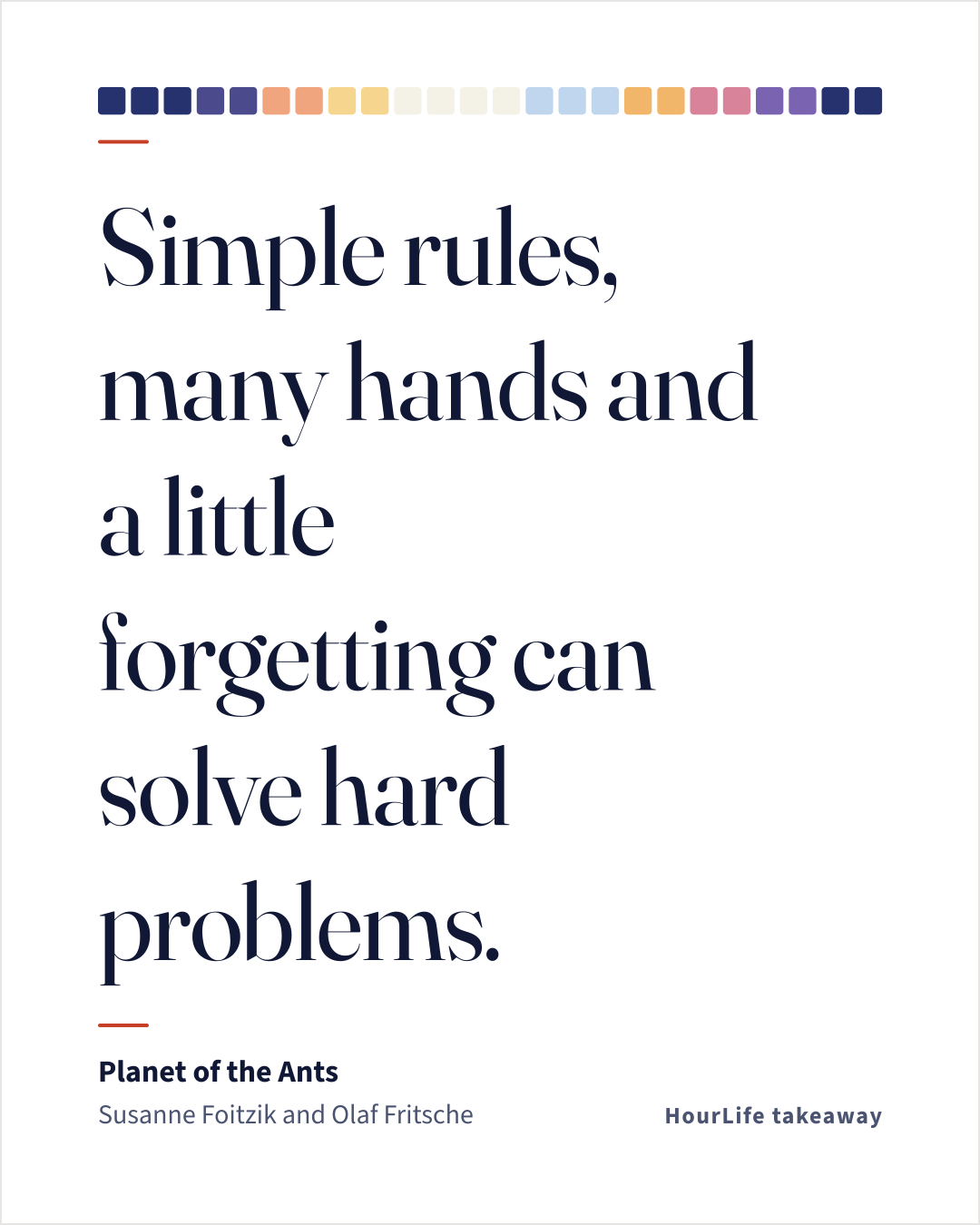
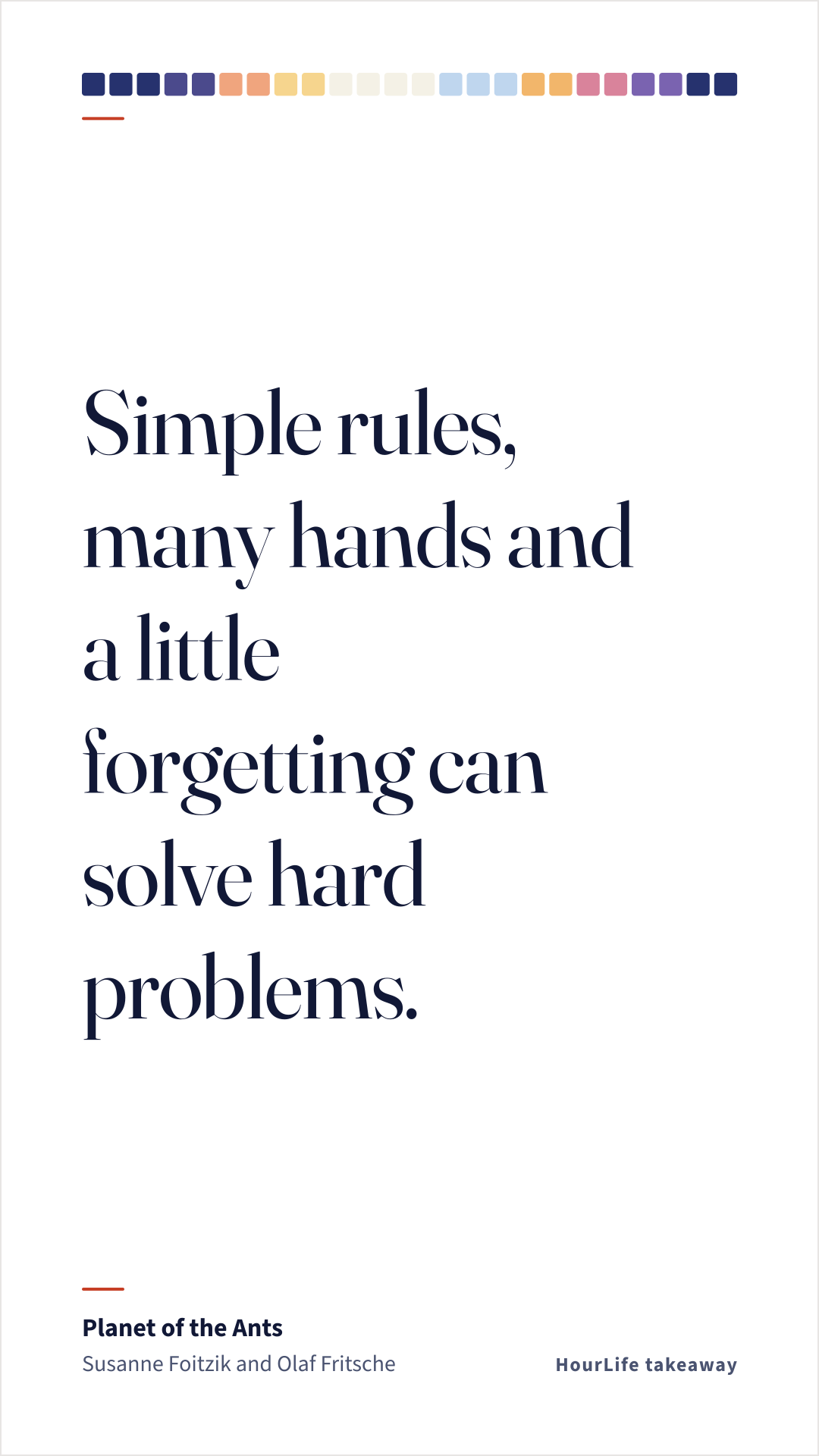
Simple rules, many hands and a little forgetting can solve hard problems.

Planet of the Ants Susanne Foitzik and Olaf Fritsche HourLife takeaway

No ant understands the colony, yet colonies find food, divide work and defend territory well. The lesson for people is not that we should act like ants. It is that good group results can come from good local rules, honest signals and the freedom to drop what no longer works.

Keep this going in the app.

HourLife turns these ideas into a daily system — goals, habits, focus, and reflection in one private place.