Keep this author quotes for later
Sign in to save

Quinn Slobodian

The most-loved lines from Quinn Slobodian, drawn from 1 book in the library.

Lines labelled “HourLife takeaway” are our wording of the book’s ideas and may paraphrase it. Only lines in quotation marks are the author’s own words, with where they appear. Check the book for exact wording before you quote it. Spot an error?

Read Musk as the avatar of a system, not as a one-off personality.

Muskism Quinn Slobodian and Ben Tarnoff HourLife takeaway

Slobodian and Tarnoff borrow the logic of Fordism, a word that named far more than Henry Ford. They use Muskism the same way: as a name for a model of running companies, markets and states. The question they ask is less who Musk is than what he is a symptom of.


Fordism promised that the many would share the gains; the authors argue that Muskism promises sovereignty to the few.

Muskism Quinn Slobodian and Ben Tarnoff HourLife takeaway

The twentieth-century bargain tied mass production to mass consumption, so workers could buy what they made. In the authors' account, the new model concentrates wealth and uses it for political and economic leverage. That contrast is the spine of the book.

Fortress futurism treats technology as a wall: a way to make a group self-sufficient against a hostile world.

Muskism Quinn Slobodian and Ben Tarnoff HourLife takeaway

The authors trace the idea partly to the apartheid South Africa of Musk's childhood, which they describe as a besieged state that bet on advanced technology and industrial self-reliance. They argue the same instinct shows up later in vertically integrated companies built to depend on no one.

The lone-disruptor story hides how much the business runs on public money.

Muskism Quinn Slobodian and Ben Tarnoff HourLife takeaway

This is what the authors call state symbiosis. They point to government launch contracts and defence programmes of the war-on-terror years as part of how the space business grew. Their claim is that these firms do not replace the state; they make the state depend on them.

When a private network carries what public systems used to carry, its owner holds a kind of power no one voted for.

Muskism Quinn Slobodian and Ben Tarnoff HourLife takeaway

The authors describe firms selling sovereignty as a service: launch, communications and data that governments come to rely on. A contract can be renegotiated, but a dependency is harder to unwind. That is why they treat infrastructure ownership as a political question, not only a business one.

Financial fabulism runs on stories about the future, and each round of money needs a bigger story.

Muskism Quinn Slobodian and Ben Tarnoff HourLife takeaway

In the authors' reading, a founder whose wealth sits in his own companies has to keep belief in those companies high. They argue this pushes toward ever larger promises, framed as the only way to avoid catastrophe. Valuation becomes partly a matter of narrative.

Attention is capital: spectacle can replace advertising, and owning the platform changes the game.

Muskism Quinn Slobodian and Ben Tarnoff HourLife takeaway

The authors see a feedback loop between public spectacle, investor belief and media power. With the 2022 purchase of Twitter, later renamed X, the platform where that loop ran came under the same ownership. In their reading, it stopped being a stage and became part of the machine.

Treating government like code to be rewritten leaves little room for argument and consent.

Muskism Quinn Slobodian and Ben Tarnoff HourLife takeaway

The authors read the Department of Government Efficiency in 2025 as Muskism applied to the state itself. In their account, deliberation gives way to the logic of debugging: find what looks like waste and delete it. They argue that the second Trump presidency gave the model its biggest stage so far.

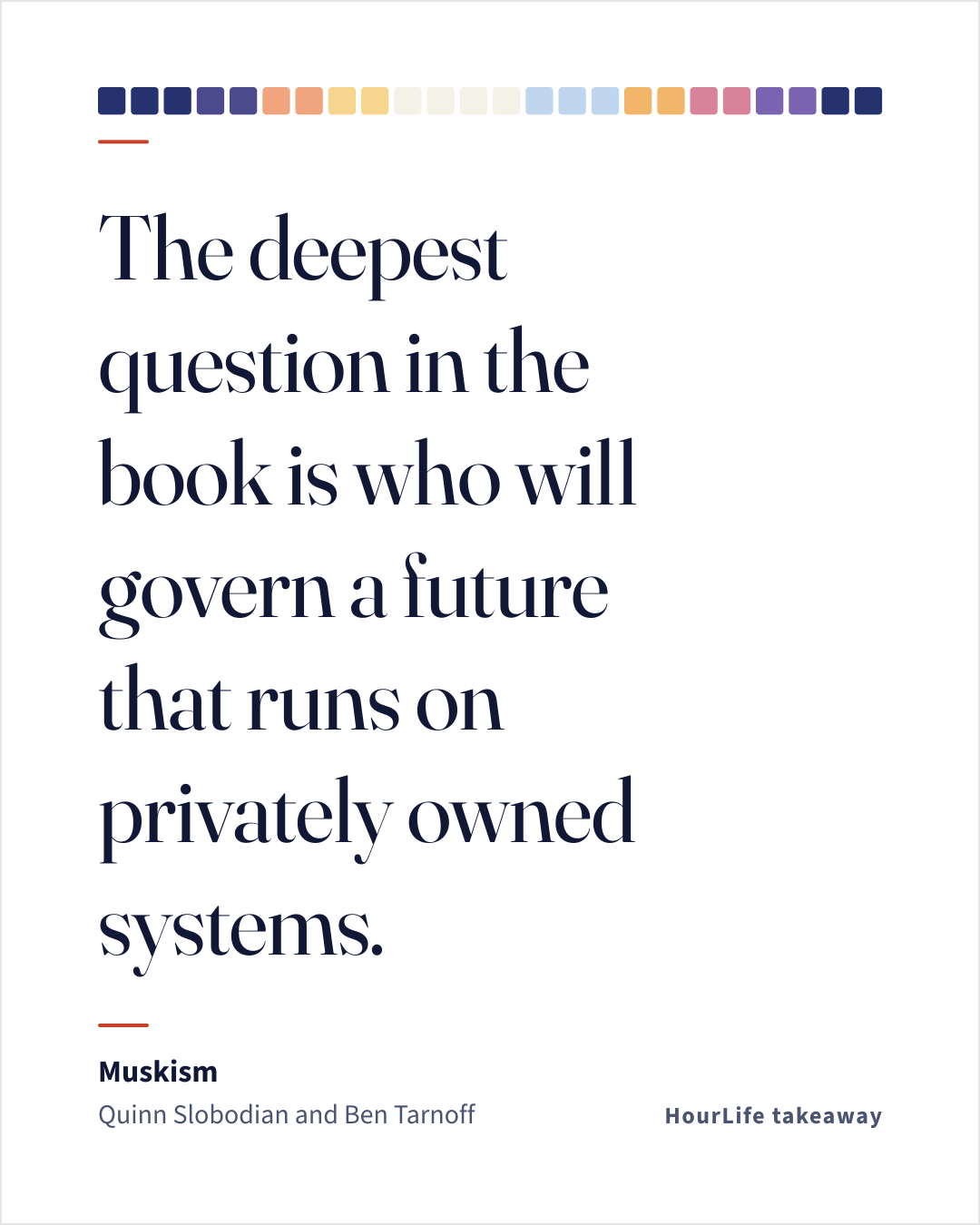
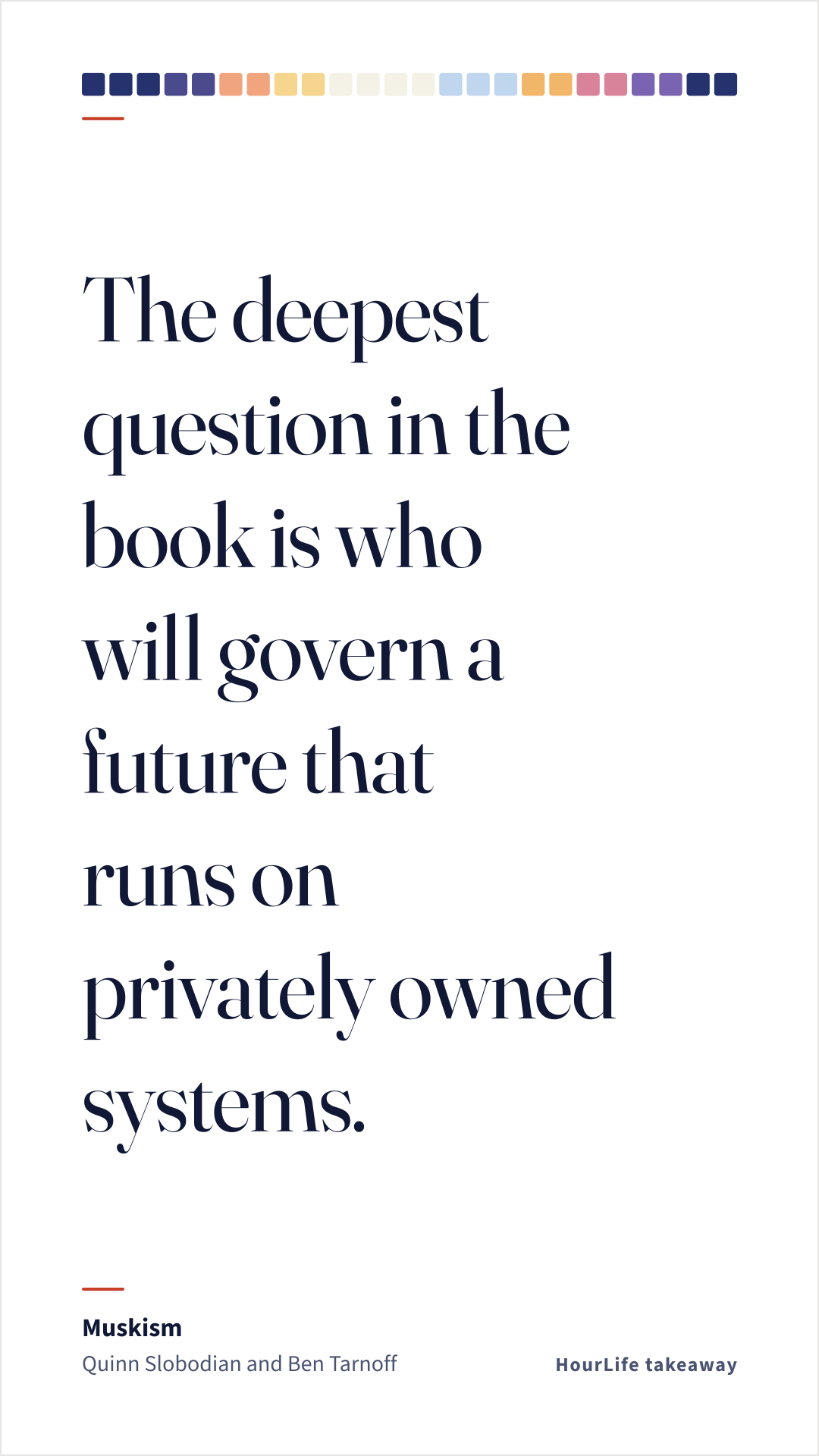
The deepest question in the book is who will govern a future that runs on privately owned systems.

Muskism Quinn Slobodian and Ben Tarnoff HourLife takeaway

The authors warn that if automation makes most people's labour unnecessary, their consent may stop seeming necessary too. They present this as a danger to name and resist, not a forecast to accept. Reviewers split on how far the argument holds, which makes it a good book to argue with.

Keep this going in the app.

HourLife turns these ideas into a daily system — goals, habits, focus, and reflection in one private place.