Keep this author quotes for later
Sign in to save

Ray Kurzweil

The most-loved lines from Ray Kurzweil, drawn from 1 book in the library.

Lines labelled “HourLife takeaway” are our wording of the book’s ideas and may paraphrase it. Only lines in quotation marks are the author’s own words, with where they appear. Check the book for exact wording before you quote it. Spot an error?

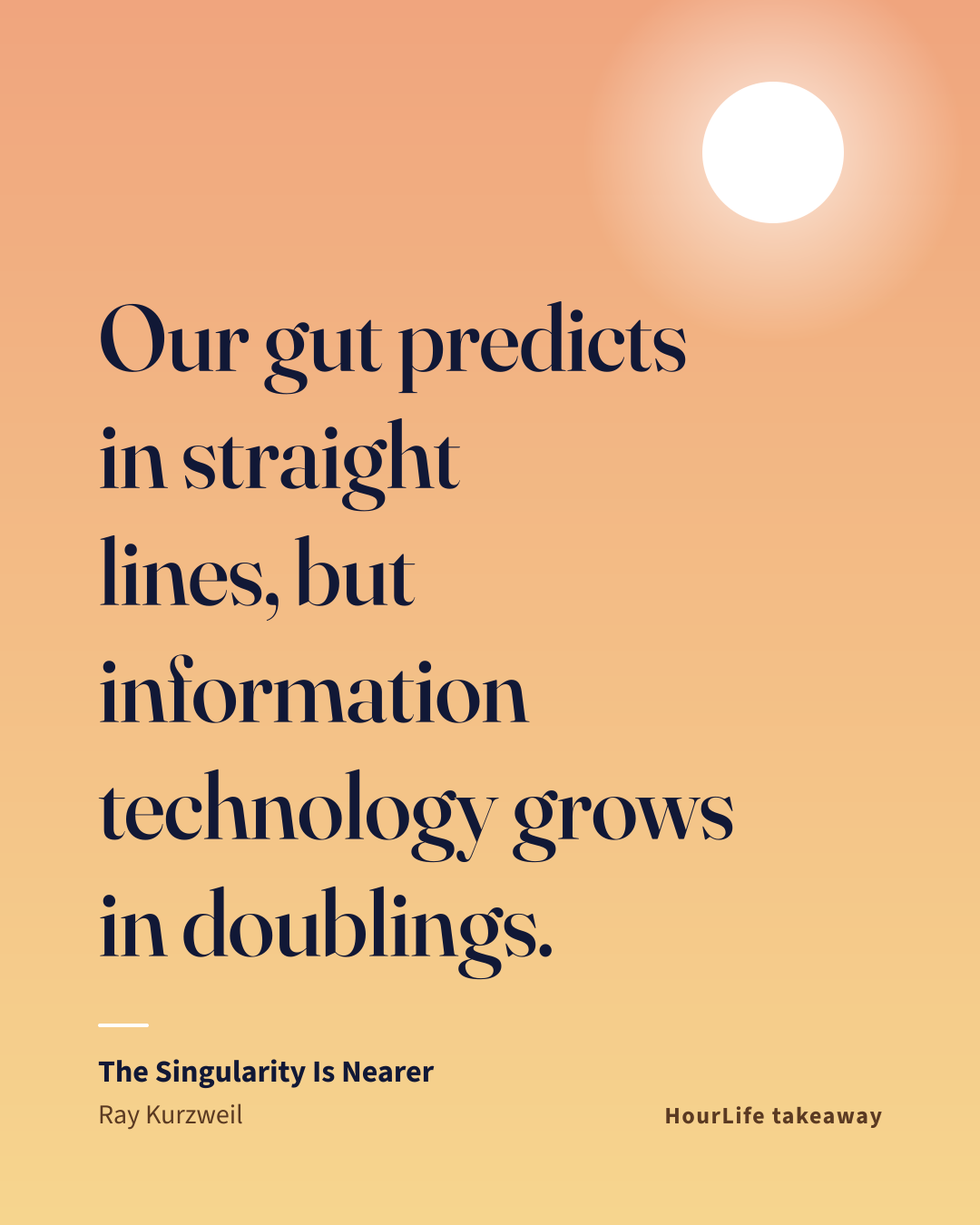
Our gut predicts in straight lines, but information technology grows in doublings.

The Singularity Is Nearer Ray Kurzweil HourLife takeaway

Kurzweil's oldest illustration: thirty linear steps take you thirty paces, while thirty doublings take you past a billion. Early on, an exponential curve looks flat and easy to dismiss. By the time it looks steep, most of the change is already close.


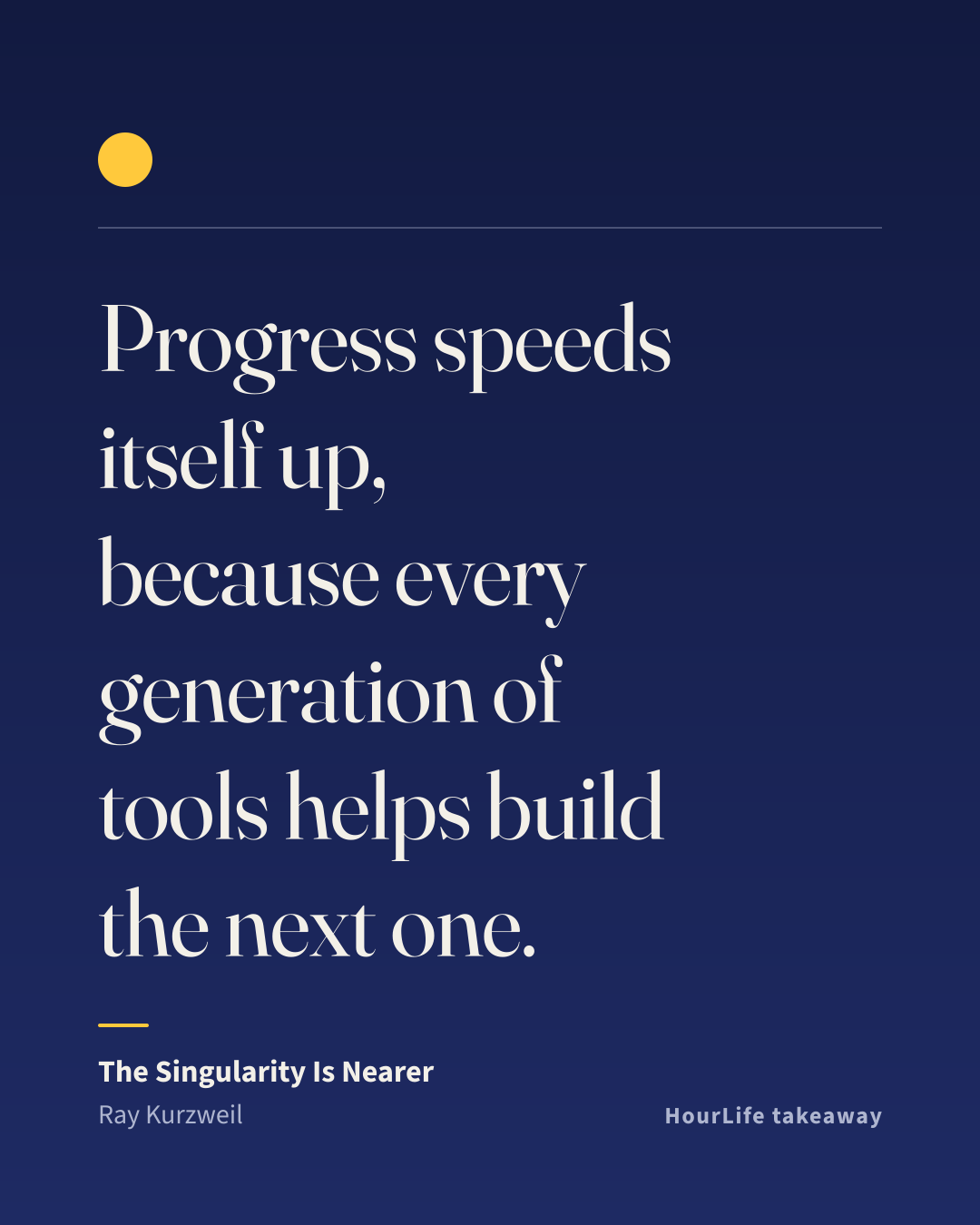
Progress speeds itself up, because every generation of tools helps build the next one.

The Singularity Is Nearer Ray Kurzweil HourLife takeaway

This is his law of accelerating returns. Faster computers design faster chips, better data trains better models, and the gains feed back into the next round. He backs it with a long chart of how much computation a constant dollar buys, running from the earliest computers to today.

Kurzweil still dates AI that passes a valid Turing test to 2029, as he first did in 1999.

The Singularity Is Nearer Ray Kurzweil HourLife takeaway

He made the forecast in The Age of Spiritual Machines, when most experts thought it was decades too early. In this book he argues that large language models show the curve is on time. Others reply that passing a conversation test is not the same as human-level understanding, and estimates for that still range widely.

In his picture, the Singularity is not machines replacing us but people extending their minds into the cloud.

The Singularity Is Nearer Ray Kurzweil HourLife takeaway

Around 2045, he expects brain-computer interfaces, eventually nanobots, to connect the neocortex to computing in the cloud and multiply our intelligence many times over. It is the boldest claim in the book. Many neuroscientists doubt that anything like it is close, and the date is his forecast, not a consensus.

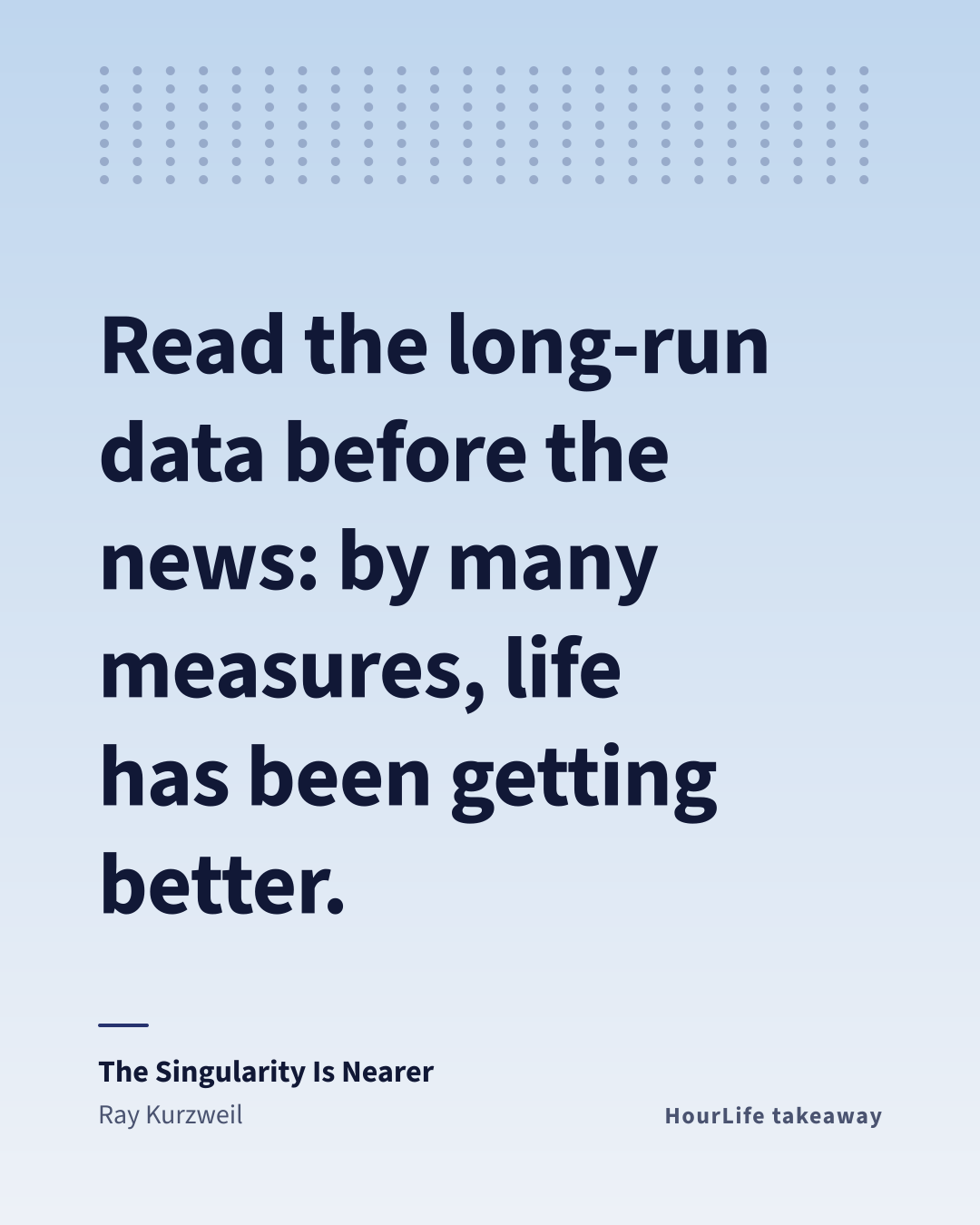
Read the long-run data before the news: by many measures, life has been getting better.

The Singularity Is Nearer Ray Kurzweil HourLife takeaway

A long chapter walks through decades of figures on poverty, literacy, life expectancy, violence and the falling cost of solar power. His point is that news reports events while the slow trends go unreported. The trends are real, though they say nothing on their own about what comes next.

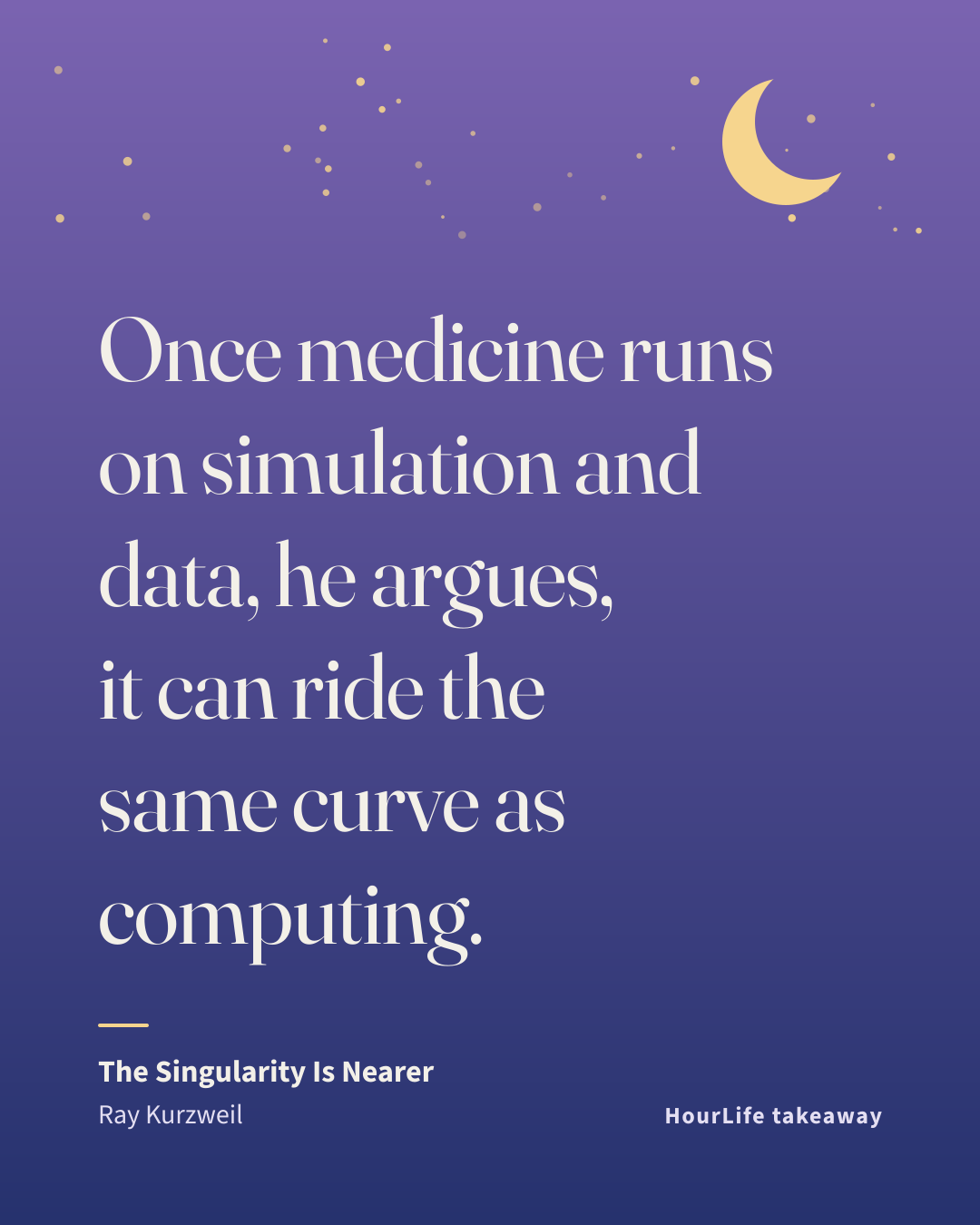
Once medicine runs on simulation and data, he argues, it can ride the same curve as computing.

The Singularity Is Nearer Ray Kurzweil HourLife takeaway

He expects AI-driven drug discovery and simulated biology to speed up research, and talks of longevity escape velocity: the point where science adds more than a year of remaining life expectancy for every year that passes. That idea is speculative, and most researchers on ageing are far more cautious about it.

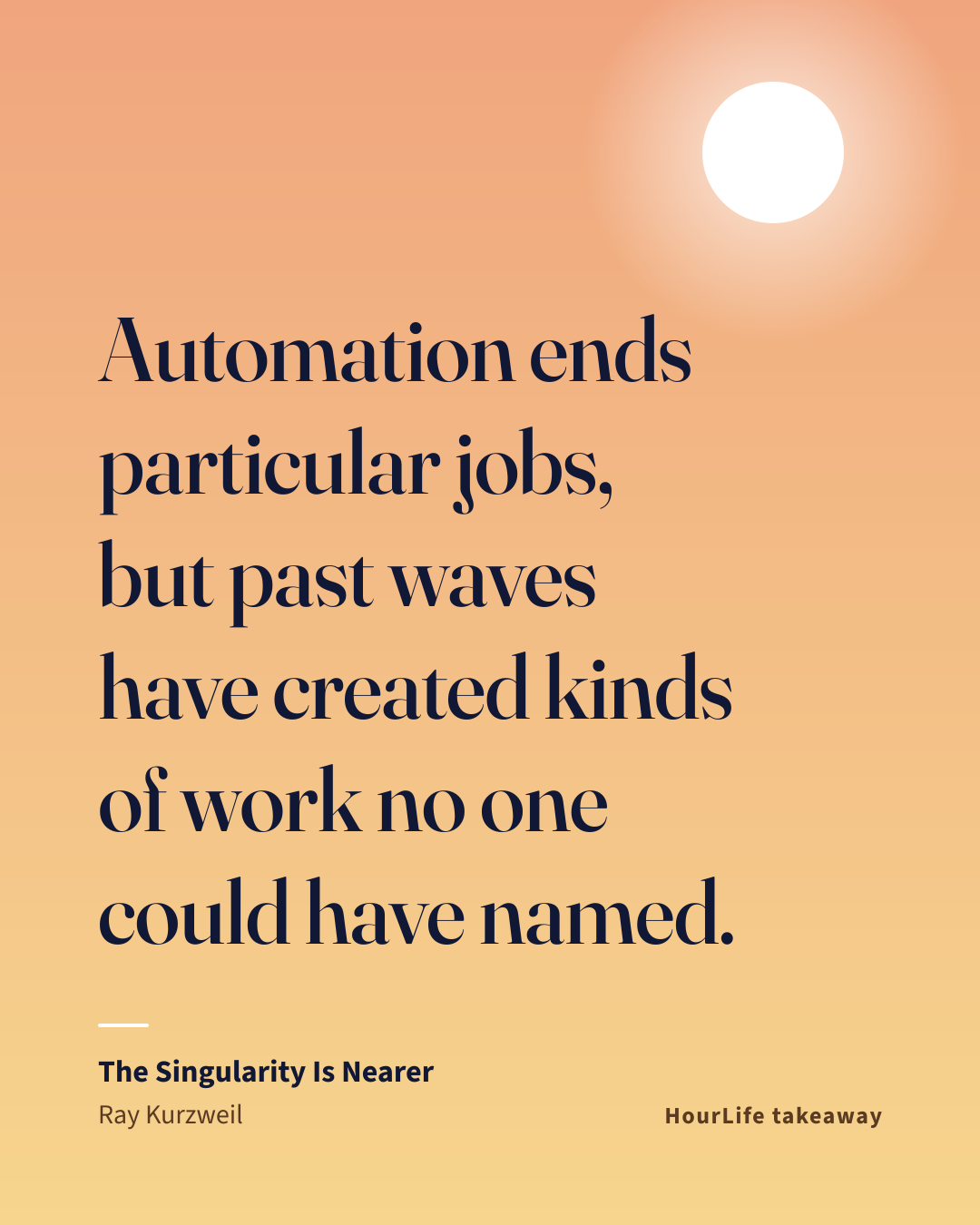
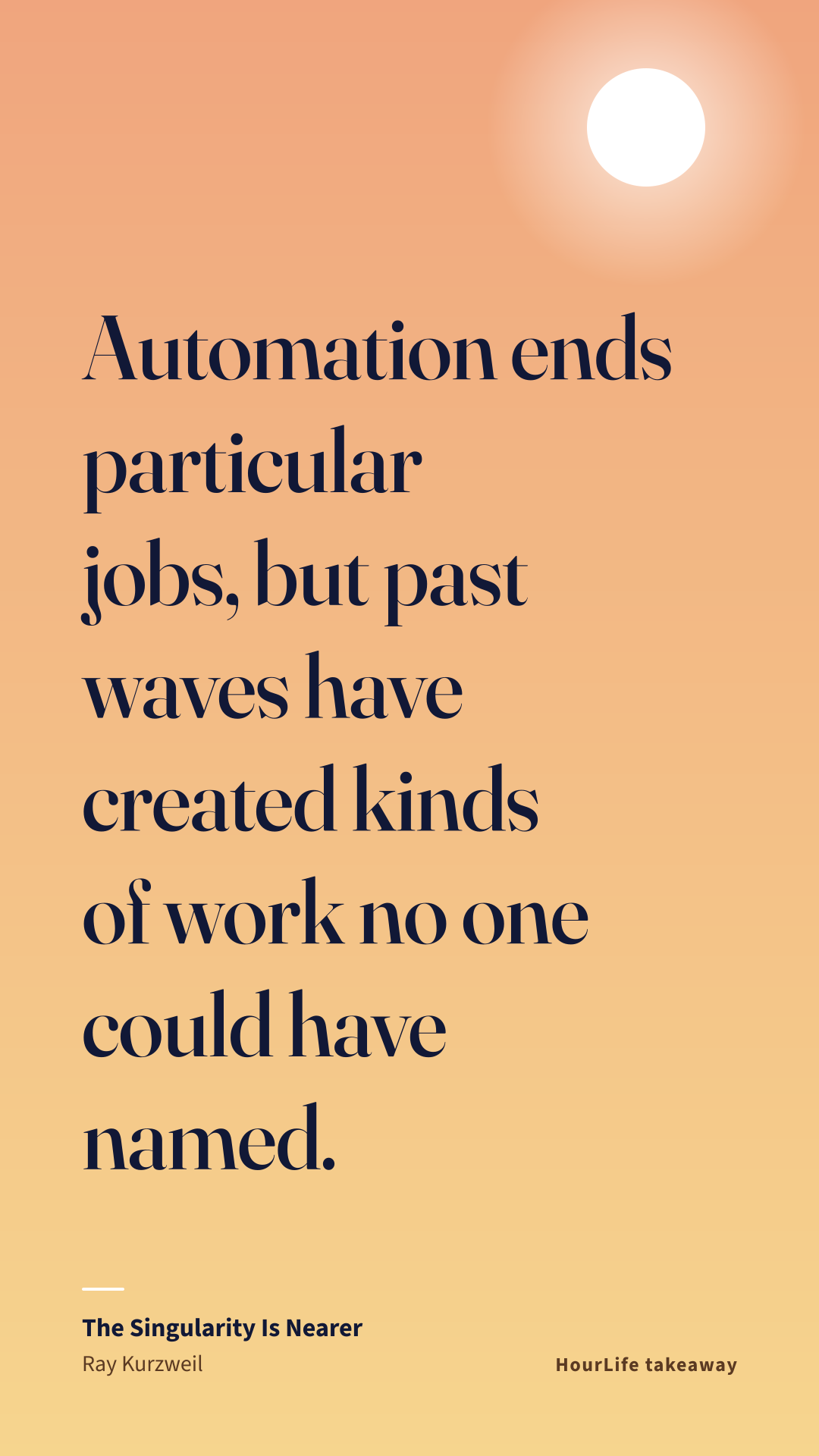
Automation ends particular jobs, but past waves have created kinds of work no one could have named.

The Singularity Is Nearer Ray Kurzweil HourLife takeaway

He points out that most people once worked on farms, and that many of today's jobs did not exist a few generations ago. He does not wave away the hard transition for people whose work disappears, and he expects the social safety net to grow as abundance does.

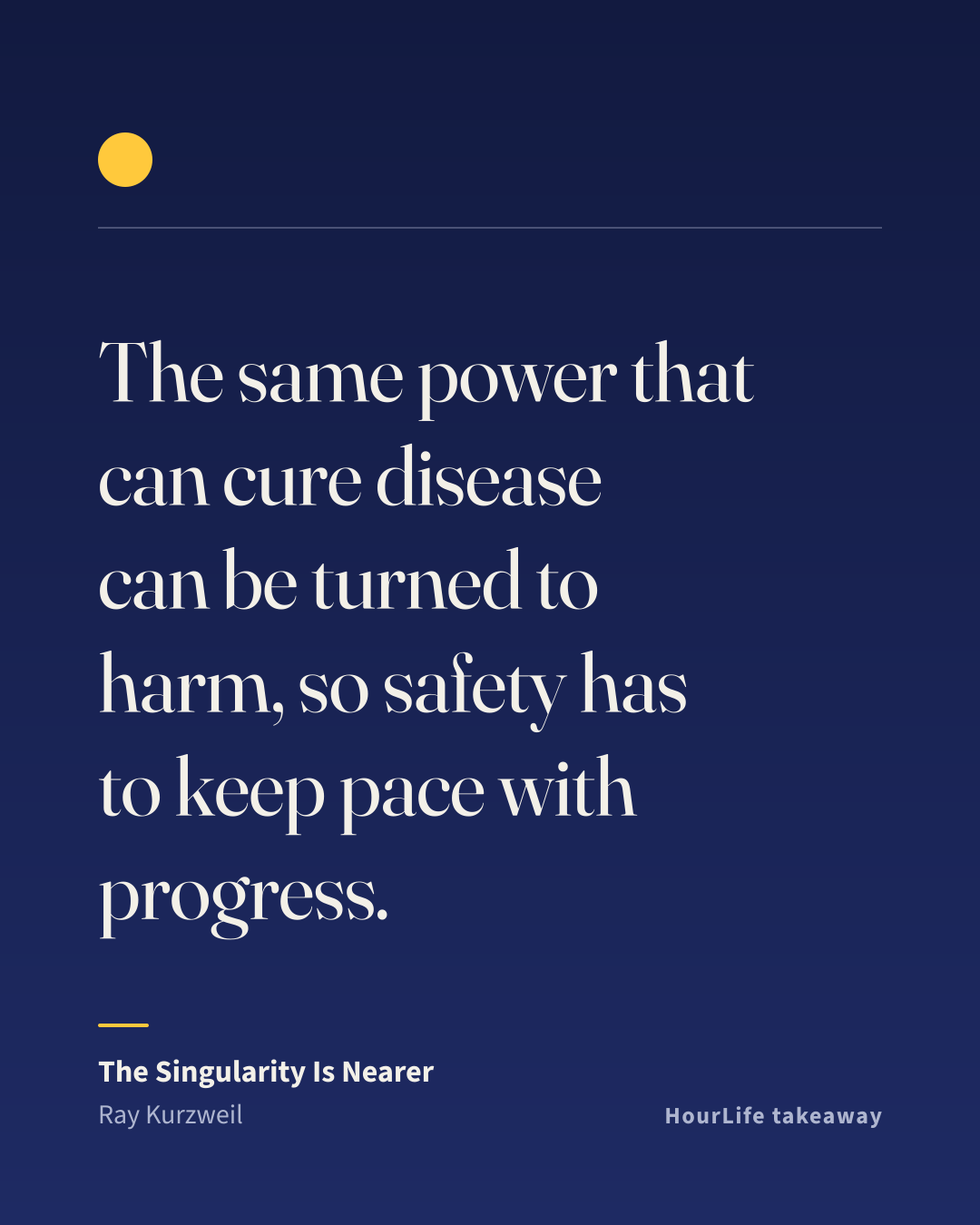
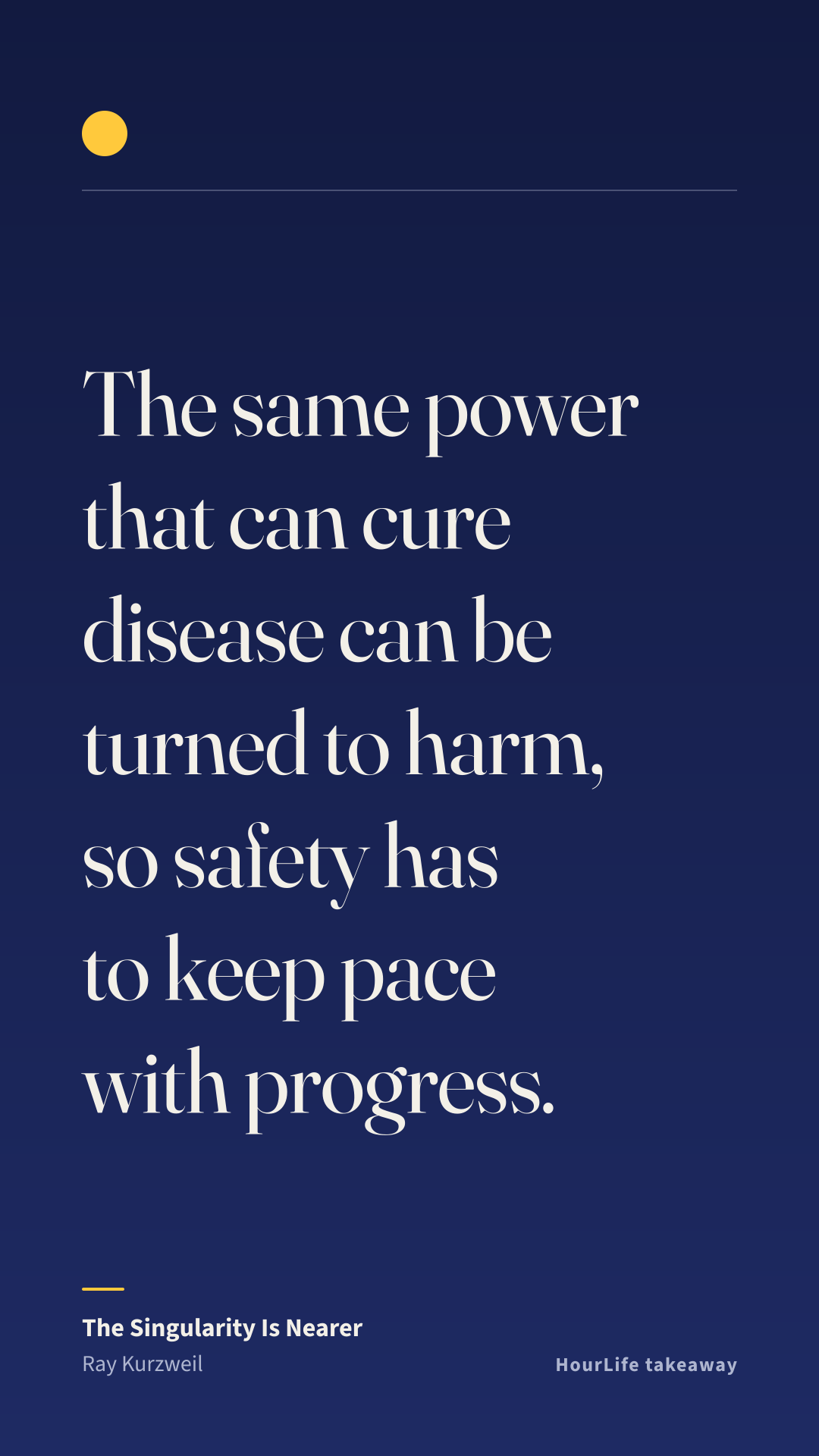
The same power that can cure disease can be turned to harm, so safety has to keep pace with progress.

The Singularity Is Nearer Ray Kurzweil HourLife takeaway

A chapter called Peril takes on the risks from nuclear weapons, biotechnology, nanotechnology and AI itself. He stays an optimist, but he argues for serious safety work rather than either stopping research or ignoring the danger. The book ends with a dialogue in which a sceptic, Cassandra, presses him on his case.

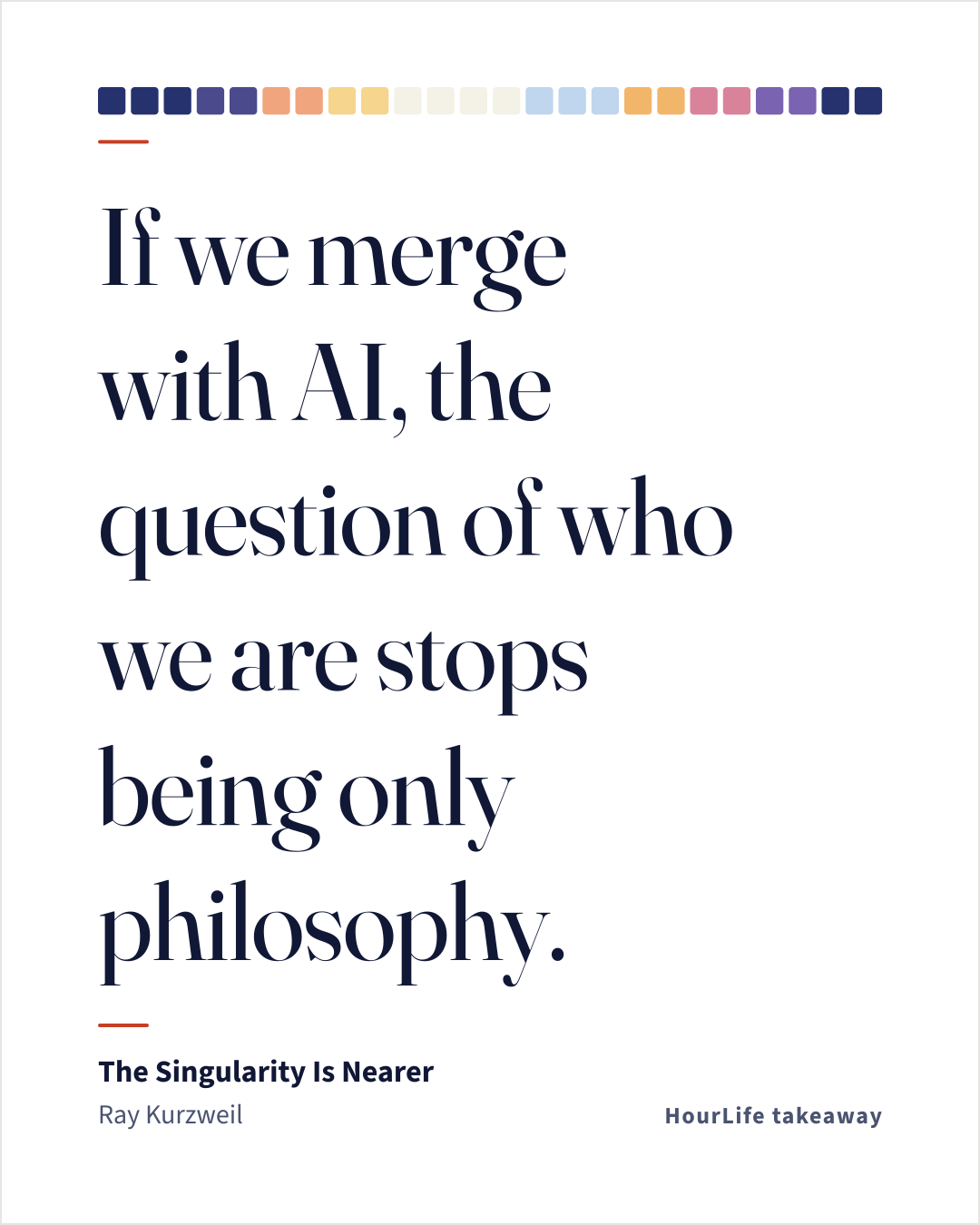
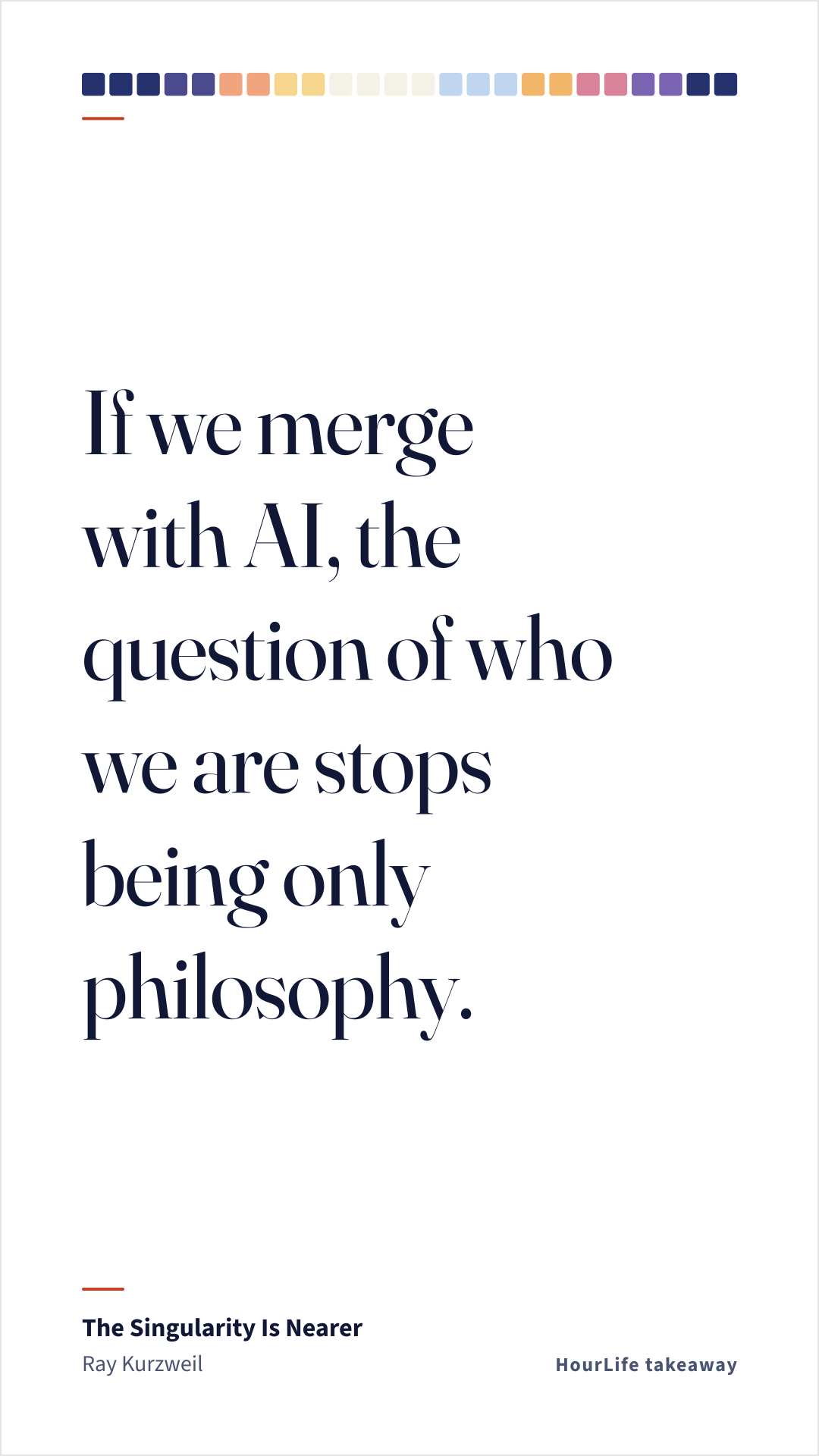
If we merge with AI, the question of who we are stops being only philosophy.

The Singularity Is Nearer Ray Kurzweil HourLife takeaway

In the chapter Who Am I? he asks what consciousness is, and whether a person who changes bit by bit, or a digital copy built from their records, is still the same person. He writes about an AI built from his late father's letters and writings. The science here is unsettled, and he says so.

Keep this going in the app.

HourLife turns these ideas into a daily system — goals, habits, focus, and reflection in one private place.