Keep this author quotes for later
Sign in to save

Shiya Ribowsky

The most-loved lines from Shiya Ribowsky, drawn from 1 book in the library.

Lines labelled “HourLife takeaway” are our wording of the book’s ideas and may paraphrase it. Only lines in quotation marks are the author’s own words, with where they appear. Check the book for exact wording before you quote it. Spot an error?

Most of a medical examiner’s work is not murder. It is the sudden, the lonely and the unexplained.

Dead Center Shiya Ribowsky HourLife takeaway

The cases in the book run from Bowery flophouses to Upper East Side apartments. An investigator is sent to any death that is sudden, unexpected, violent or unattended, and most of those turn out to have ordinary causes. The job is to find out which ones do not.


Real death investigation is slower, plainer and more careful than the television version.

Dead Center Shiya Ribowsky HourLife takeaway

Readers come to the book for the gap between the job and the crime drama. The investigator's work is mostly looking, asking and writing it down: the scene, the medical history, the people who knew the person. Ribowsky later advised television crime shows, so he knows both versions well.

A death certificate is only as good as the care of the person who filled it in.

Dead Center Shiya Ribowsky HourLife takeaway

Ribowsky is sceptical of causes of death written down without a real look at the case. A careless certificate can hide a crime, an accident or a pattern. Treat a cause of death that nobody investigated as a best guess, not a finding.

Careful death investigation is a way of protecting the living.

Dead Center Shiya Ribowsky HourLife takeaway

When an investigator notices that several deaths share a cause, the finding can point to a disease, a dangerous product or a hazard in the home. One death, looked at closely, can stop the next one. That is the public health side of the office that most people never see.

Getting a name right matters more than getting it fast.

Dead Center Shiya Ribowsky HourLife takeaway

After September 11, some remains were found with identification that belonged to someone else. A wrong match would mean telling one family their loved one was found, and another nothing. The office chose proof over speed, even when families were desperate for news.

In a disaster, the system you build in the first days decides what is possible for years.

Dead Center Shiya Ribowsky HourLife takeaway

The office had to invent a way to log every remain and every piece of information from families almost overnight, while the site was still burning. Because each item was catalogued with care, it could be checked again later as the science improved. The formal effort ran until 2005.

Families give the evidence that science needs to bring someone home.

Dead Center Shiya Ribowsky HourLife takeaway

Identification by DNA works only when there is something to compare against. The office collected samples and details from thousands of families and matched them to what was recovered. The people who were grieving were also the ones who made the names possible.

Every grieving family deserves the same care, whatever uniform their person wore.

Dead Center Shiya Ribowsky HourLife takeaway

The book describes how families of firefighters and police officers were sometimes treated differently from civilian families, and the hurt that caused. Ribowsky's work was to name everyone with the same rigour. Fairness to the grieving is part of the job, not an extra.

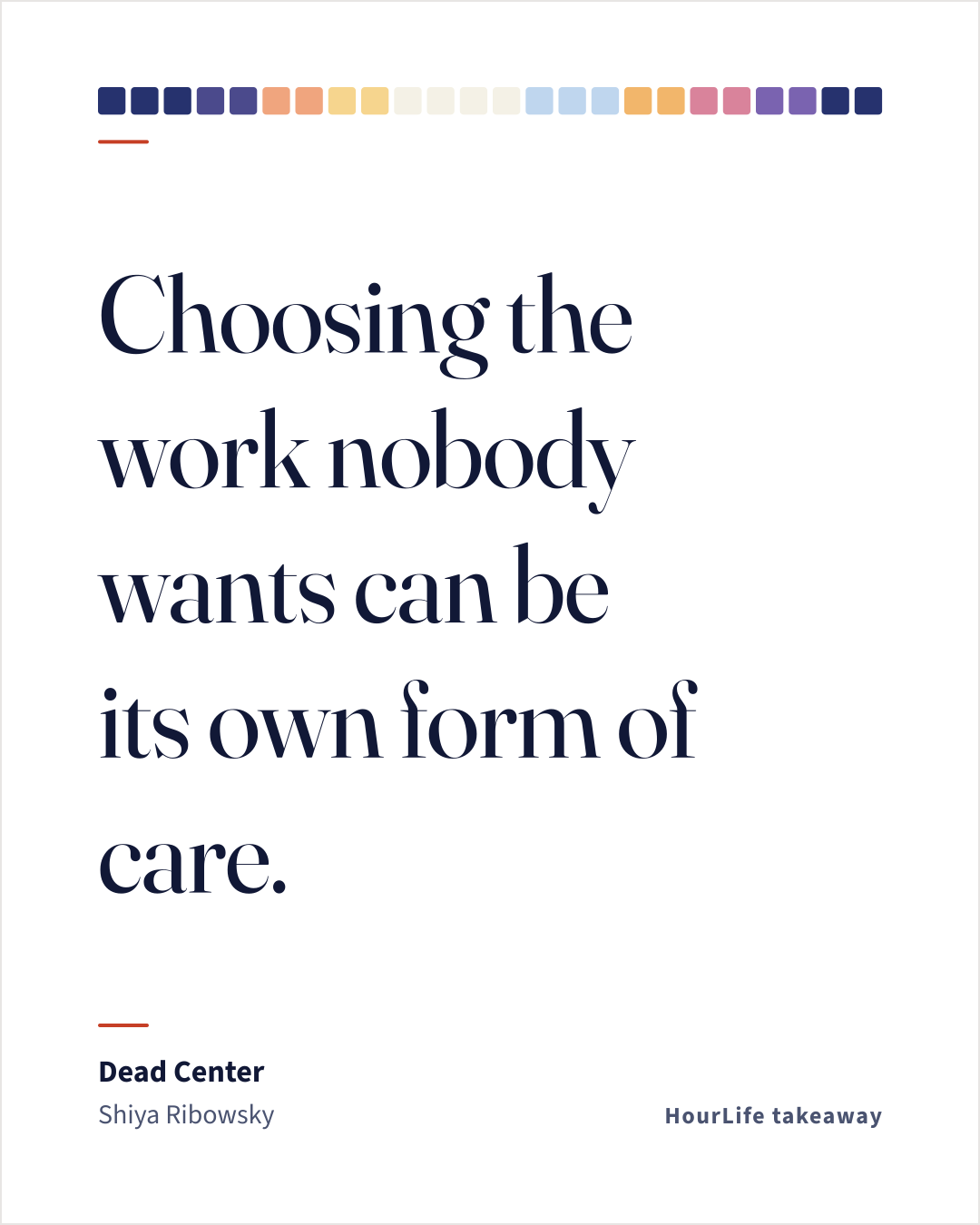
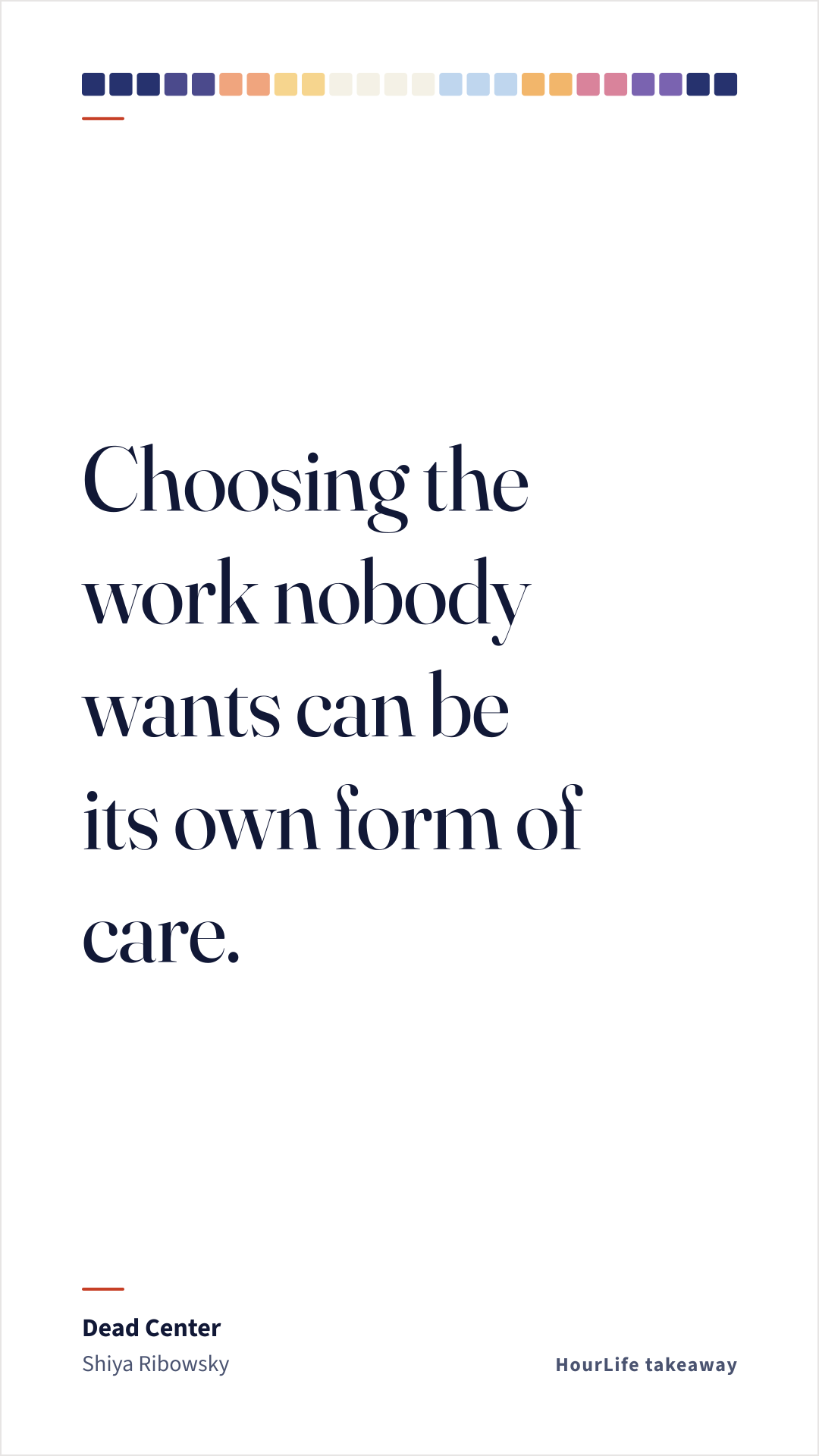
Choosing the work nobody wants can be its own form of care.

Dead Center Shiya Ribowsky HourLife takeaway

Ribowsky trained to treat the living as a physician assistant, then chose to work for the dead. The book is as much about his own path and choices as about the cases. It shows that this work is done by ordinary people who decided someone had to do it well.

Keep this going in the app.

HourLife turns these ideas into a daily system — goals, habits, focus, and reflection in one private place.