Keep this author quotes for later
Sign in to save

Siddhartha Mukherjee

The most-loved lines from Siddhartha Mukherjee, drawn from 2 books in the library.

Lines labelled “HourLife takeaway” are our wording of the book’s ideas and may paraphrase it. Only lines in quotation marks are the author’s own words, with where they appear. Check the book for exact wording before you quote it. Spot an error?

Cancer is not an invader from outside but our own cells, changed so they keep dividing.

The Emperor of All Maladies Siddhartha Mukherjee HourLife takeaway

This is the idea the whole book turns on. Cancer cells use the same machinery as healthy ones, which is why it has been so hard to kill them without harming the body around them. It also explains why the disease can adapt to treatment.


To understand an illness, find the cell that has gone wrong.

The Song of the Cell Siddhartha Mukherjee HourLife takeaway

This is the shift the book is built on. For centuries doctors explained disease through humours or whole organs. Rudolf Virchow's cellular pathology in the 1850s moved the question down to the cell, and most of modern medicine still starts there.

Cancer is many diseases that share one name, so a single cure was never likely.

The Emperor of All Maladies Siddhartha Mukherjee HourLife takeaway

Early campaigners hoped for one breakthrough that would end cancer, the way a vaccine ends an infection. The book shows leukaemia, breast cancer, lung cancer and others behaving very differently, each yielding to different tools and at a different pace.

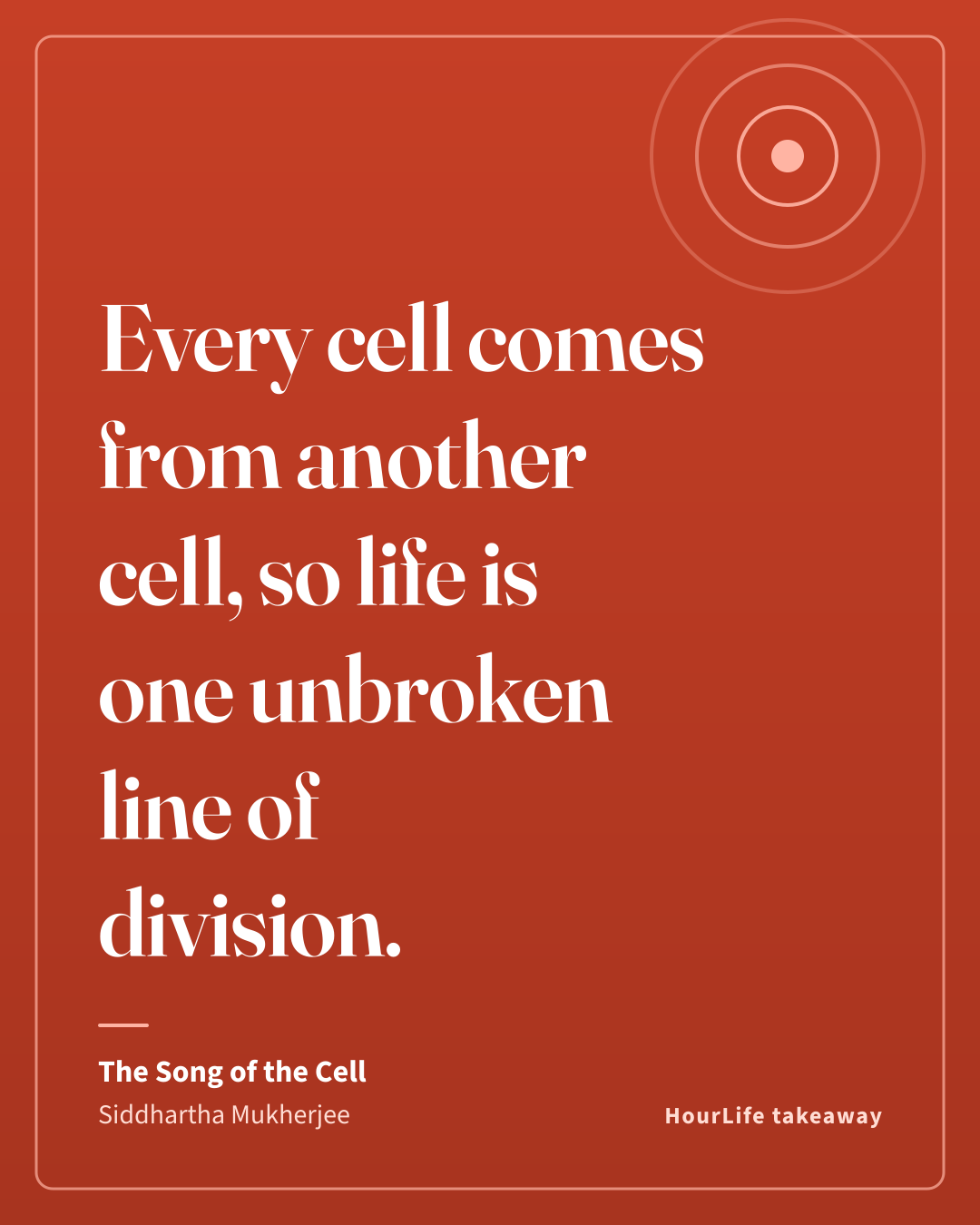
Every cell comes from another cell, so life is one unbroken line of division.

The Song of the Cell Siddhartha Mukherjee HourLife takeaway

Matthias Schleiden and Theodor Schwann argued in the late 1830s that plants and animals are made of cells, but Schwann thought new cells could form out of fluid. Virchow and others showed that cells only arise by dividing. The Latin phrase that sums it up, omnis cellula e cellula, became a founding rule of biology.

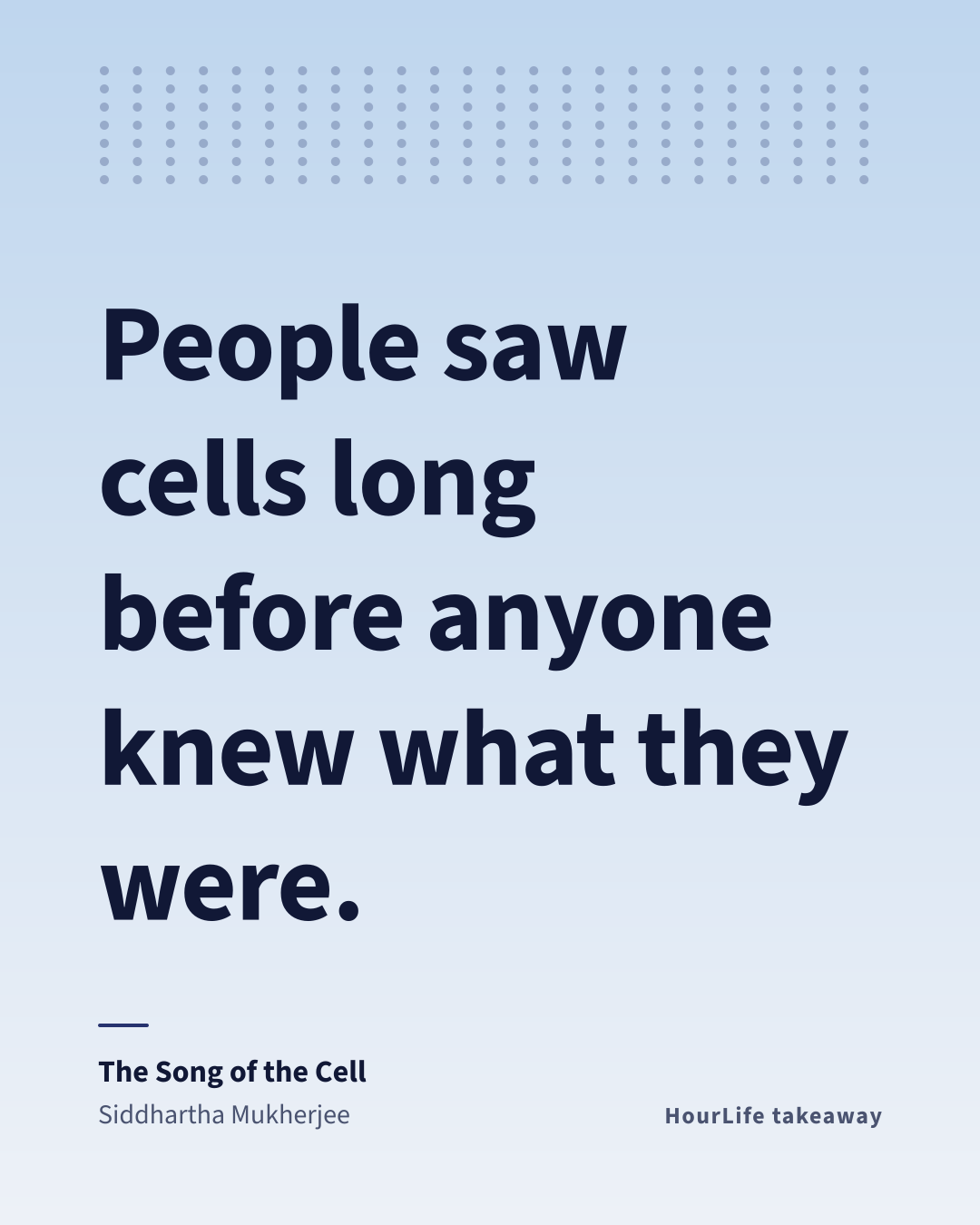
People saw cells long before anyone knew what they were.

The Song of the Cell Siddhartha Mukherjee HourLife takeaway

In 1665 Robert Hooke looked at a slice of cork and named its little boxes cells. In the 1670s Antonie van Leeuwenhoek, a cloth merchant in Delft with hand-made lenses, saw living creatures in a drop of water. It took nearly two centuries to turn those sightings into a theory.

Cutting more did not save more lives, and it took a trial to prove it.
The Emperor of All Maladies Siddhartha Mukherjee HourLife takeaway

William Halsted's radical mastectomy removed more and more tissue on the belief that cancer spread outward from one centre. For decades surgeons trusted the logic rather than testing it. A controlled trial led by Bernard Fisher later showed that less extensive surgery did as well for many women.

The first chemical remissions came in children with leukaemia, and they did not last.

The Emperor of All Maladies Siddhartha Mukherjee HourLife takeaway

In 1948 Sidney Farber in Boston reported that aminopterin, a drug that blocks folic acid, could push acute leukaemia in children into remission. The cancer came back within months. Brief as they were, those remissions showed that a drug could make cancer retreat.

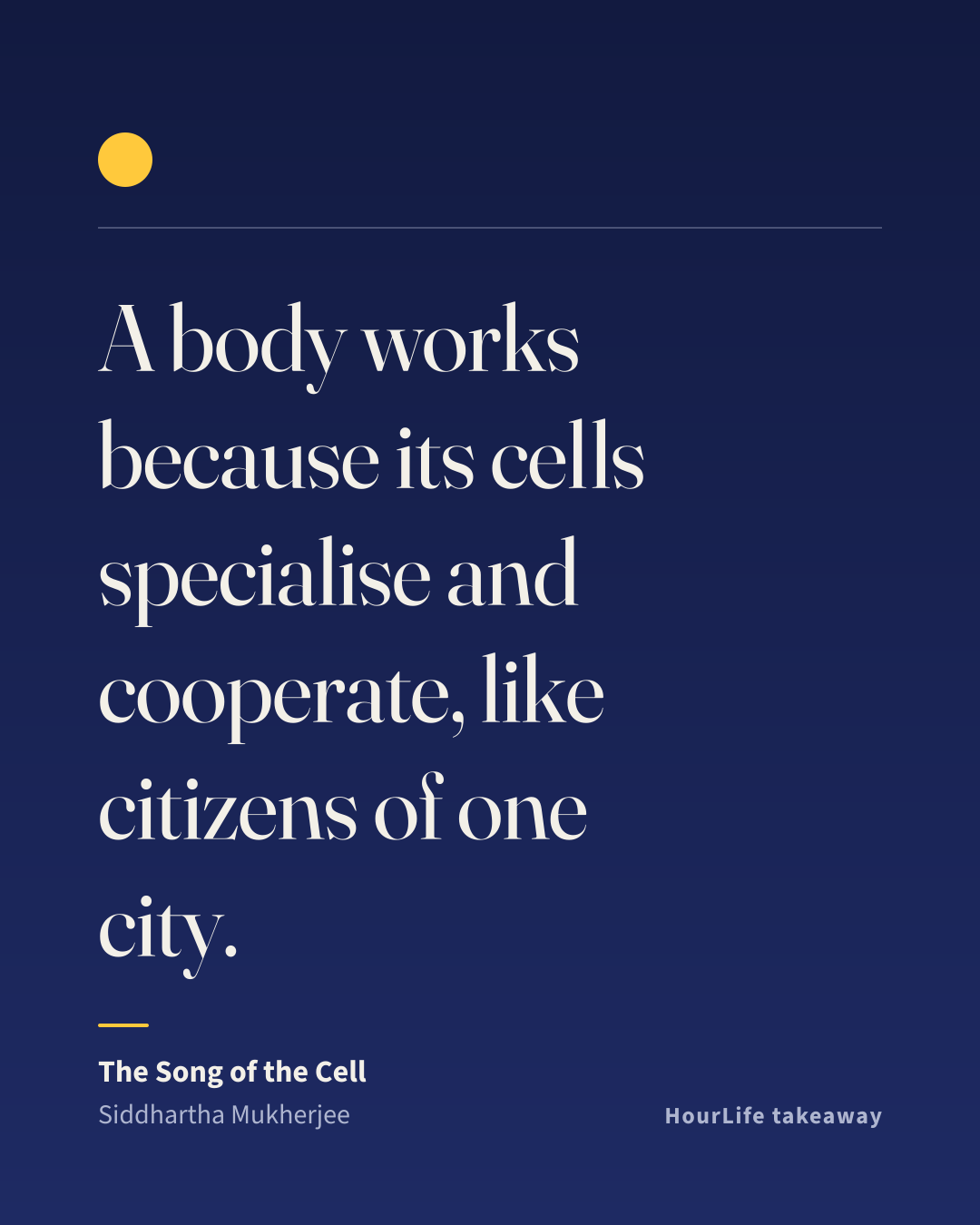
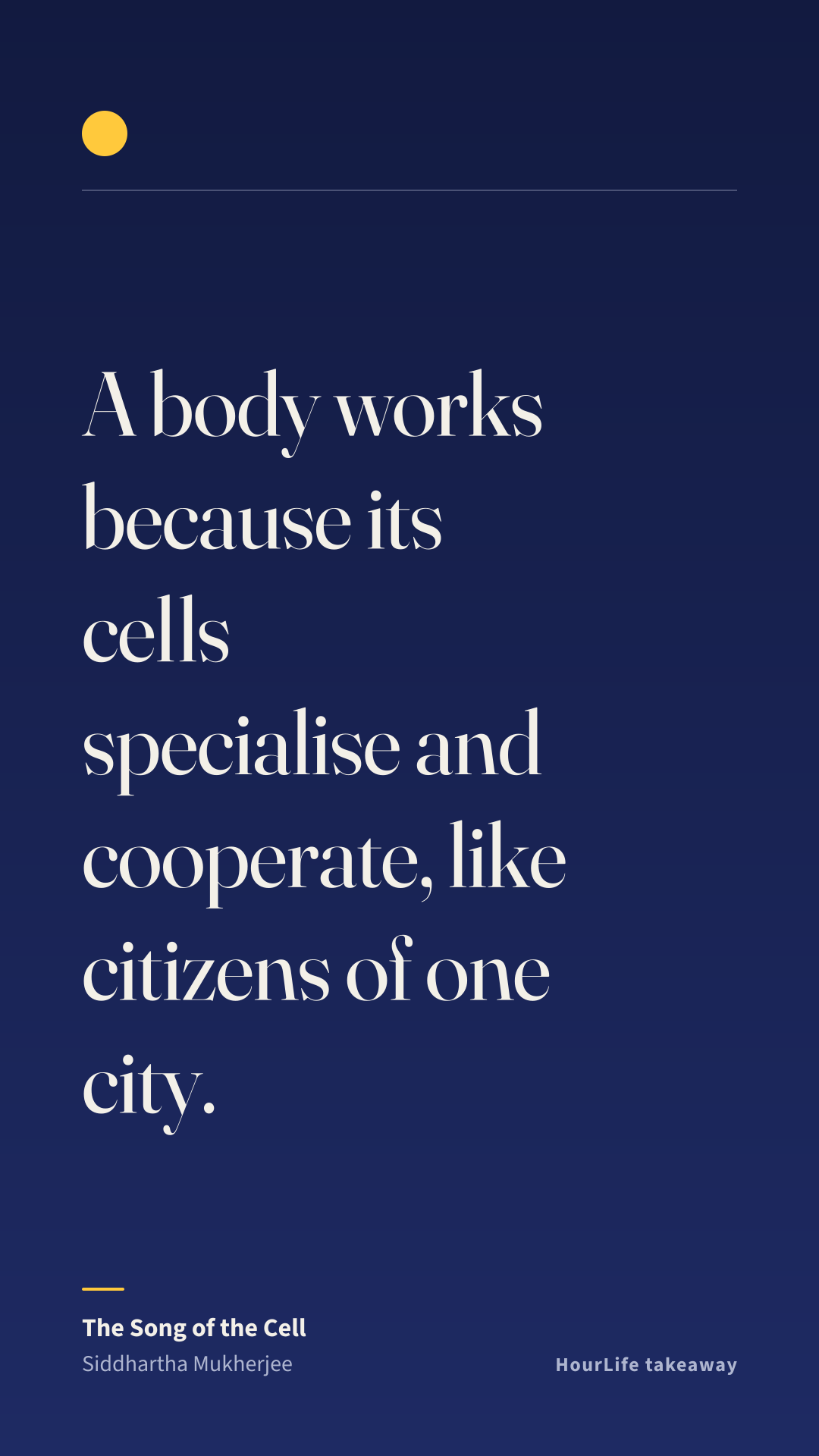
A body works because its cells specialise and cooperate, like citizens of one city.

The Song of the Cell Siddhartha Mukherjee HourLife takeaway

Blood cells carry, guard and repair. Neurons signal. Cells in the pancreas keep sugar in balance. Each does one job for the good of the whole, and the book reads cancer as a citizen that stops cooperating and serves only itself.

Drugs given together worked where single drugs failed, because cancer adapts.

The Emperor of All Maladies Siddhartha Mukherjee HourLife takeaway

At the National Cancer Institute in the 1960s, Emil Frei and Emil Freireich combined several drugs against childhood leukaemia so that cells resistant to one would be caught by another. Combination treatment helped make childhood leukaemia and Hodgkin's lymphoma among the first cancers that many patients survived.

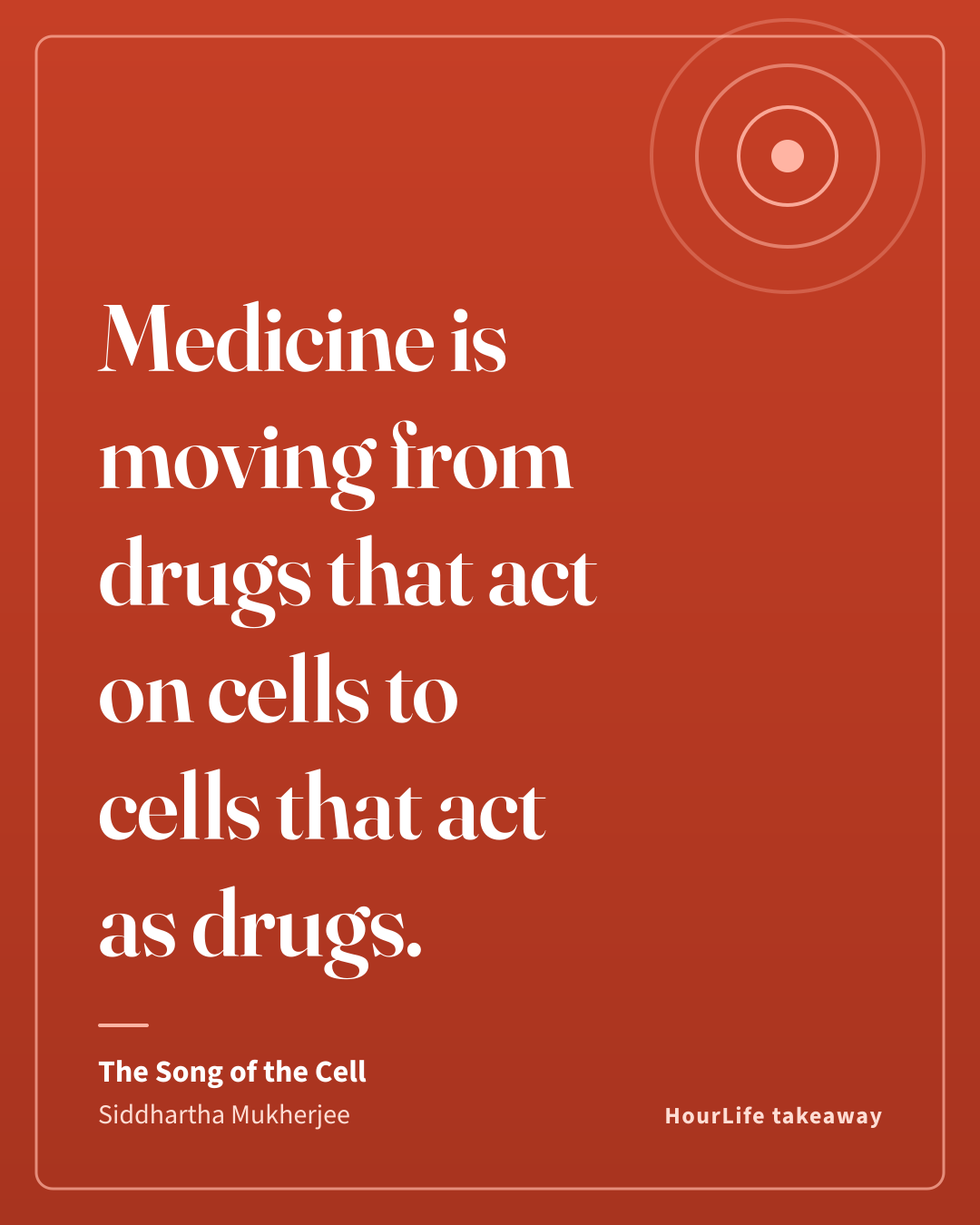
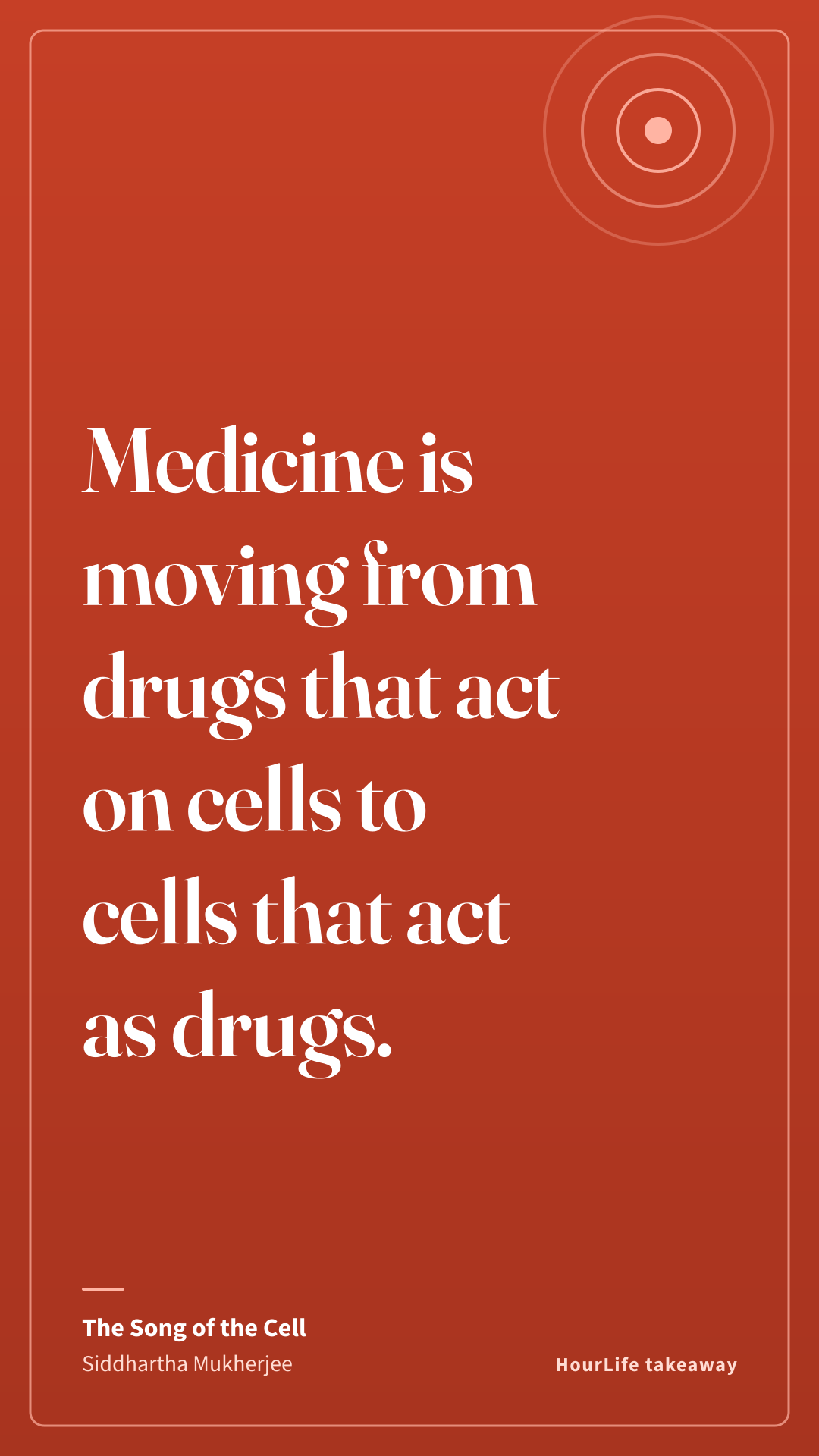
Medicine is moving from drugs that act on cells to cells that act as drugs.

The Song of the Cell Siddhartha Mukherjee HourLife takeaway

In 2012 Emily Whitehead, a young girl with leukaemia that had returned after treatment, became one of the first children given CAR-T therapy: her own T cells, engineered to find and attack her cancer. She went into remission and stayed there. Her case is one of the book's central stories.

An immune system has to tell self from other, and its mistakes run both ways.

The Song of the Cell Siddhartha Mukherjee HourLife takeaway

Too little defence lets infection in; too much turns the body's guards against itself. The book follows neutrophils, T cells and the Covid pandemic. In severe Covid, much of the harm came from an immune response that would not stand down.

Preventing a cause can save more lives than any cure, and tobacco is the proof.

The Emperor of All Maladies Siddhartha Mukherjee HourLife takeaway

In 1950, studies by Richard Doll and Austin Bradford Hill in Britain and by Ernst Wynder and Evarts Graham in the United States linked smoking to lung cancer. The book follows the long fight that came after, as the tobacco industry spent decades casting doubt on the evidence.

The brain thinks with separate cells joined in networks, not one continuous web.

The Song of the Cell Siddhartha Mukherjee HourLife takeaway

Around 1890 Santiago Ramón y Cajal, using a stain developed by Camillo Golgi, argued that the nervous system is made of distinct cells that meet at gaps. Golgi disagreed, and the two shared the Nobel Prize in 1906. Cajal's view, the neuron doctrine, won out.

A confident theory is not a result until it has been tested against the alternative.

The Emperor of All Maladies Siddhartha Mukherjee HourLife takeaway

The book returns to this lesson again and again: the radical mastectomy, the early hopes for a single cure, and the high-dose chemotherapy with bone marrow transplants given for breast cancer in the 1990s, which trials later found did not help. Randomised trials are how medicine tells hope from benefit.

Every new power over cells needs trust, consent and open rules.

The Song of the Cell Siddhartha Mukherjee HourLife takeaway

In vitro fertilisation was attacked as unnatural before Louise Brown's birth in 1978 and is now routine. In 2018 He Jiankui announced twin girls whose embryos he had gene-edited in secret, and was later jailed in China. The book sets the two side by side to ask how a new technology earns a society's trust.

Public pressure and money changed how fast cancer research moved.

The Emperor of All Maladies Siddhartha Mukherjee HourLife takeaway

Mary Lasker, a New York philanthropist, built a campaign that pushed cancer research up the national agenda and helped bring about the National Cancer Act of 1971. Mukherjee shows both sides: the energy and funding it brought, and the promise of a quick victory that the science of the time could not keep.

Once you know which gene is broken, you can build a drug aimed at it.

The Emperor of All Maladies Siddhartha Mukherjee HourLife takeaway

Chronic myeloid leukaemia is driven by a fused gene created when two chromosomes swap pieces. Imatinib, sold as Gleevec, blocks the protein that gene makes, and Brian Druker's trials around 2000 showed striking responses. Mukherjee also notes that cancers can find ways around even a targeted drug.

The new human is already among us, one rebuilt cell at a time.

The Song of the Cell Siddhartha Mukherjee HourLife takeaway

People alive after a bone marrow transplant, children born by IVF and patients living with engineered T cells are all bodies changed at the level of the cell. Mukherjee asks readers to welcome these advances while still questioning them, and reminds us how much of the cells' signalling we do not yet understand.

Keep this going in the app.

HourLife turns these ideas into a daily system — goals, habits, focus, and reflection in one private place.