Keep this author quotes for later
Sign in to save

Tim Marshall

The most-loved lines from Tim Marshall, drawn from 1 book in the library.

Lines labelled “HourLife takeaway” are our wording of the book’s ideas and may paraphrase it. Only lines in quotation marks are the author’s own words, with where they appear. Check the book for exact wording before you quote it. Spot an error?

Mountains, rivers, seas and plains set the limits inside which every leader has to choose.

Prisoners of Geography Tim Marshall HourLife takeaway

This is the book's starting point. Leaders are not free to do anything they like, because the land decides what is cheap, what is costly and what is close to impossible. Marshall does not claim geography decides everything, but he argues it is the factor most often left out of the news.


Russia looks west across a wide, flat plain and sees an open door.

Prisoners of Geography Tim Marshall HourLife takeaway

The North European Plain runs from France to the Urals, and armies have crossed it into Russia more than once, including Napoleon's in 1812 and Germany's in the twentieth century. Marshall argues that this is why Moscow wants the narrow stretch around Poland to be friendly or neutral: a short front is easier to defend than a wide one.

A great power without a port that stays free of ice will keep looking for one.

Prisoners of Geography Tim Marshall HourLife takeaway

Russia's northern ports freeze for much of the year, and Vladivostok in the far east for part of it. Its warm-water fleet is based at Sevastopol in Crimea, yet ships leaving the Black Sea must pass through the Bosphorus, which Turkey controls. Marshall reads Russia's moves in Crimea in 2014 largely through this need.

China’s crowded heartland is guarded by the wide, thinly peopled regions around it.

Prisoners of Geography Tim Marshall HourLife takeaway

Most Chinese people live on the plains of the east, watered by the Yellow River and the Yangtze. Tibet, Xinjiang, Inner Mongolia and Manchuria ring that core, and Marshall argues that holding them keeps any rival far from it. Tibet matters twice over: the Himalayas keep India at a distance, and great rivers rise on its plateau.

The United States drew a winning hand: two oceans, weak neighbours and rivers that carry its harvest to the sea.

Prisoners of Geography Tim Marshall HourLife takeaway

Marshall describes the Mississippi basin as a network of navigable rivers that moves goods cheaply to the Gulf of Mexico. The Louisiana Purchase of 1803 brought that basin under American control. With oceans to the east and west and no rival power on its borders, the country could grow without fear of invasion by land.

Africa’s great rivers carry water more easily than they carry trade.

Prisoners of Geography Tim Marshall HourLife takeaway

Many of the continent's largest rivers are broken by waterfalls and rapids, so boats cannot run far inland, and the smooth coastline has few deep natural harbours. The Sahara cut much of the continent off from the Mediterranean world. Marshall is clear that this is a story about terrain, not about the people who live on it.

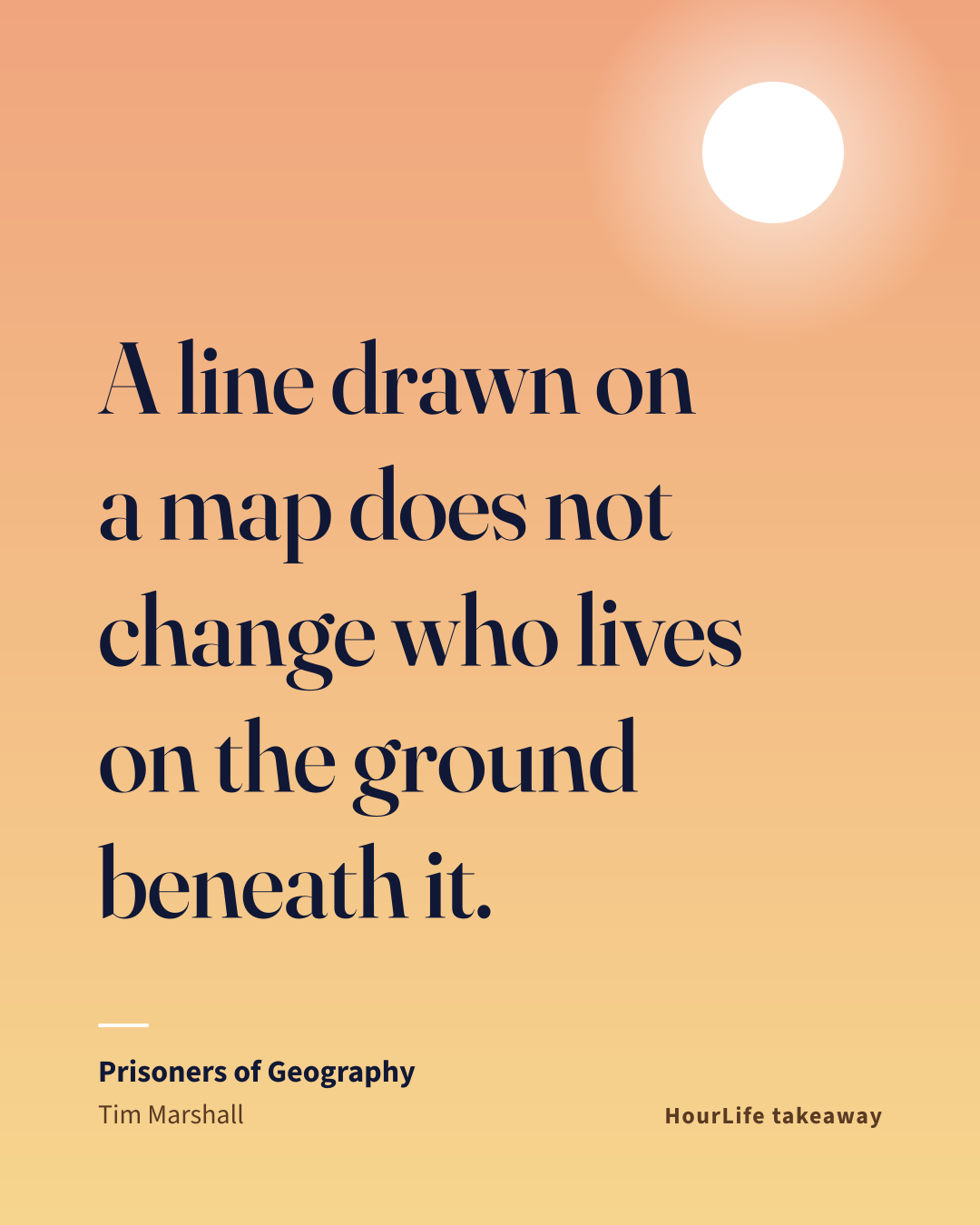
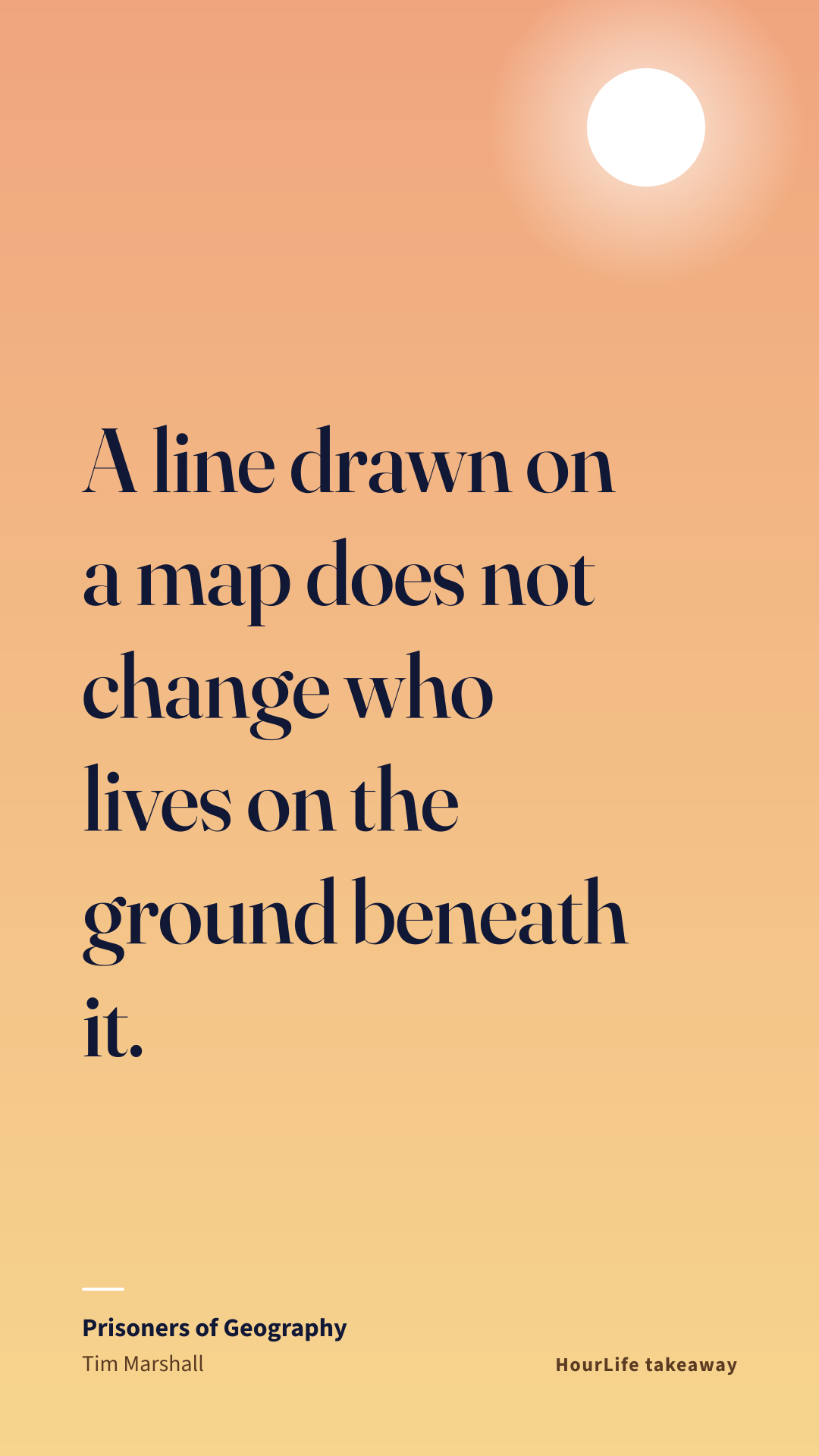
A line drawn on a map does not change who lives on the ground beneath it.

Prisoners of Geography Tim Marshall HourLife takeaway

In the Middle East and in Africa, many borders were drawn by European powers with little regard for where peoples, faiths and tribes actually lived. The Sykes-Picot agreement of 1916 between Britain and France is Marshall's best-known example. He argues that many later conflicts grew from states whose borders made little sense to the people inside them.

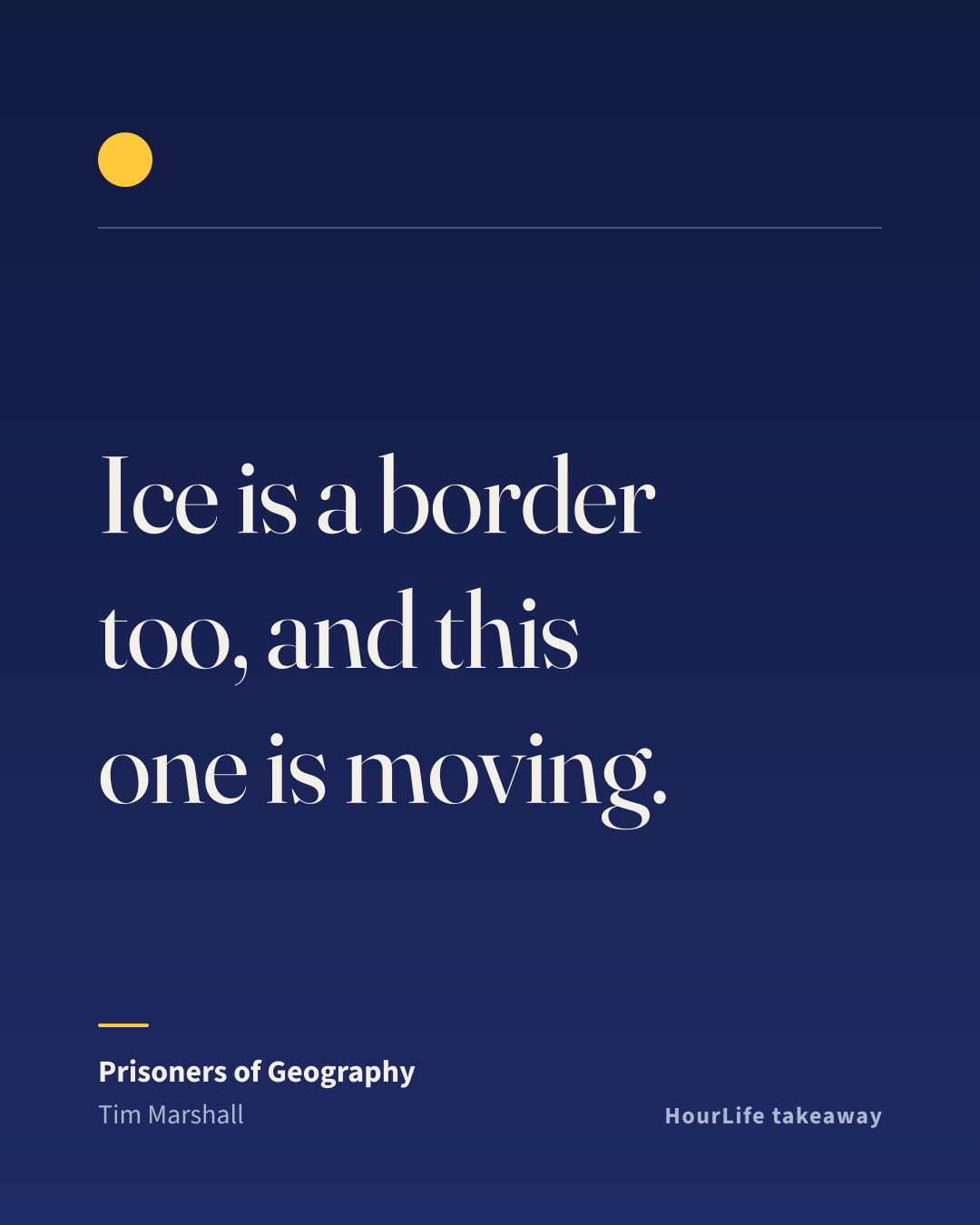
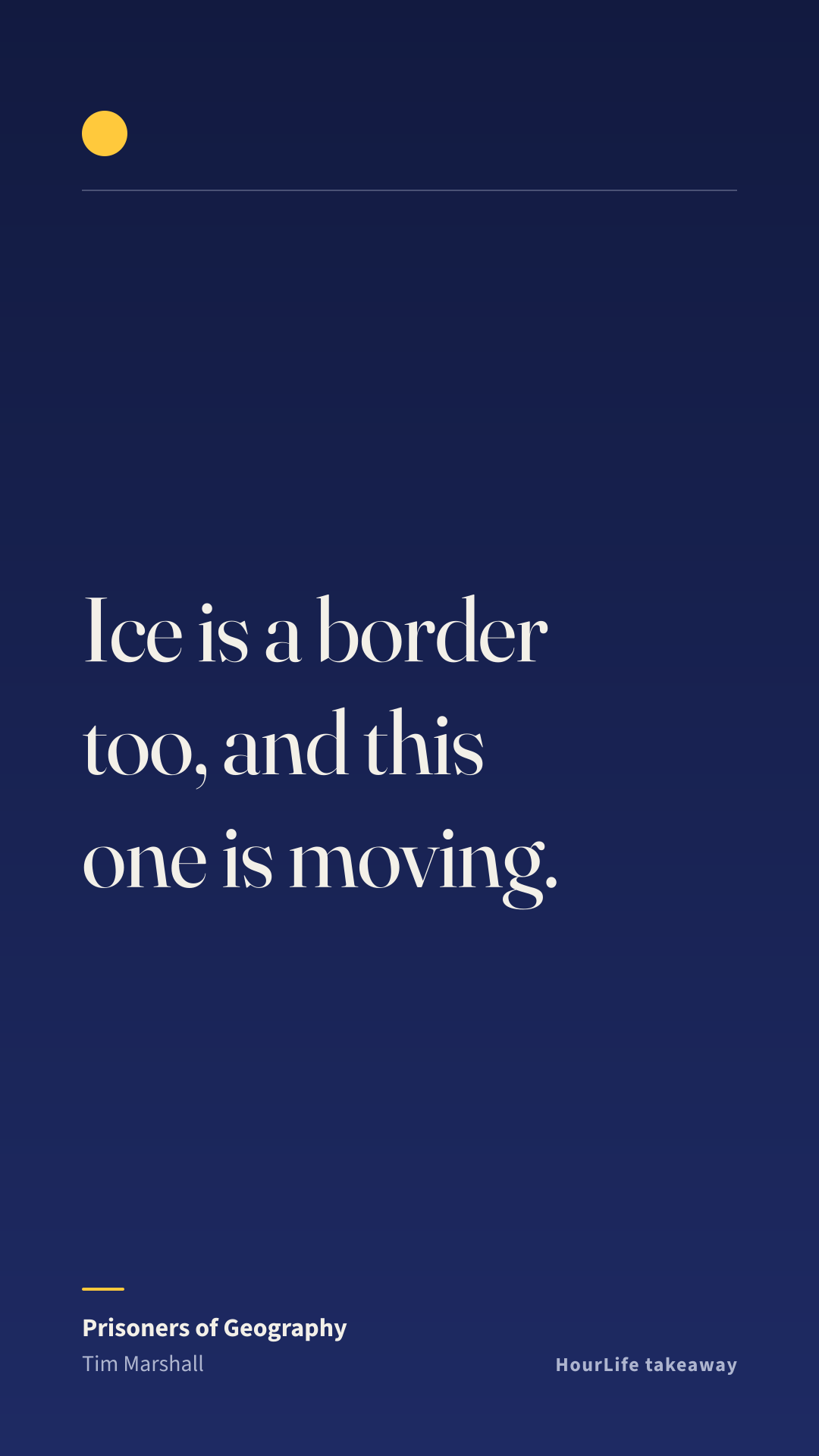
Ice is a border too, and this one is moving.

Prisoners of Geography Tim Marshall HourLife takeaway

As the Arctic's summer sea ice retreats, shipping routes along the top of Russia and through Canada's islands open for longer, and the seabed becomes easier to reach. The countries with Arctic coastlines have made claims that overlap. Marshall treats the Arctic as the place where geography is changing fastest.

Geography sets the limits, but people still choose within them.

Prisoners of Geography Tim Marshall HourLife takeaway

Marshall accepts that technology, ideas and individual leaders matter. Aircraft fly over mountains and the internet ignores rivers. His point is that the old constraints have been softened, not removed, so anyone trying to understand a country should start with its map rather than end there.

Keep this going in the app.

HourLife turns these ideas into a daily system — goals, habits, focus, and reflection in one private place.