Keep this book quotes for later
Sign in to save

The Explosive Child

8 memorable lines from The Explosive Child by Ross W. Greene, each with the idea behind it.

As an Amazon Associate, HourLife earns from qualifying purchases.

Lines labelled “HourLife takeaway” are our wording of the book’s ideas and may paraphrase it. Only lines in quotation marks are the author’s own words, with where they appear. Check the book for exact wording before you quote it. Spot an error?

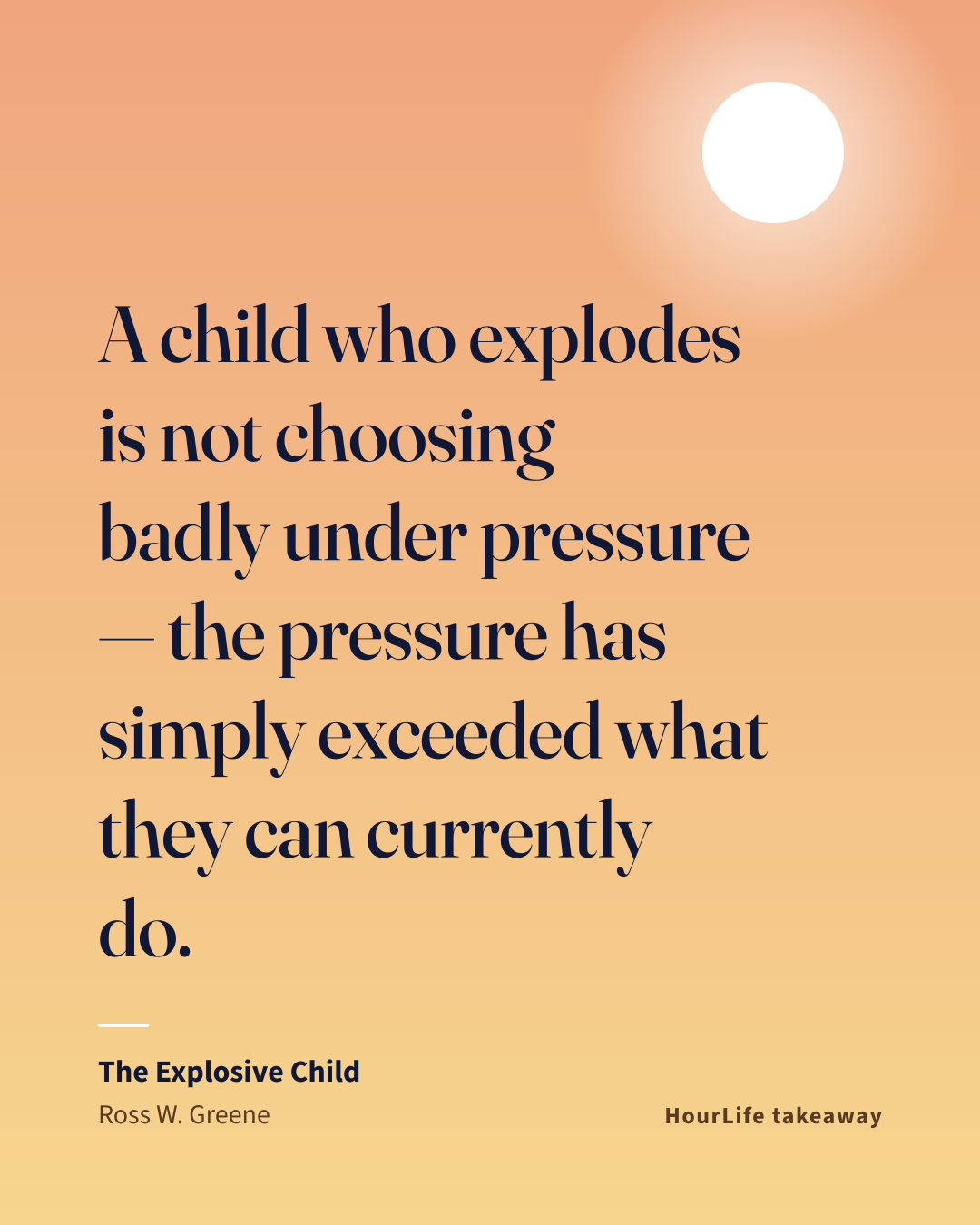
A child who explodes is not choosing badly under pressure — the pressure has simply exceeded what they can currently do.

The Explosive Child Ross W. Greene HourLife takeaway

Greene's own formulation is that challenging behaviour occurs when the demands being placed on a child outstrip the skills they have to respond adaptively. Read that way, an outburst is not a verdict on character. It is a reading on a gauge, and it tells you the demand went past the capacity — nothing more and nothing less.


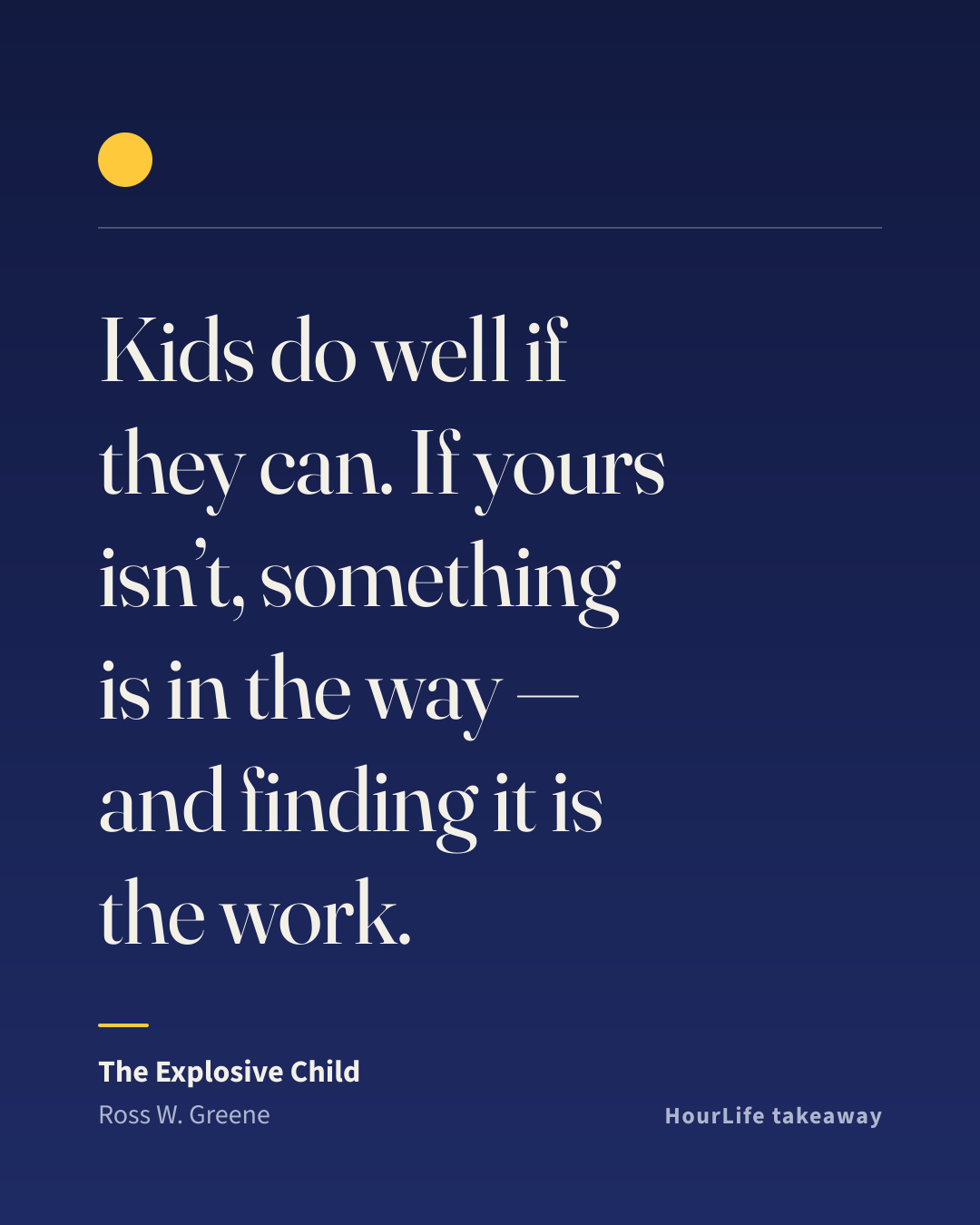
Kids do well if they can. If yours isn’t, something is in the way — and finding it is the work.

The Explosive Child Ross W. Greene HourLife takeaway

The competing belief, the one most discipline is built on, is that kids do well if they want to. That belief makes motivation the missing ingredient, which makes rewards and punishments the obvious tools. Greene's version makes skill the missing ingredient, and nothing you can offer or withhold installs a skill.

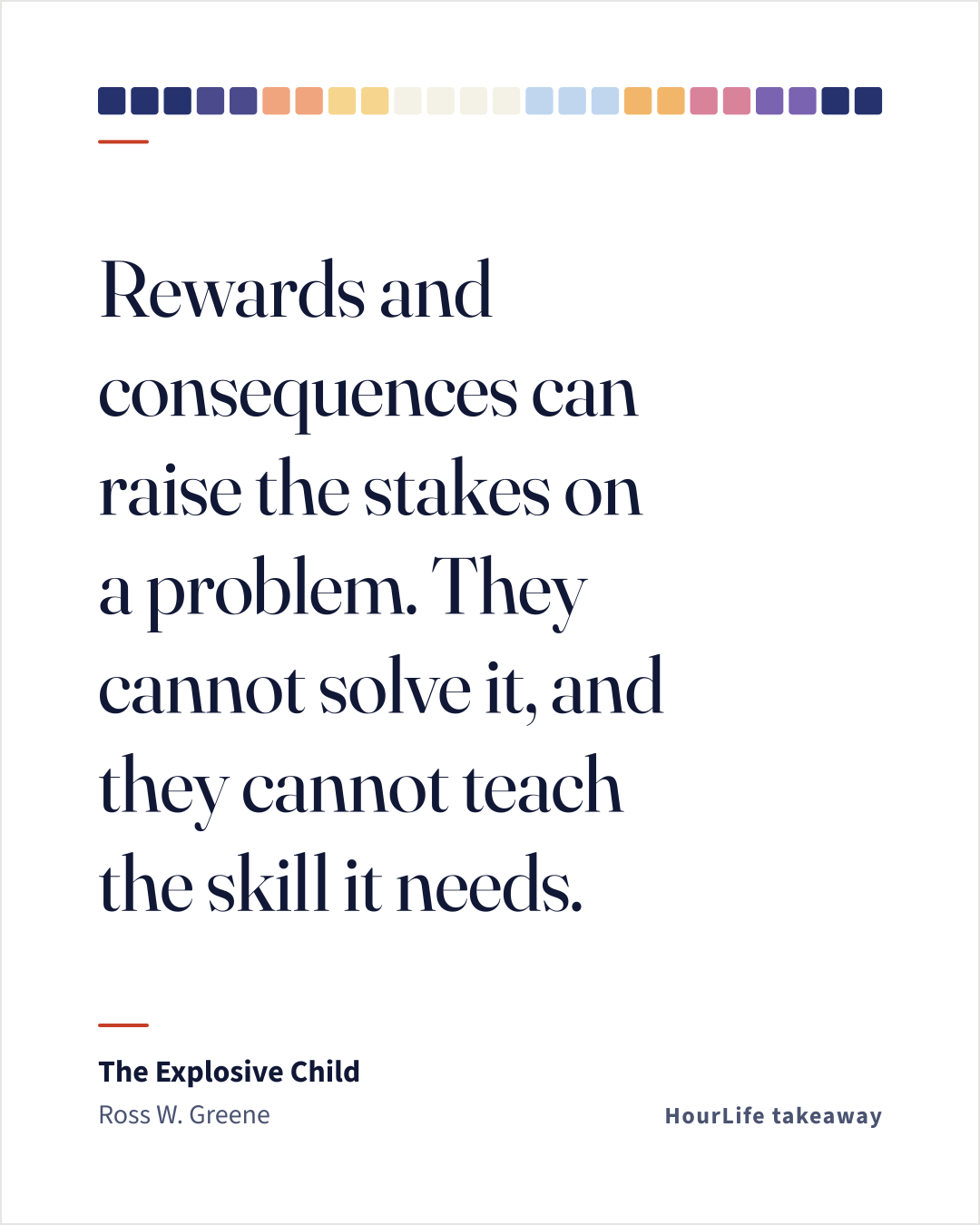
Rewards and consequences can raise the stakes on a problem. They cannot solve it, and they cannot teach the skill it needs.

The Explosive Child Ross W. Greene HourLife takeaway

The sticker chart assumes the child already knows how and just isn't bothering. If that were true it would have worked by the second week. When it doesn't work, the honest conclusion is not that the incentive was too small.

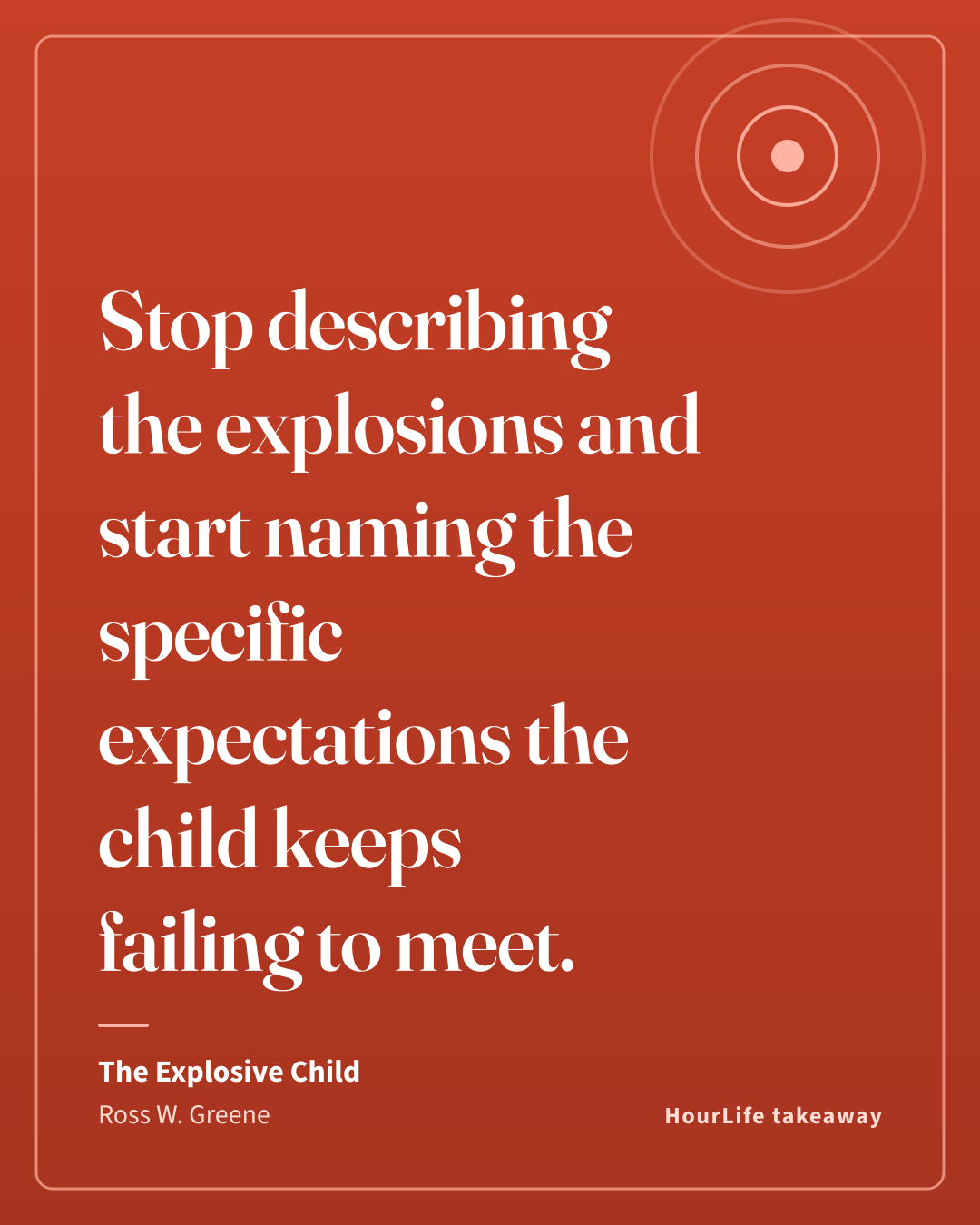
Stop describing the explosions and start naming the specific expectations the child keeps failing to meet.

The Explosive Child Ross W. Greene HourLife takeaway

Greene calls these unsolved problems, and the rules for writing one are strict: no mention of the behaviour, no theory about why, split into pieces rather than clumped, and as specific as you can make it. Most start with the word difficulty followed by a verb — difficulty coming to the table when dinner is ready. It looks small. That is the point.

There are only three things you can do about any expectation: impose it, solve it together, or set it aside for now.

The Explosive Child Ross W. Greene HourLife takeaway

Plan A imposes your solution. Plan C drops the expectation, at least for the moment. Plan B solves the problem with the child. Plan C is not surrender — it is triage, and without it you are working on nineteen problems at once and finishing none of them.

You cannot solve a problem you only half understand, and the half you are missing is the child’s.

The Explosive Child Ross W. Greene HourLife takeaway

The first step of Plan B is nothing but gathering that half: ask what makes the thing hard, then keep asking until you actually know. Greene's phrase for the discipline it takes is drilling, not grilling. Most parents skip this step because they are certain they already know the answer, and most of the time they are wrong.

The middle of an explosion is the worst possible time to solve anything — and the most predictable moment you have.

The Explosive Child Ross W. Greene HourLife takeaway

Almost every episode is triggered by a problem that has been going off for weeks. That predictability is the opening: the conversation belongs on a quiet Tuesday afternoon, not in the doorway at bedtime. Proactive beats emergency almost every time.

A solution only counts if both people can actually live with it and actually do it.

The Explosive Child Ross W. Greene HourLife takeaway

Realistic and mutually satisfactory are the two tests, and a solution that fails either one comes back. Most first attempts do come back — which means the process is iterative by design, not because you did it wrong.

Keep this going in the app.

HourLife turns these ideas into a daily system — goals, habits, focus, and reflection in one private place.