
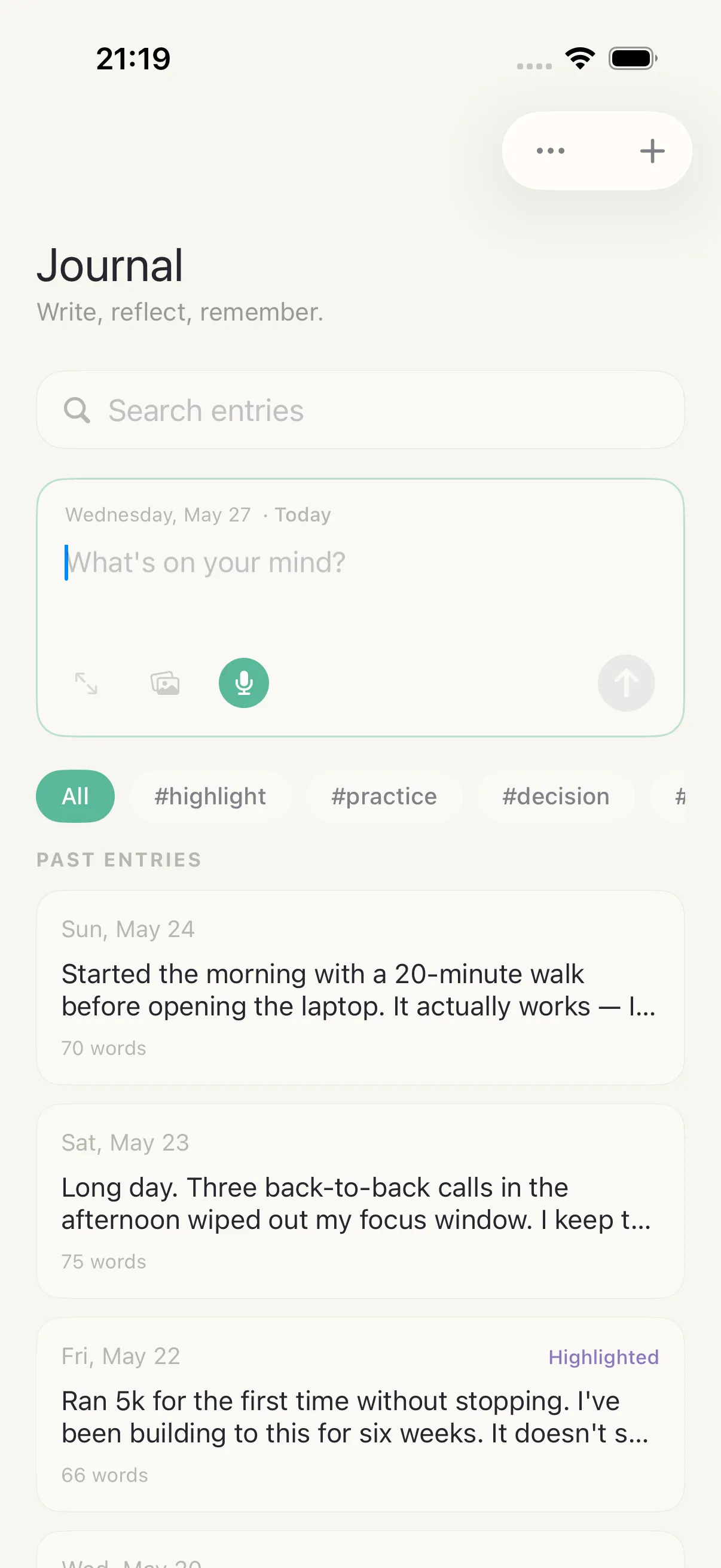
A dedicated journal is a real craft
Apps built purely for journaling take the writing itself seriously: the blank page, the media you attach, the years of entries you can wander back through. That is a genuine specialism, and HourLife does not claim to beat a focused journal on its own ground.
If your goal is a beautiful archive of memories, a dedicated journal is the honest recommendation.
When the writing is about steering, not preserving
Some journaling is memory keeping. Some of it is thinking out loud about a decision, a stuck project, an energy pattern, or a goal that is quietly slipping. The second kind is much less useful in isolation, because the answer usually sits in the day around the entry rather than in the entry itself.
You write that the week felt heavy. Two months later the sentence is still there and the explanation is gone.
What HourLife keeps beside the entry
In HourLife the journal lives inside the daily record, so an entry sits next to the answers to:
- What did you actually work on today?
- Which habits held, and which ones slipped?
- Which goal did the day move?
- What did your mood and energy look like?
- What decision did you make, and on what basis?
- What highlight is worth keeping?
Reflection stops being a separate ritual you have to remember and becomes the closing step of a day you already recorded.
Private and exportable
HourLife is personal software with no social feed, no public profile, and no audience. Journaling is only honest when nobody is watching, and that is the assumption the app is built on.
Markdown export is part of the same promise. A journal you cannot take with you is a journal you are renting, so HourLife keeps your entries and daily records readable outside the app.