Keep this author quotes for later
Sign in to save

George Orwell

The most-loved lines from George Orwell, drawn from 1 book in the library.

Lines labelled “HourLife takeaway” are our wording of the book’s ideas and may paraphrase it. Only lines in quotation marks are the author’s own words, with where they appear. Check the book for exact wording before you quote it. Spot an error?

Cut the words people have, and you cut what they can think.

Nineteen Eighty-Four George Orwell HourLife takeaway

Newspeak is the Party's language, and it is designed to shrink. Syme, a colleague of Winston's who works on the dictionary, is proud that each new edition has fewer words. The appendix spells out the aim: once the old words are gone, a rebellious thought has nothing to be said in. Watch the words you are given for the things you might want to object to.


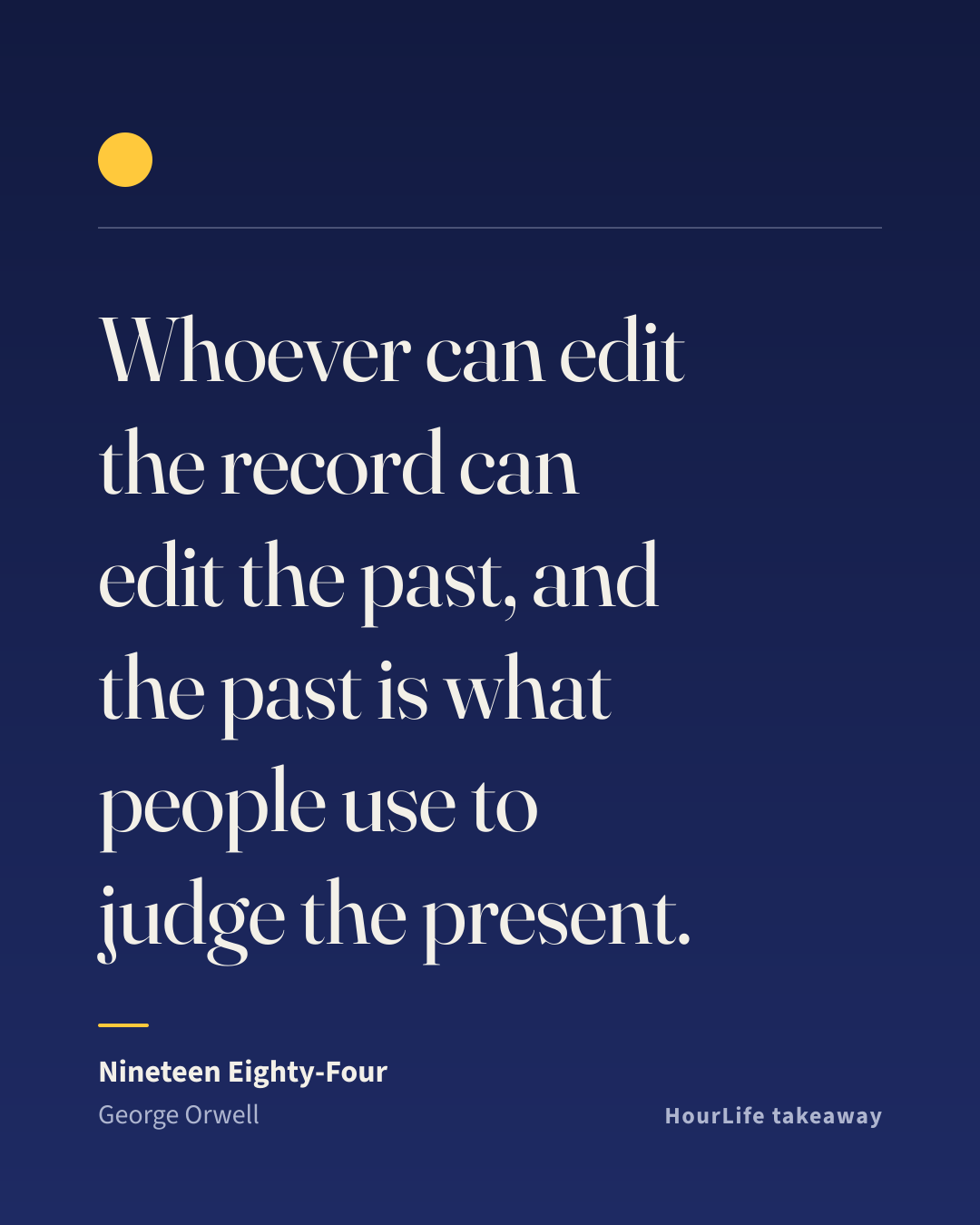
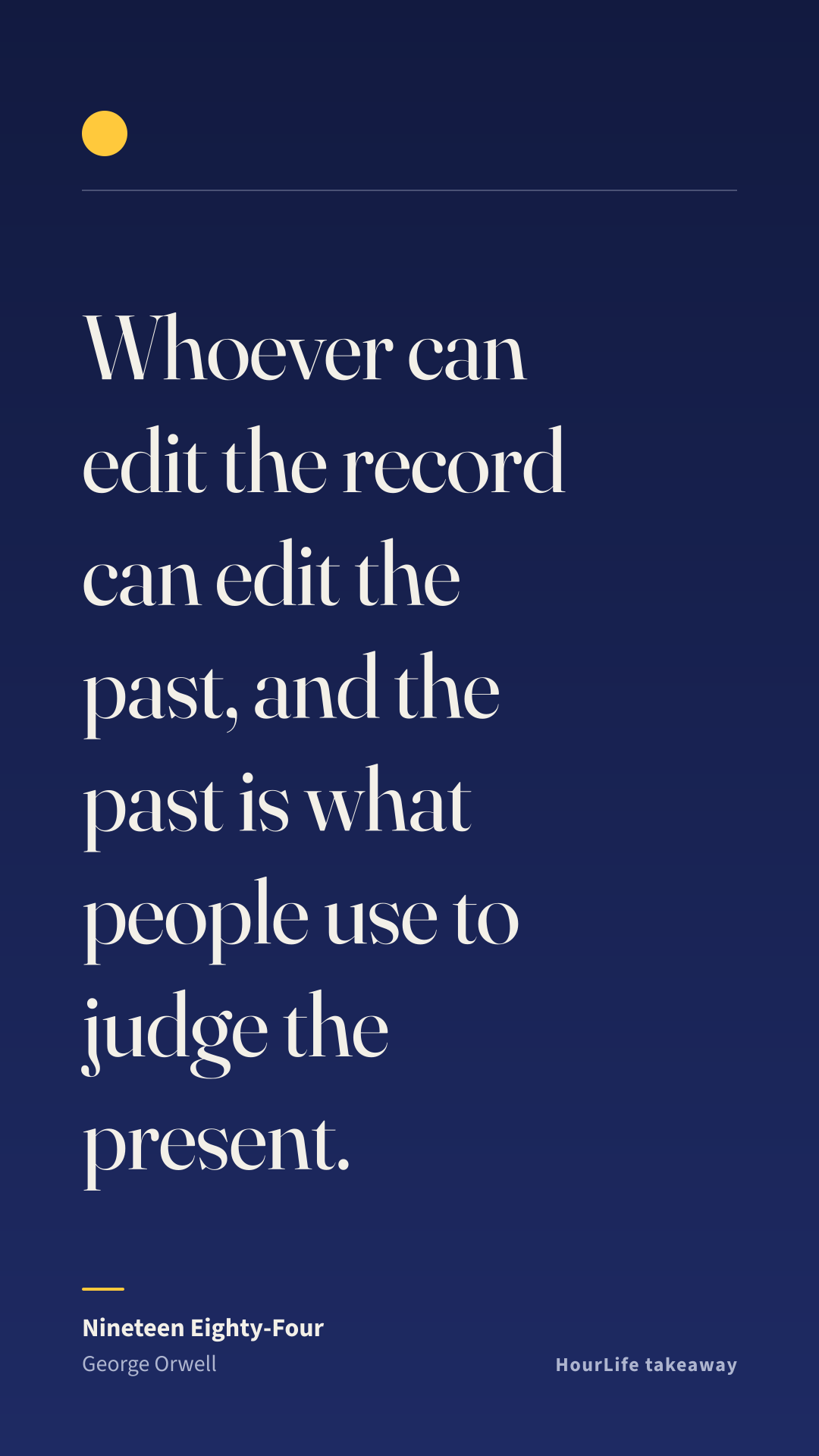
Whoever can edit the record can edit the past, and the past is what people use to judge the present.

Nineteen Eighty-Four George Orwell HourLife takeaway

Winston's job at the Ministry of Truth is to rewrite old newspaper stories so they match whatever the Party says now. The originals go down the memory hole to be burned. Once every copy agrees, there is nothing left to check a promise against. One of the Party's slogans links the two: control the present and you control the past, and through it the future.

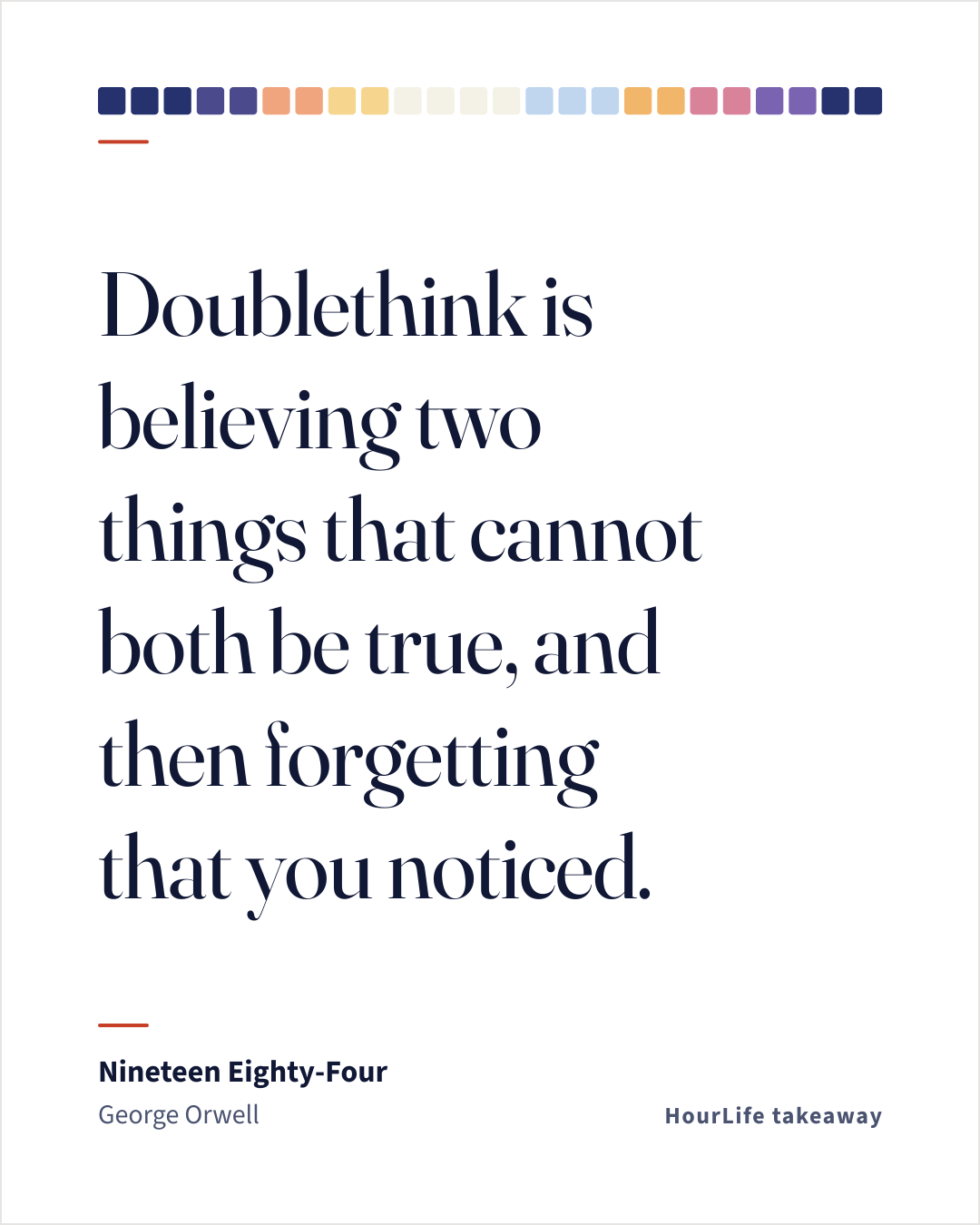
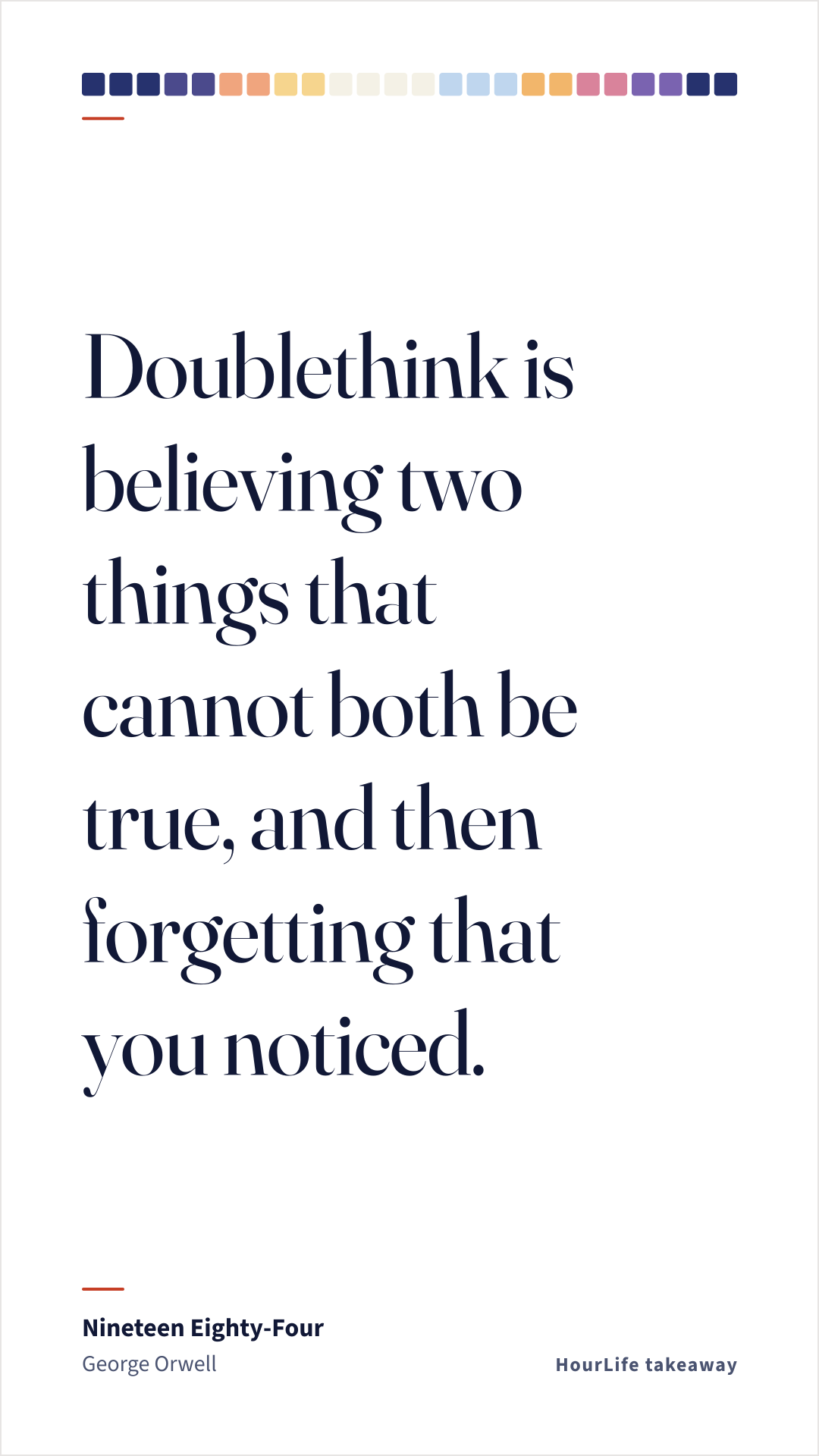
Doublethink is believing two things that cannot both be true, and then forgetting that you noticed.

Nineteen Eighty-Four George Orwell HourLife takeaway

The clearest scene comes during Hate Week, when the enemy changes from Eurasia to Eastasia in the middle of a speech. The crowd carries straight on, and turns on the old banners as sabotage. Doublethink is not stupidity. It is a trained habit of not looking, and milder forms of it are common in ordinary life.

When you can never tell whether you are being watched, you start watching yourself.

Nineteen Eighty-Four George Orwell HourLife takeaway

The telescreen in every room both shows and records, and there is no way to know when anyone is looking. So people act as if someone always is, down to the look on their faces. The novel even has a word for the wrong expression: facecrime. The control works because people end up doing the watching for the state.

Anger on a schedule is easy to steer.

Nineteen Eighty-Four George Orwell HourLife takeaway

Every day, Party members gather for the Two Minutes Hate and shout at the face of Emmanuel Goldstein on the screen. Winston dislikes it and still finds himself joining in, and he notices that the rage can be switched from one target to another. Feeds that reward outrage work in a similar way, so it is worth asking who gains from your anger.

A war that never ends keeps people poor, scared and loyal.

Nineteen Eighty-Four George Orwell HourLife takeaway

Oceania is always at war with one of the other two superstates, and the war is never meant to be won. The book Winston is given, said to be by Goldstein, argues that constant war uses up what people produce and keeps everyone afraid and obedient. The lesson for today is to ask what a permanent emergency is being used to justify.

Keeping your own record is a small act of keeping your own mind.

Nineteen Eighty-Four George Orwell HourLife takeaway

Winston's first rebellion is buying a blank notebook in a junk shop and writing in it, out of the telescreen's view. He doesn't know who it is for, only that putting his thoughts into his own words is something the Party forbids. A diary can't stop a rewrite, but it lets you see when your memory has been changed.

Freedom rests on being allowed to say what plainly checks out.

Nineteen Eighty-Four George Orwell HourLife takeaway

Winston writes in his diary that freedom begins with being able to state simple arithmetic, and he holds on to it as solid ground. In the Ministry of Love, O'Brien sets out to make him accept a false sum because the Party says so. The point is not the maths. A person who will give up an obvious fact under pressure can be made to give up anything.

Control is complete when people stop trusting each other.

Nineteen Eighty-Four George Orwell HourLife takeaway

The Party breaks every private bond it can. Children report their parents, as Parsons finds out when his own daughter denounces him, and love is treated as disloyalty. Room 101 exists to make Winston betray Julia, because a person with no one left to trust has nowhere to stand. Protecting your close relationships also protects your judgement.

Keep this going in the app.

HourLife turns these ideas into a daily system — goals, habits, focus, and reflection in one private place.