Keep this author quotes for later
Sign in to save

John J. Ratey

The most-loved lines from John J. Ratey, drawn from 3 books in the library.

Lines labelled “HourLife takeaway” are our wording of the book’s ideas and may paraphrase it. Only lines in quotation marks are the author’s own words, with where they appear. Check the book for exact wording before you quote it. Spot an error?

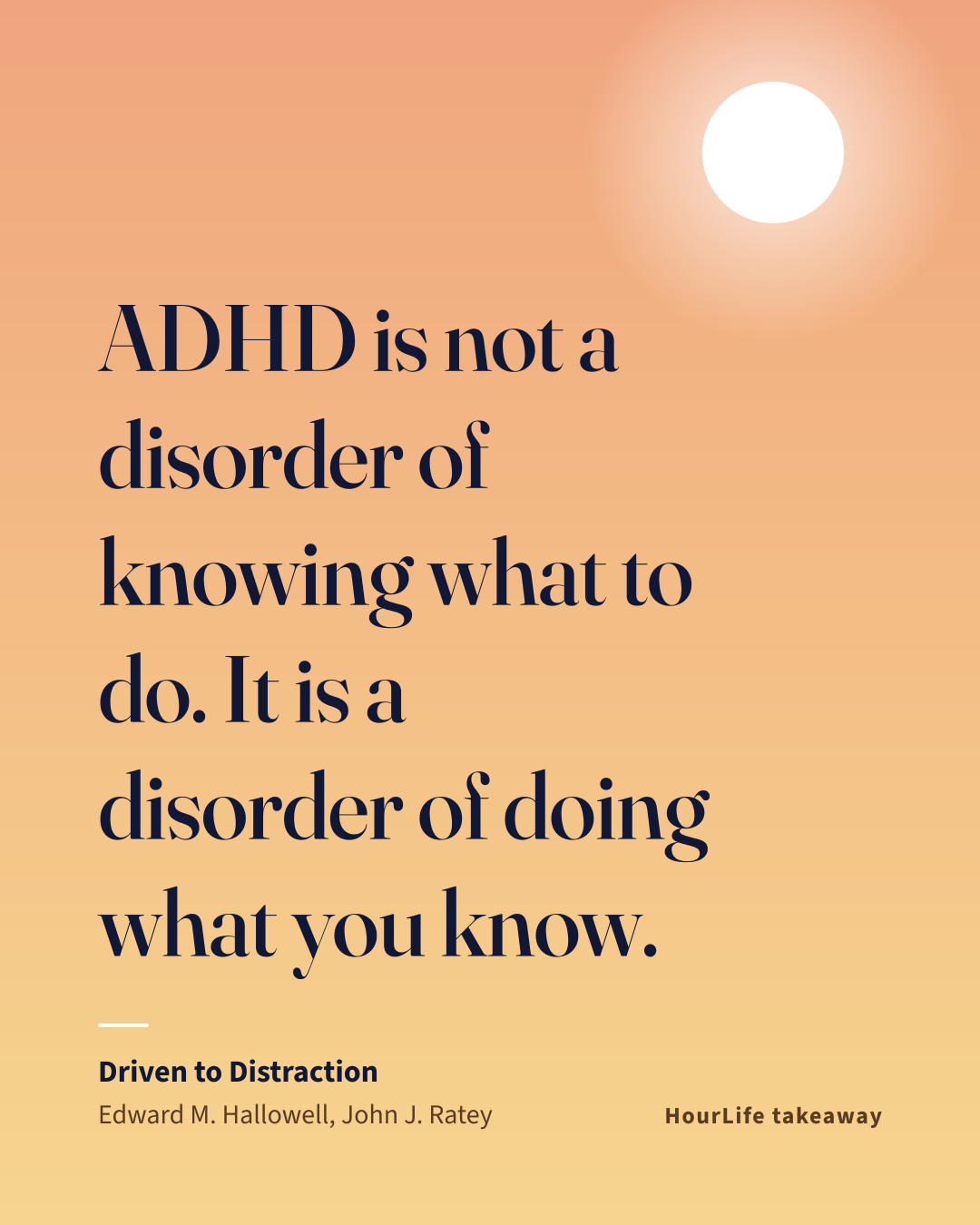
ADHD is not a disorder of knowing what to do. It is a disorder of doing what you know.

Driven to Distraction Edward M. Hallowell, John J. Ratey HourLife takeaway

Hallowell and Ratey's sharpest diagnostic distinction: IQ and intention are intact. The breakdown is in converting intention into consistent action. Willpower arguments miss this biological reality entirely.


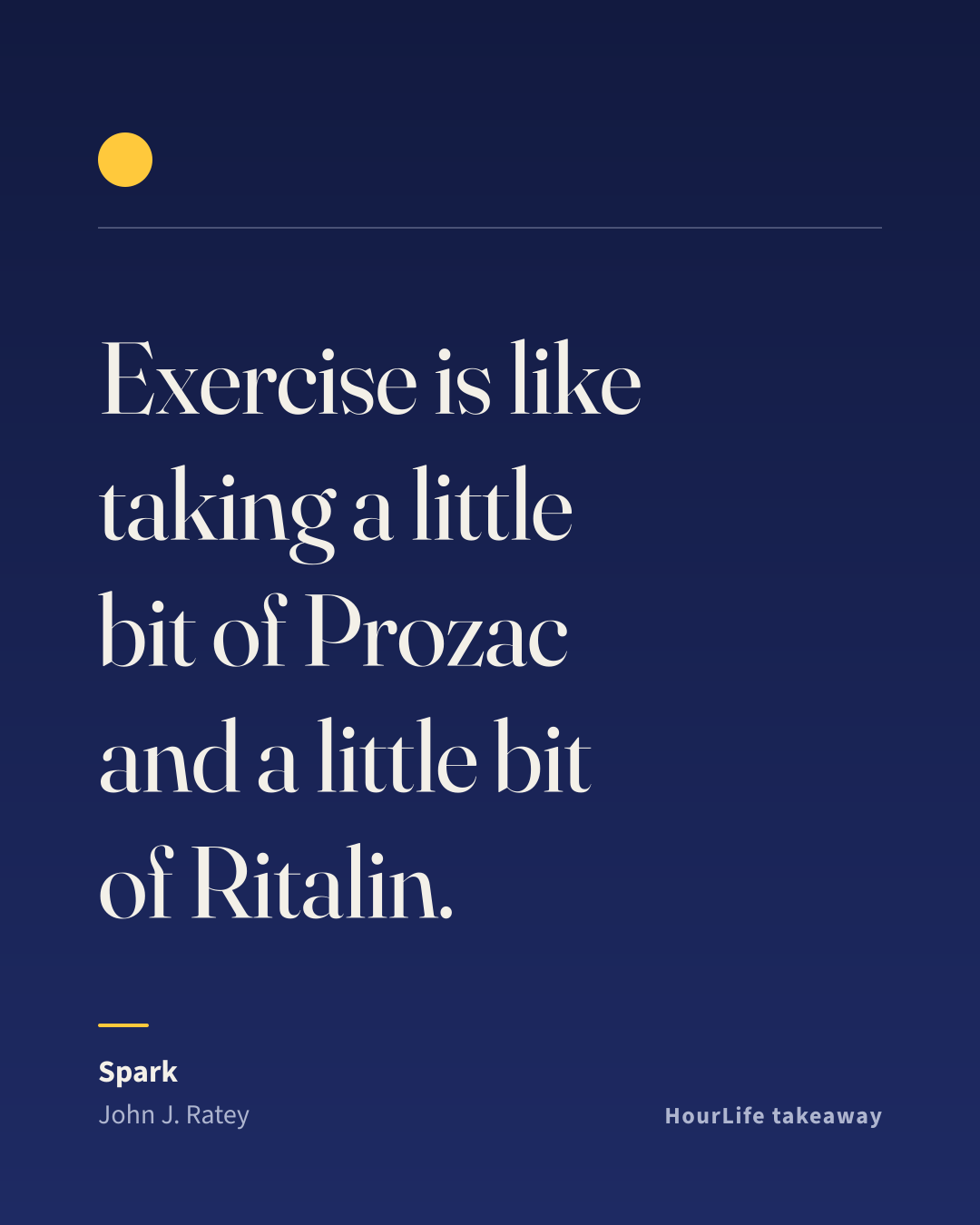
Exercise is like taking a little bit of Prozac and a little bit of Ritalin.

Spark John J. Ratey HourLife takeaway

Ratey's blunt clinical framing: movement improves mood chemistry and attention pathways simultaneously, without waiting for motivation to appear first.

ADHD is not a deficit of intelligence; it is a challenge of regulating attention, emotion, and effort in inconsistent conditions.

ADHD 2.0 Edward M. Hallowell, John J. Ratey HourLife takeaway

Hallowell and Ratey shift the lens from character flaw to regulation mechanics. The right support system changes outcomes more than self-criticism ever will.

People with ADD often feel a sense of underachievement — of not living up to their potential. It is one of the hallmarks of the condition.

Driven to Distraction Edward M. Hallowell, John J. Ratey HourLife takeaway

The gap between capacity and output is viscerally real for people with ADHD. Understanding that this gap is neurological, not motivational, changes both the self-narrative and the treatment plan.

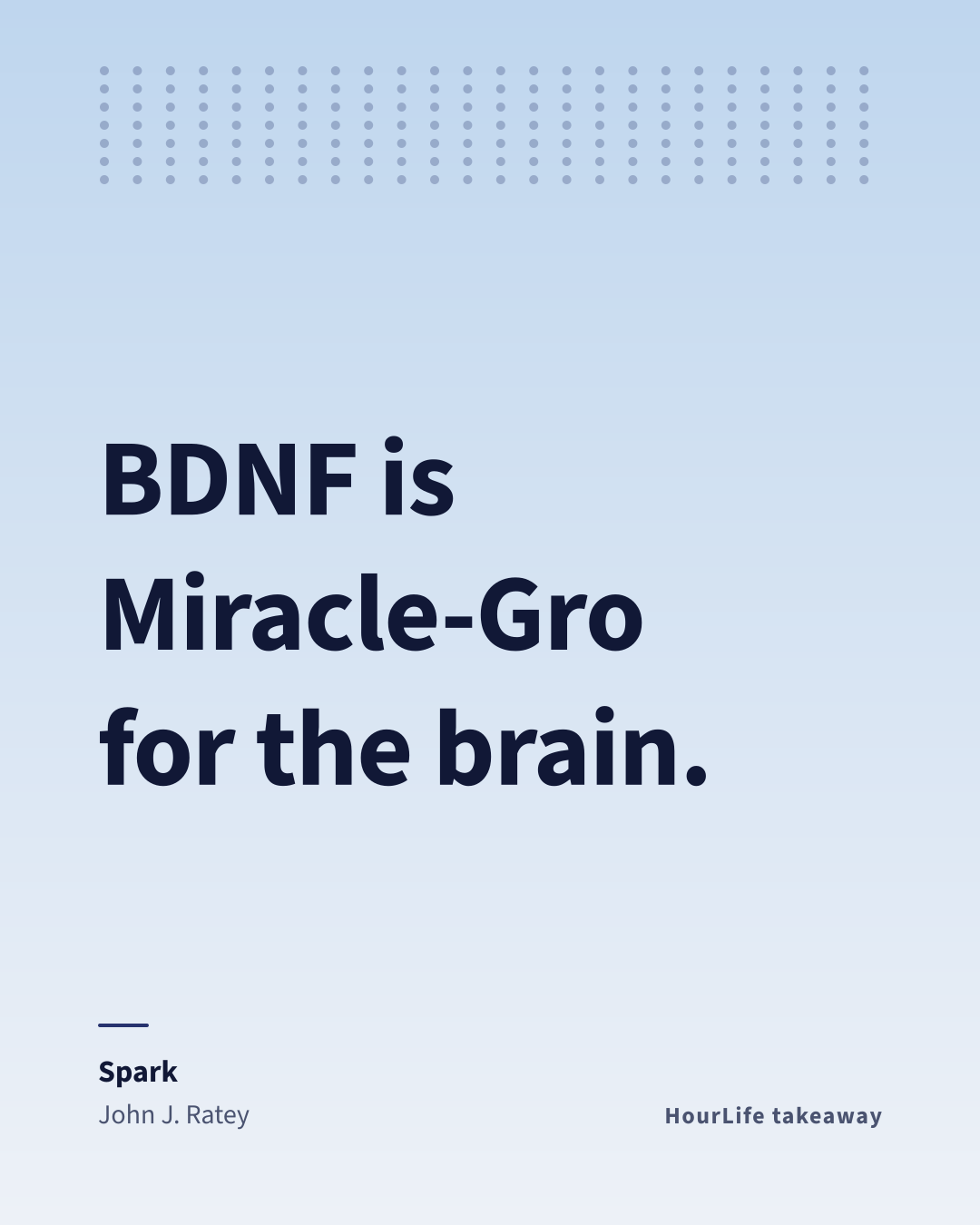
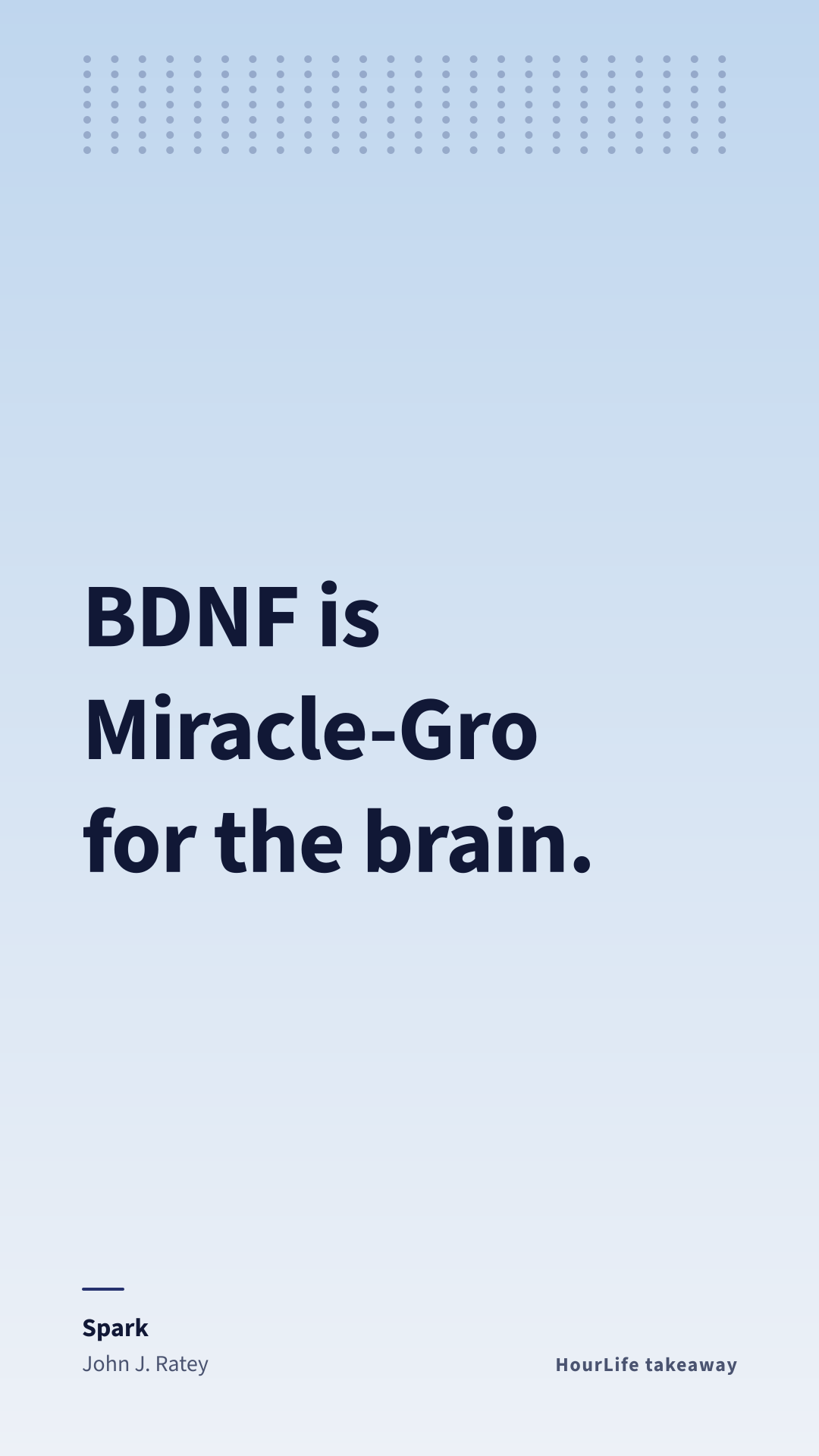
BDNF is Miracle-Gro for the brain.

Spark John J. Ratey HourLife takeaway

One of Spark's defining ideas: aerobic effort increases the growth factor that helps neurons connect, adapt, and retain learning under pressure.

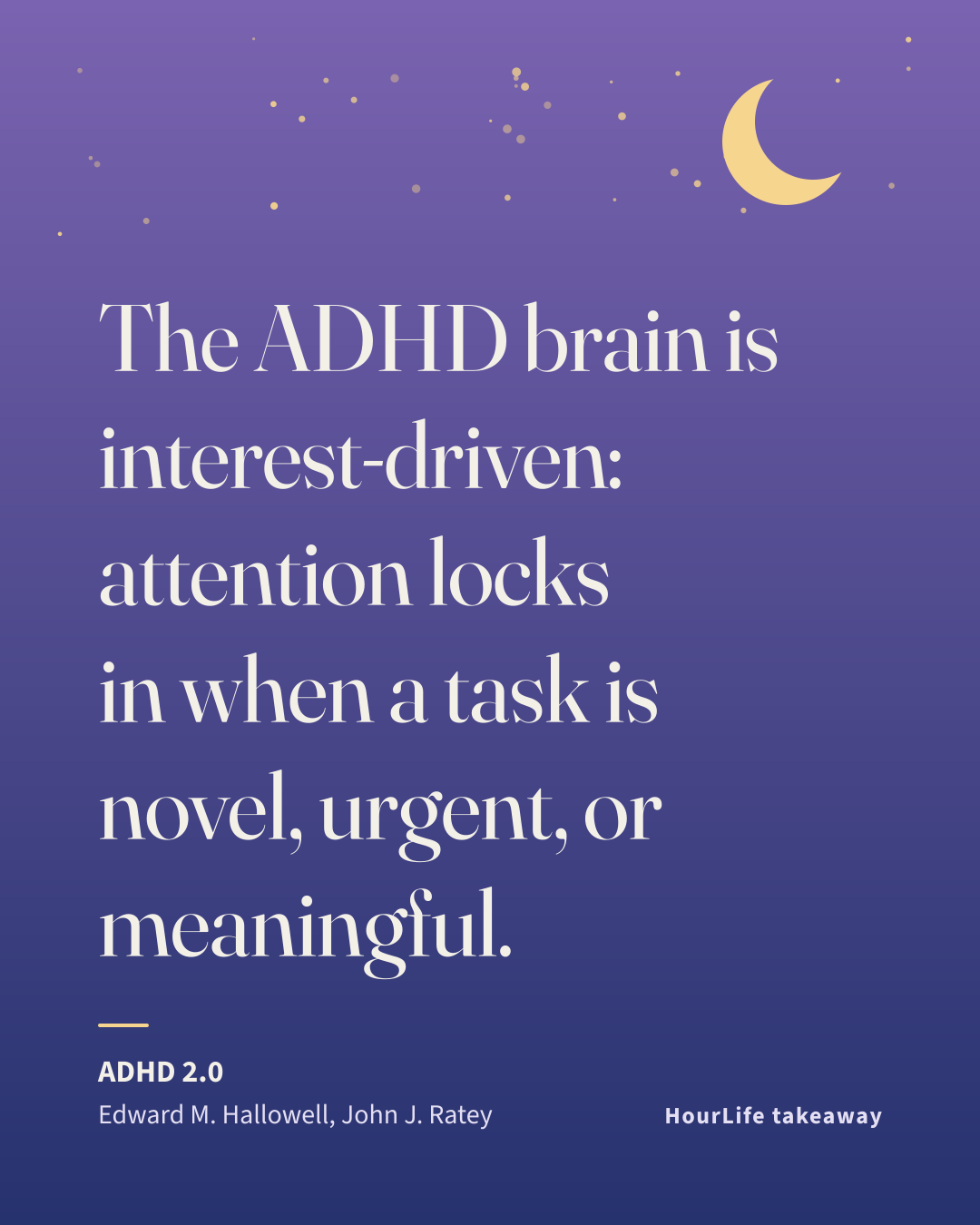
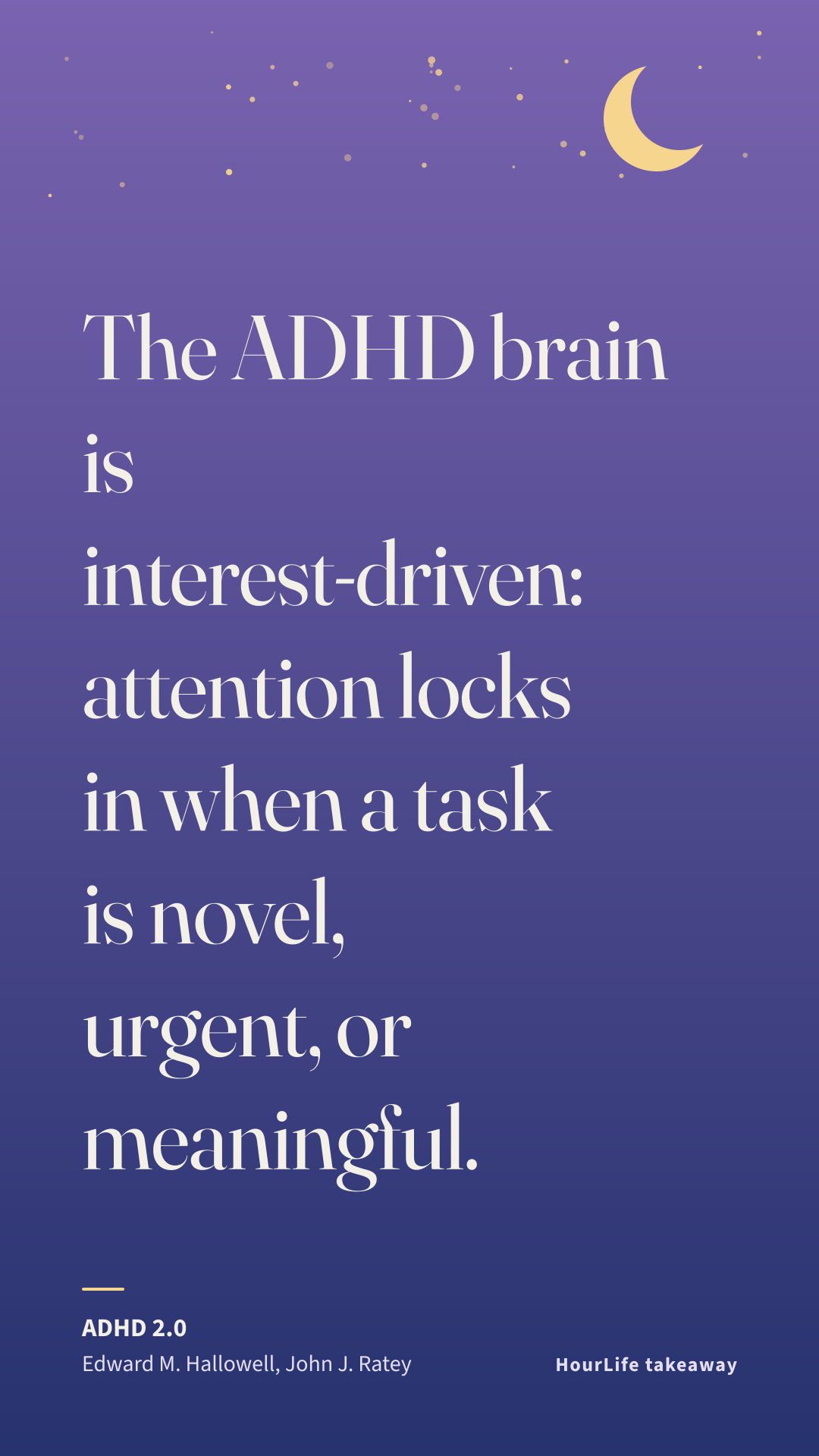
The ADHD brain is interest-driven: attention locks in when a task is novel, urgent, or meaningful.

ADHD 2.0 Edward M. Hallowell, John J. Ratey HourLife takeaway

Motivation is not linear in ADHD. Strategy means designing entry conditions that trigger engagement, not waiting for generic discipline to appear.

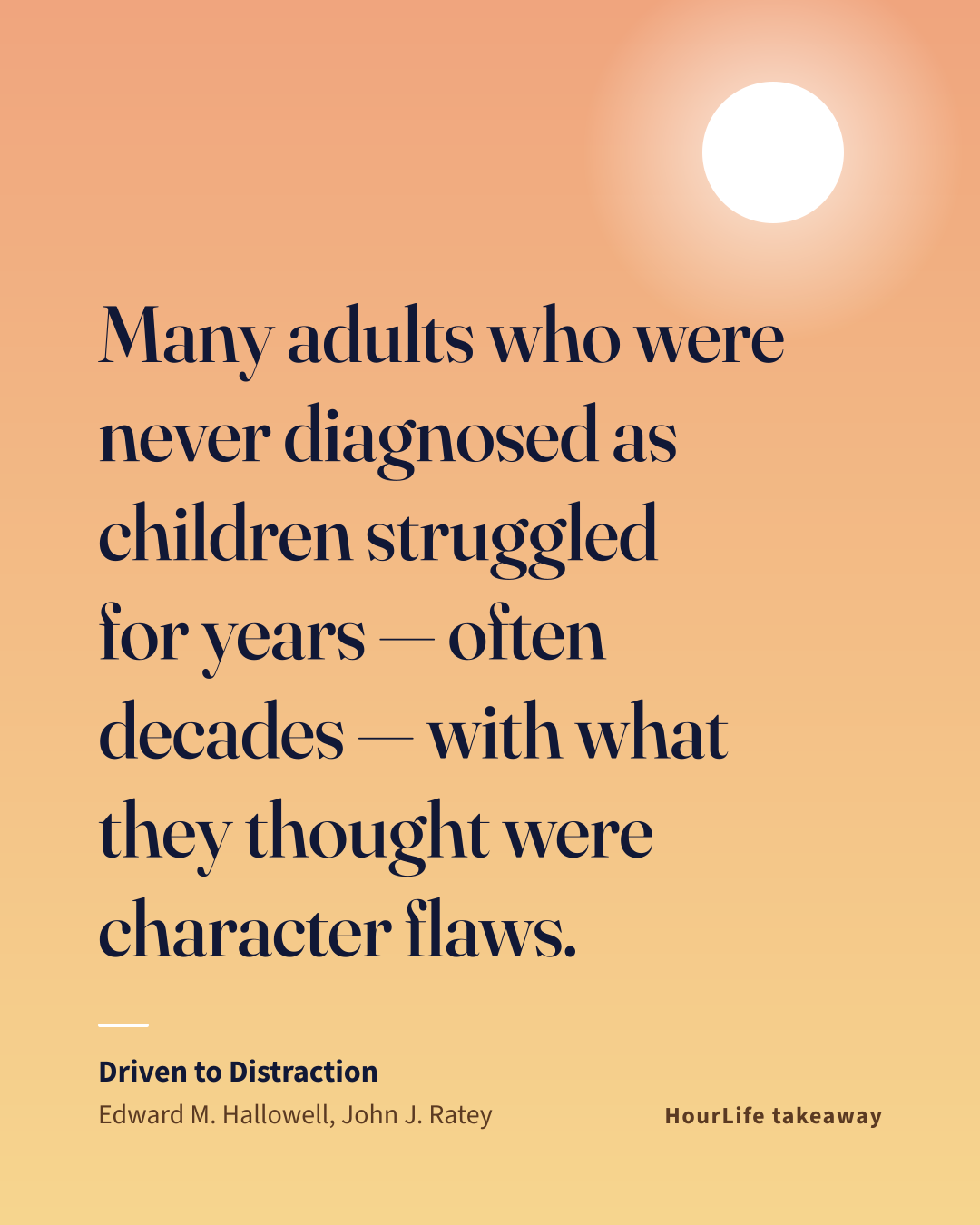
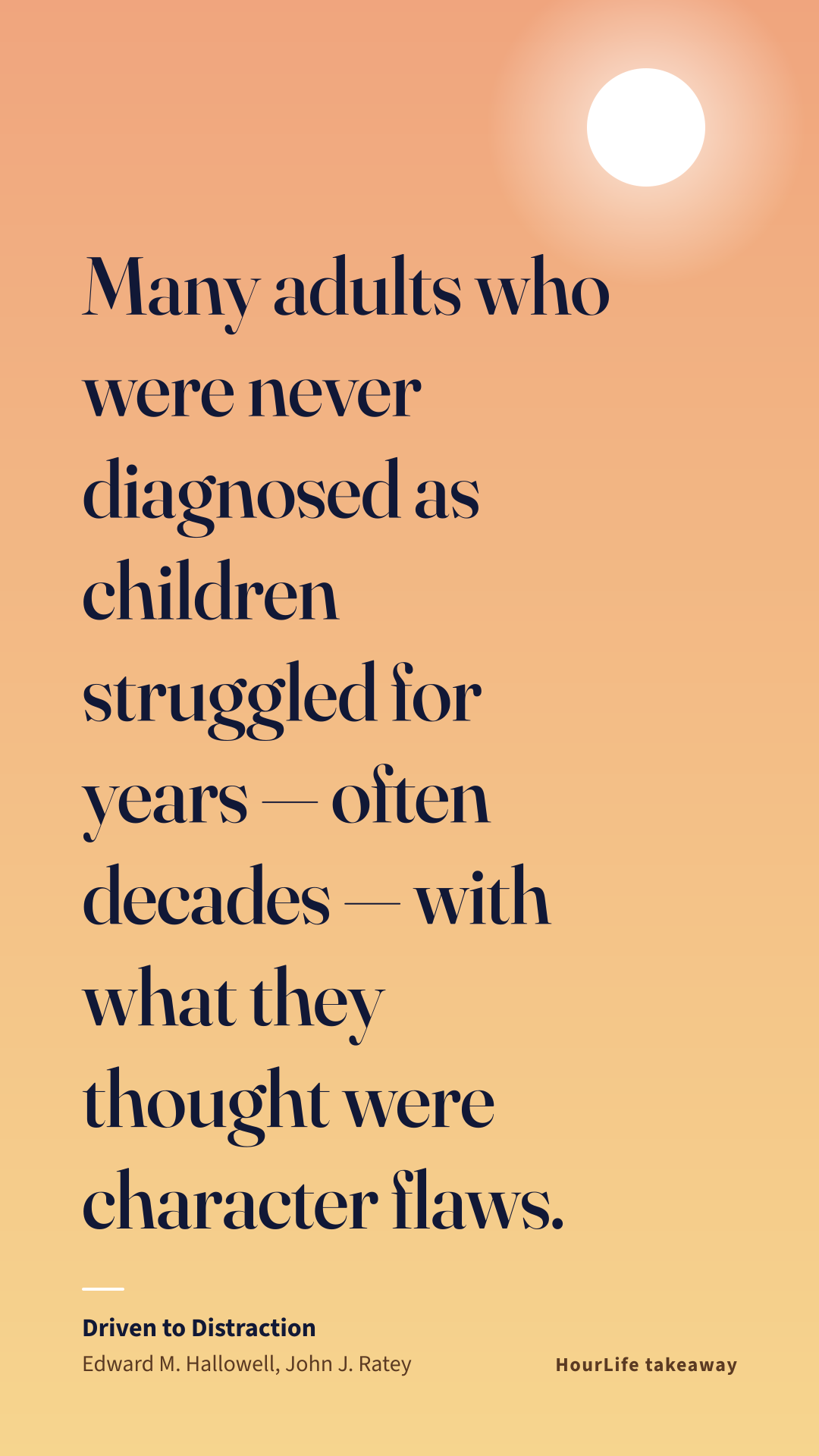
Many adults who were never diagnosed as children struggled for years — often decades — with what they thought were character flaws.

Driven to Distraction Edward M. Hallowell, John J. Ratey HourLife takeaway

Late diagnosis is transformative. Understanding that you have ADHD — not a broken personality — produces profound relief followed by productive grief for lost years and squandered energy.
The fittest kids in school are often the best learners.

Spark John J. Ratey HourLife takeaway

Ratey links movement to classroom performance through data: better cardiovascular conditioning is associated with stronger attention, memory, and executive function.

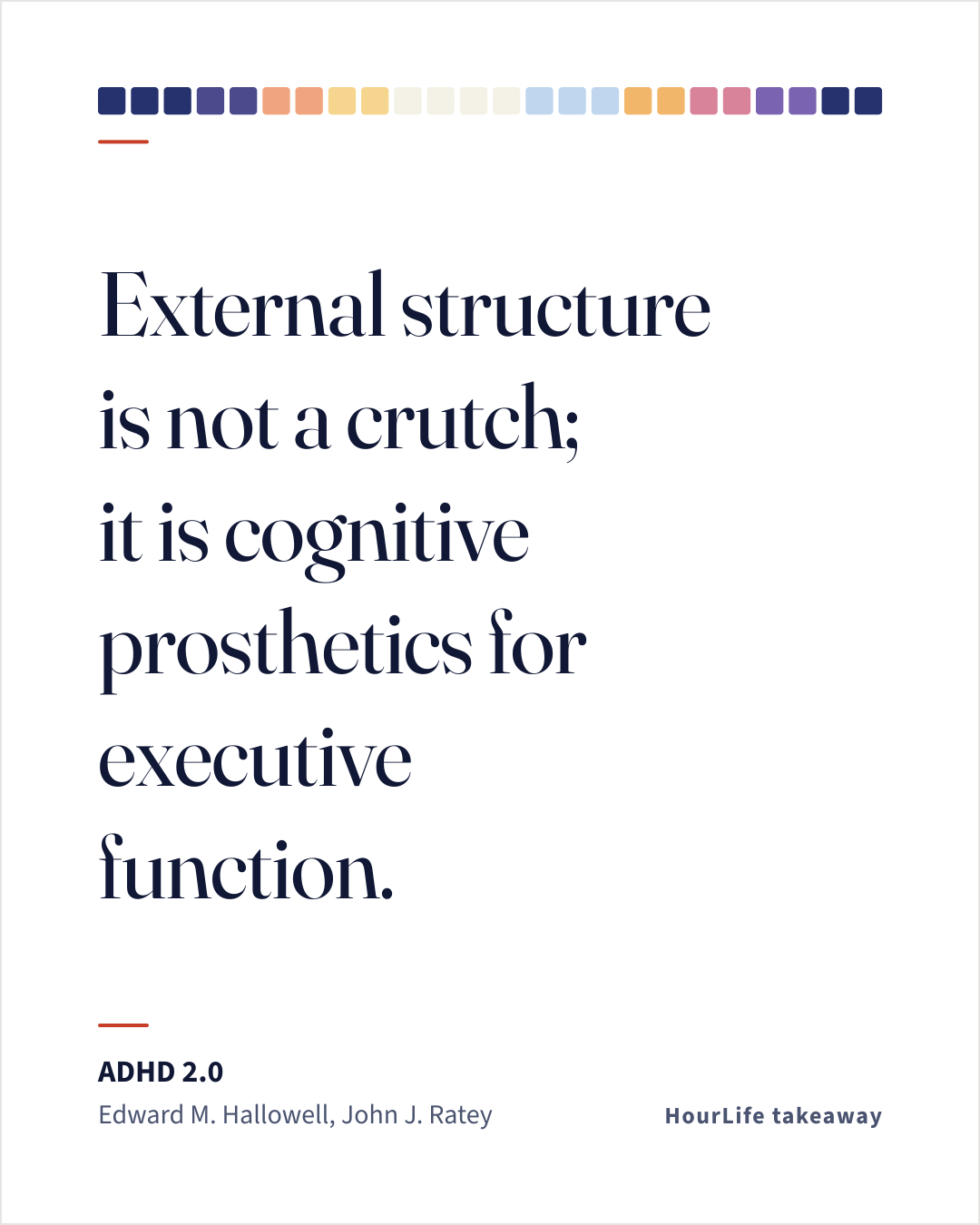
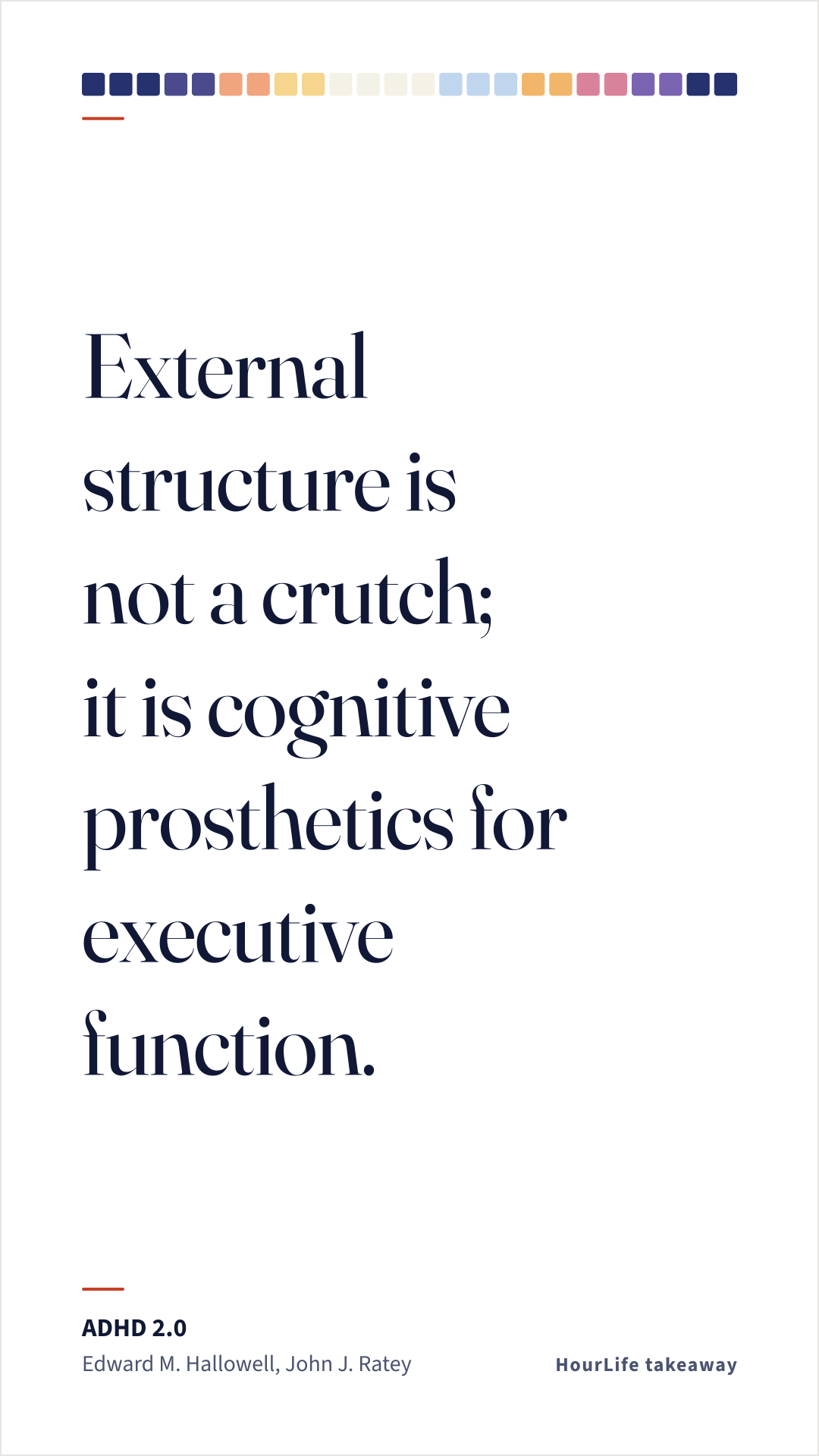
External structure is not a crutch; it is cognitive prosthetics for executive function.

ADHD 2.0 Edward M. Hallowell, John J. Ratey HourLife takeaway

Timers, body doubling, visual plans, and constrained environments function as load-bearing systems for planning and follow-through.

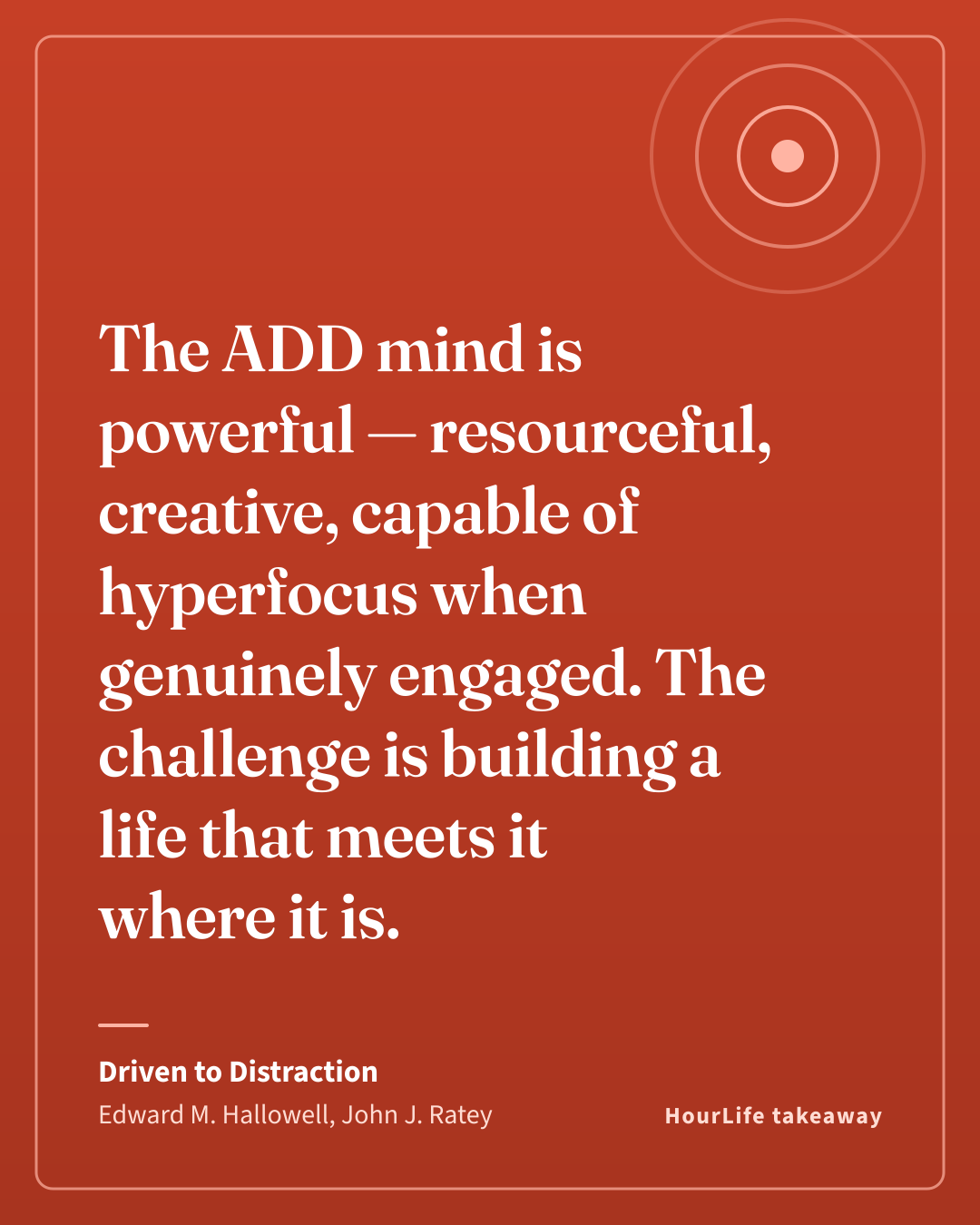
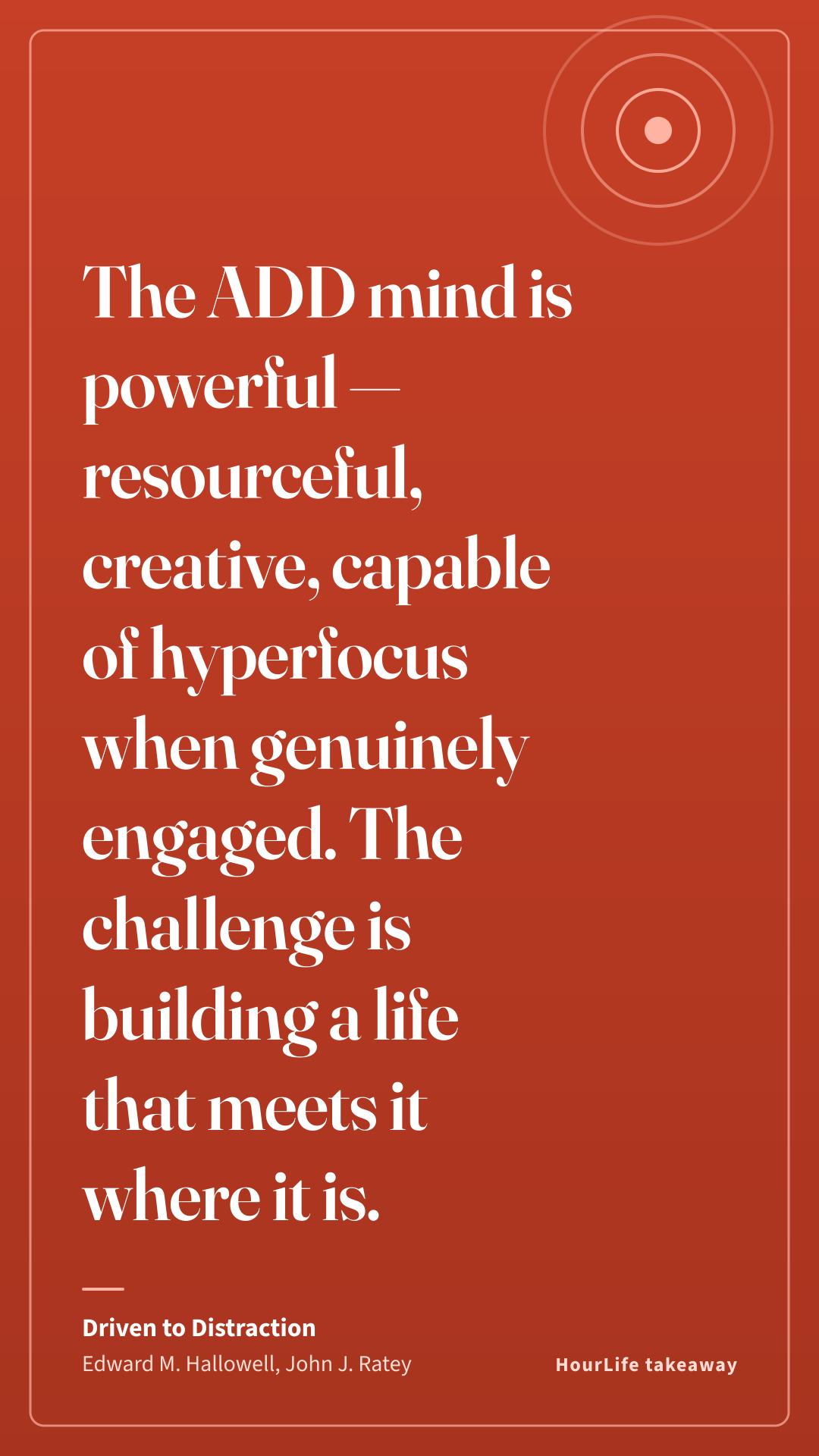
The ADD mind is powerful — resourceful, creative, capable of hyperfocus when genuinely engaged. The challenge is building a life that meets it where it is.

Driven to Distraction Edward M. Hallowell, John J. Ratey HourLife takeaway

Hallowell's optimism is grounded: the same neural wiring that makes attention management hard also produces originality, intensity, and entrepreneurial thinking. The goal is environment-fit, not self-correction.

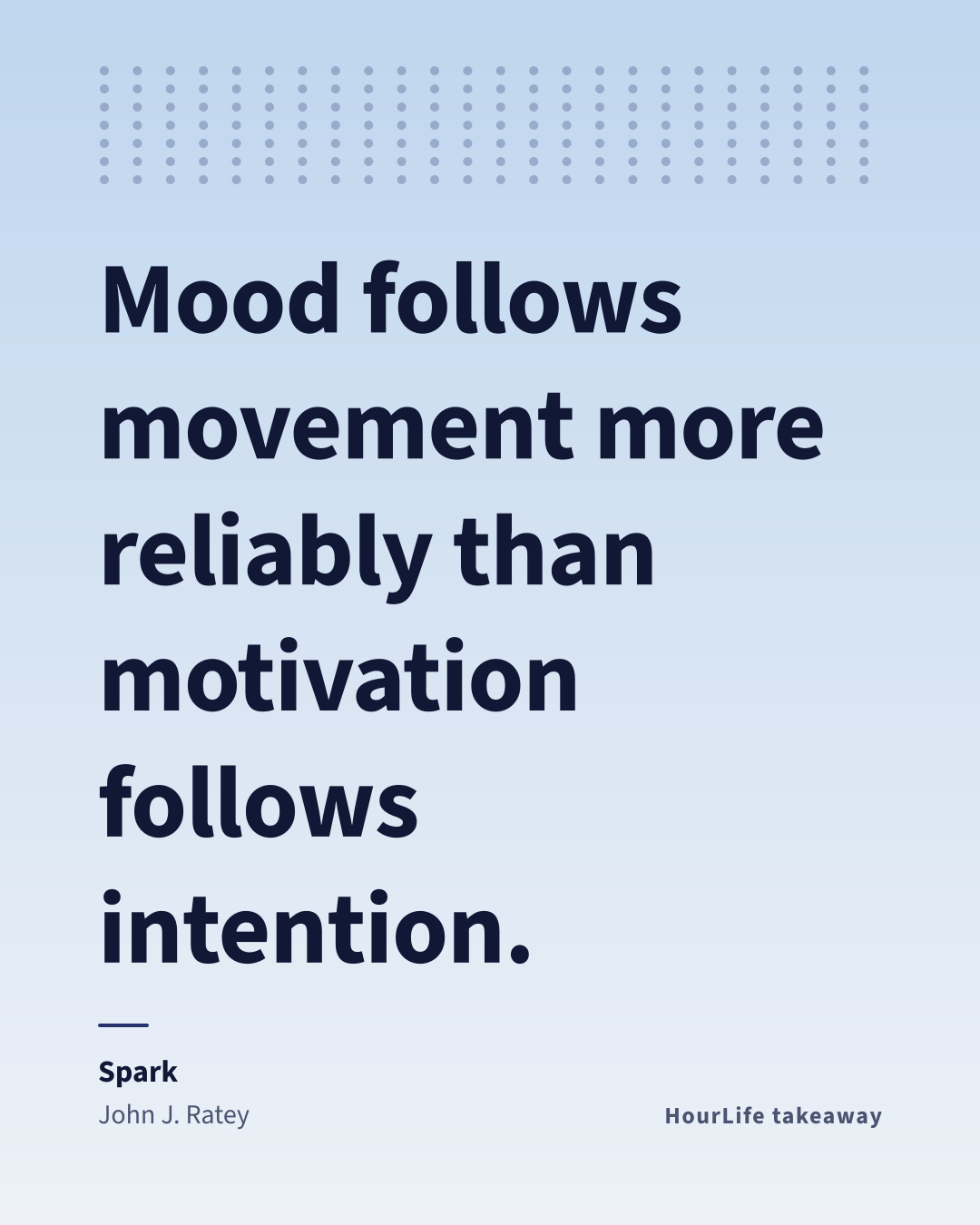
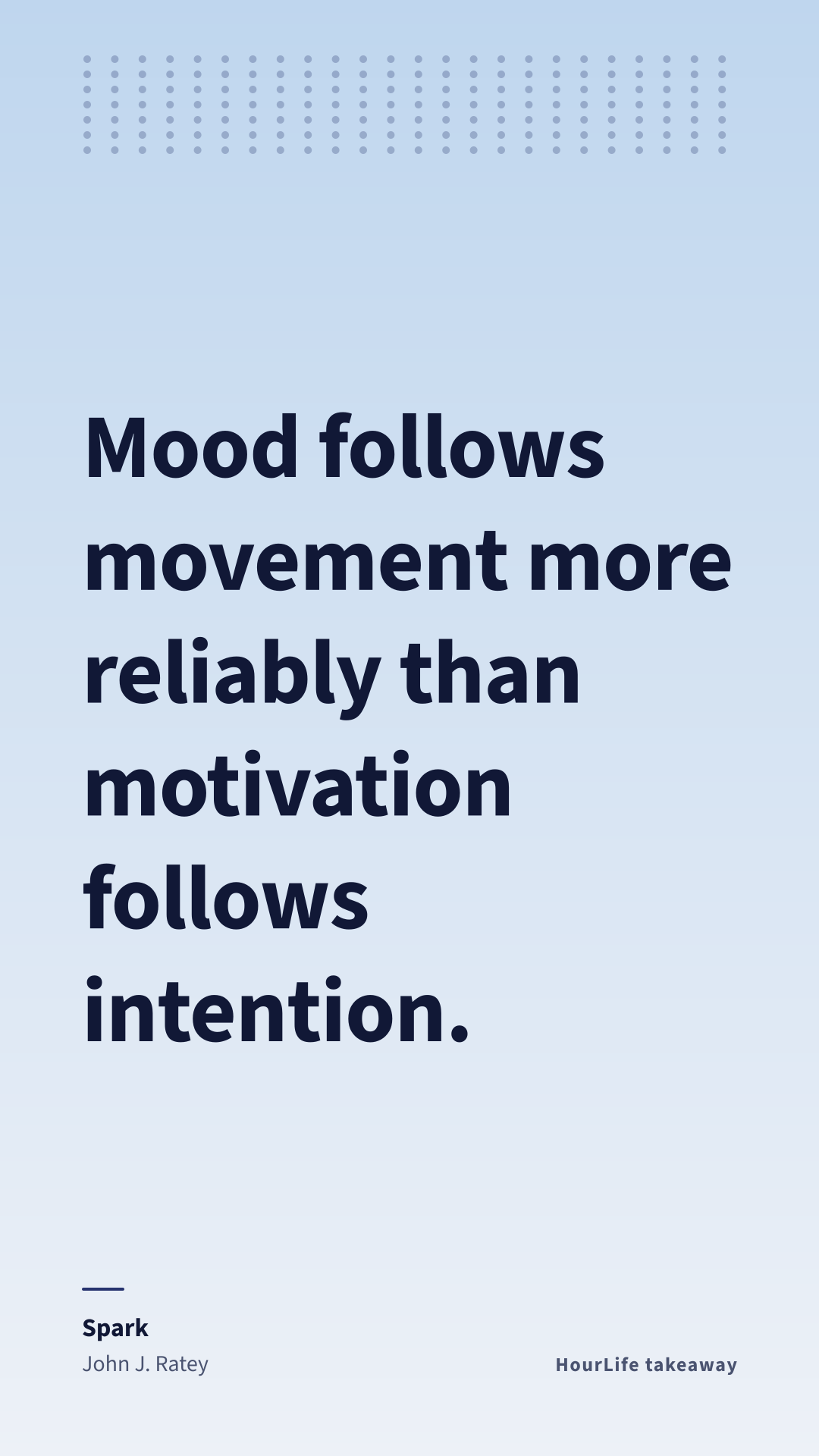
Mood follows movement more reliably than motivation follows intention.

Spark John J. Ratey HourLife takeaway

Spark reframes emotional regulation as behavioral: act with your body first, and your brain chemistry often catches up afterward.

Movement changes brain state; physical activation can restore focus faster than forcing stillness.

ADHD 2.0 Edward M. Hallowell, John J. Ratey HourLife takeaway

Exercise and micro-movement regulate arousal and improve attention control. For many with ADHD, motion is therapeutic, not distracting.

Diagnosis is not a life sentence. It is, in most cases, a key that unlocks a door that seemed permanently shut.

Driven to Distraction Edward M. Hallowell, John J. Ratey HourLife takeaway

For millions, diagnosis was the turning point. Not the start of a limitation, but the end of a mystery — and the beginning of strategies that actually match how their brain works.

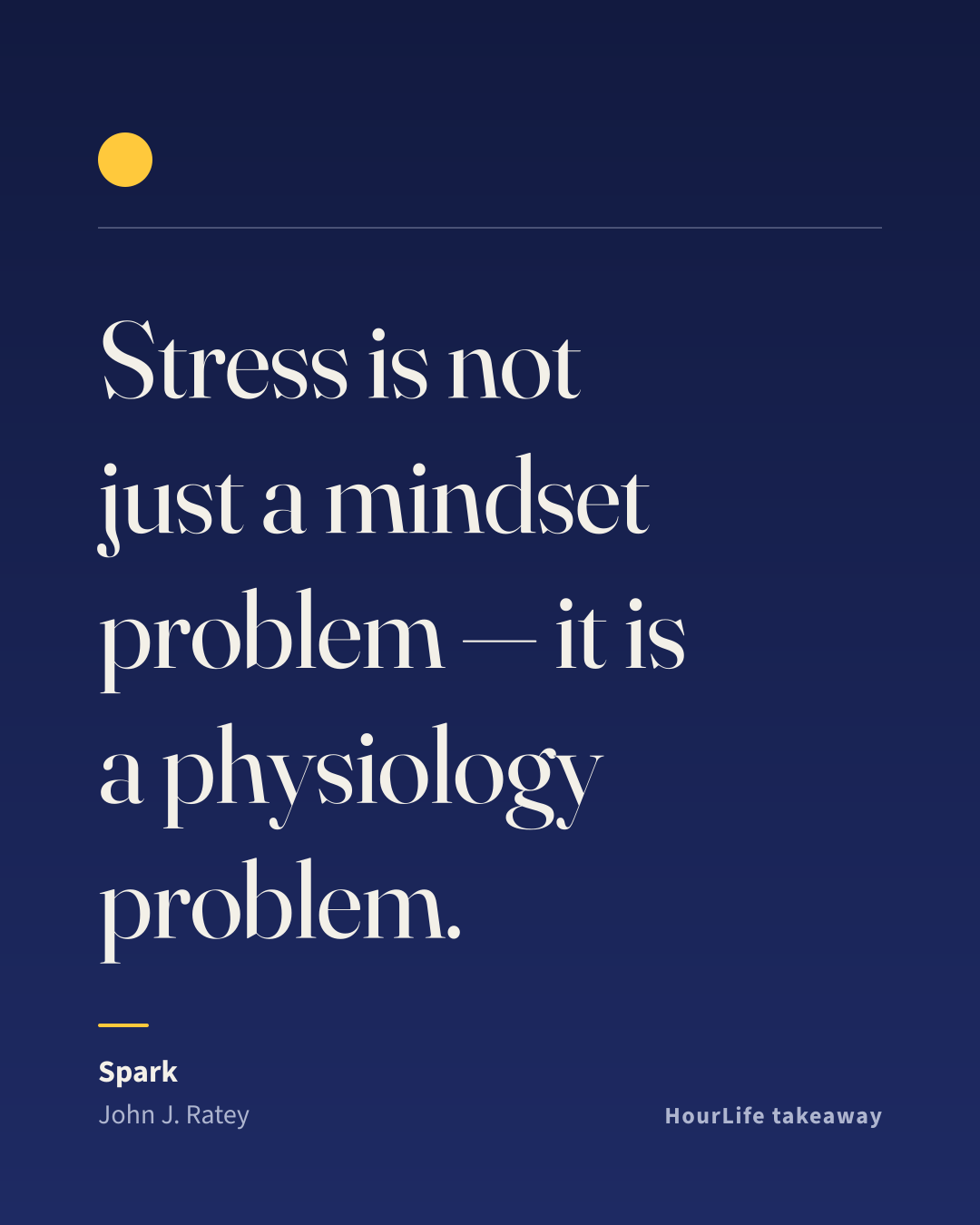
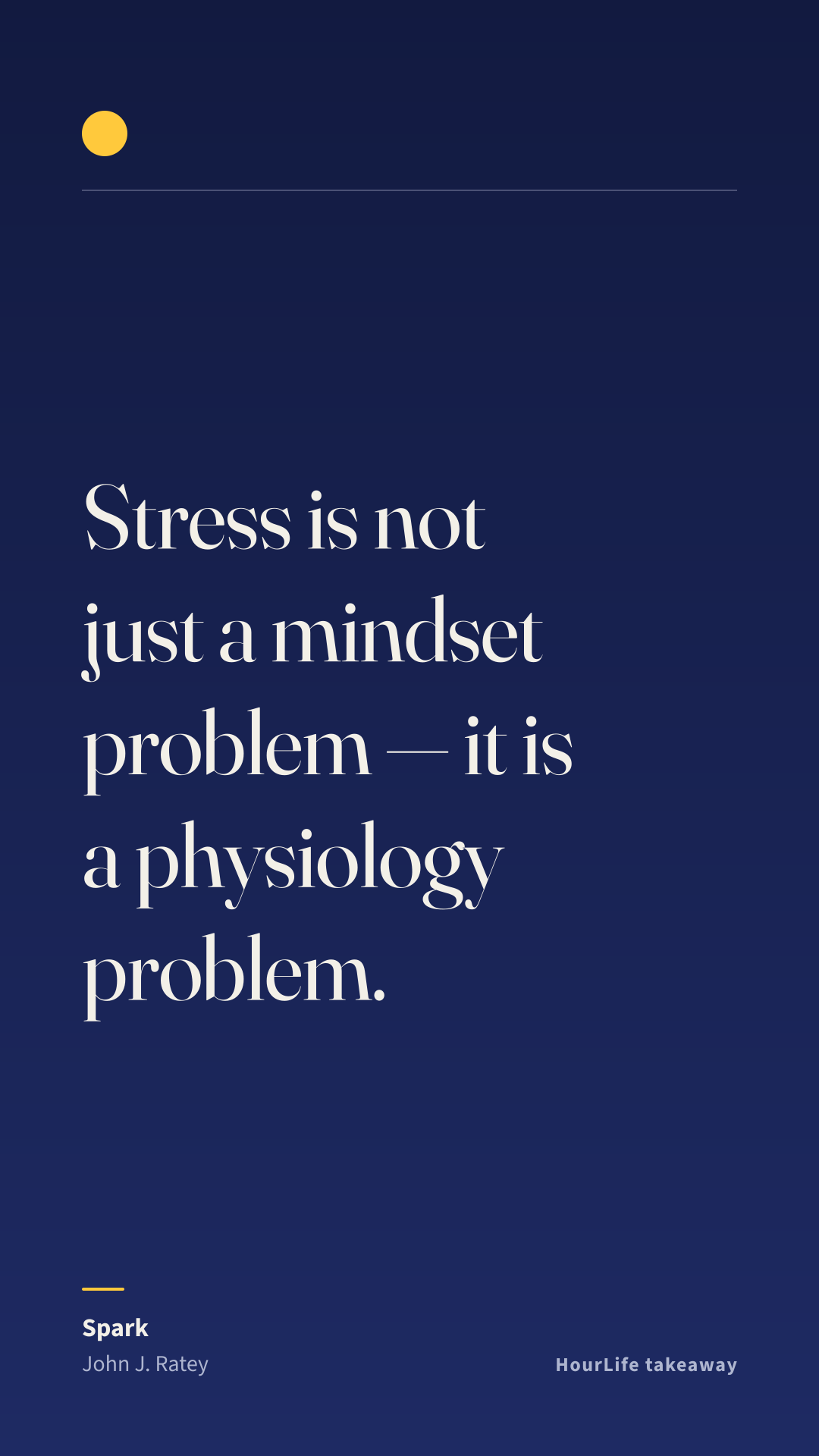
Stress is not just a mindset problem — it is a physiology problem.

Spark John J. Ratey HourLife takeaway

Regular training lowers baseline reactivity and improves recovery speed, making cognitive performance more stable in demanding environments.

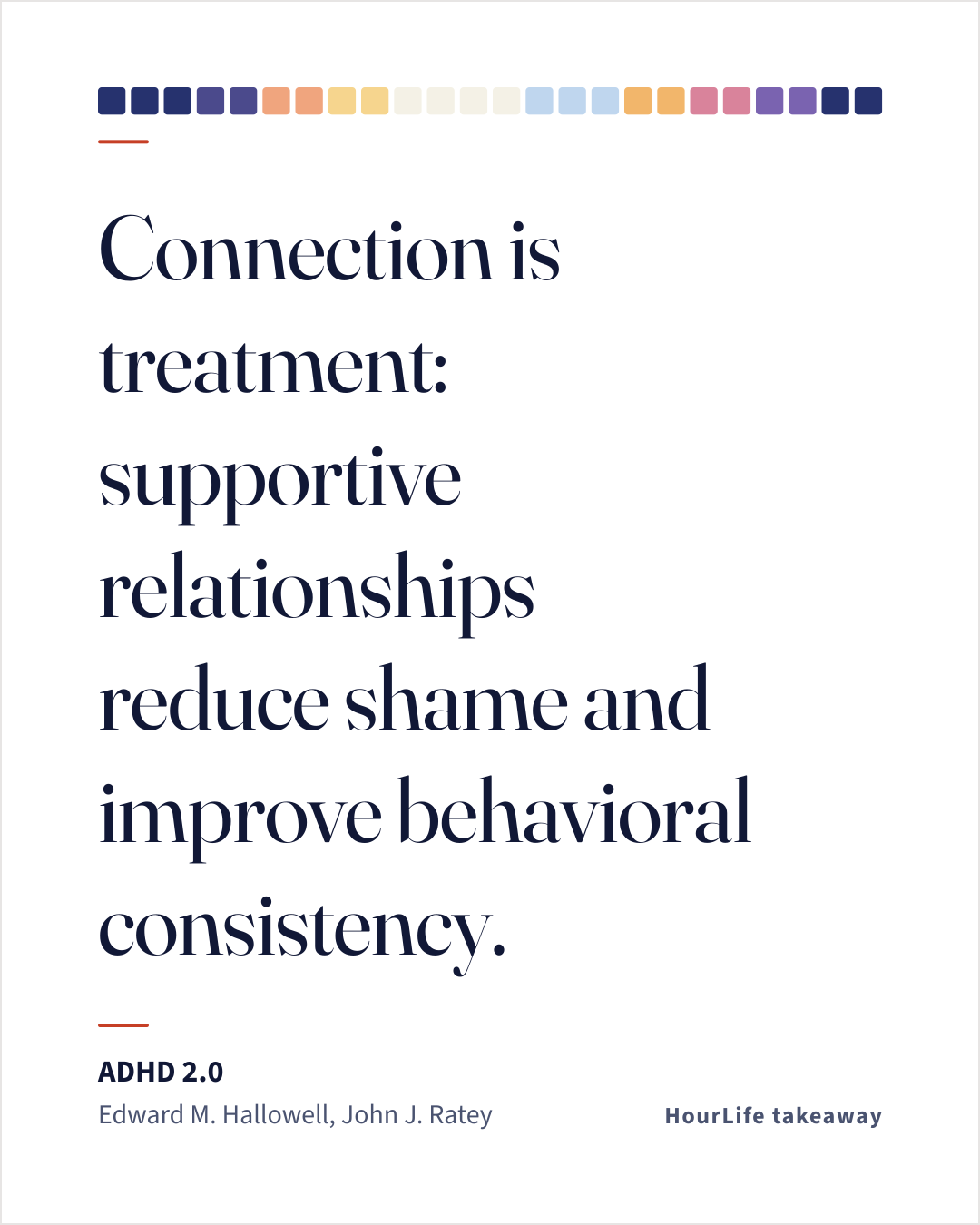
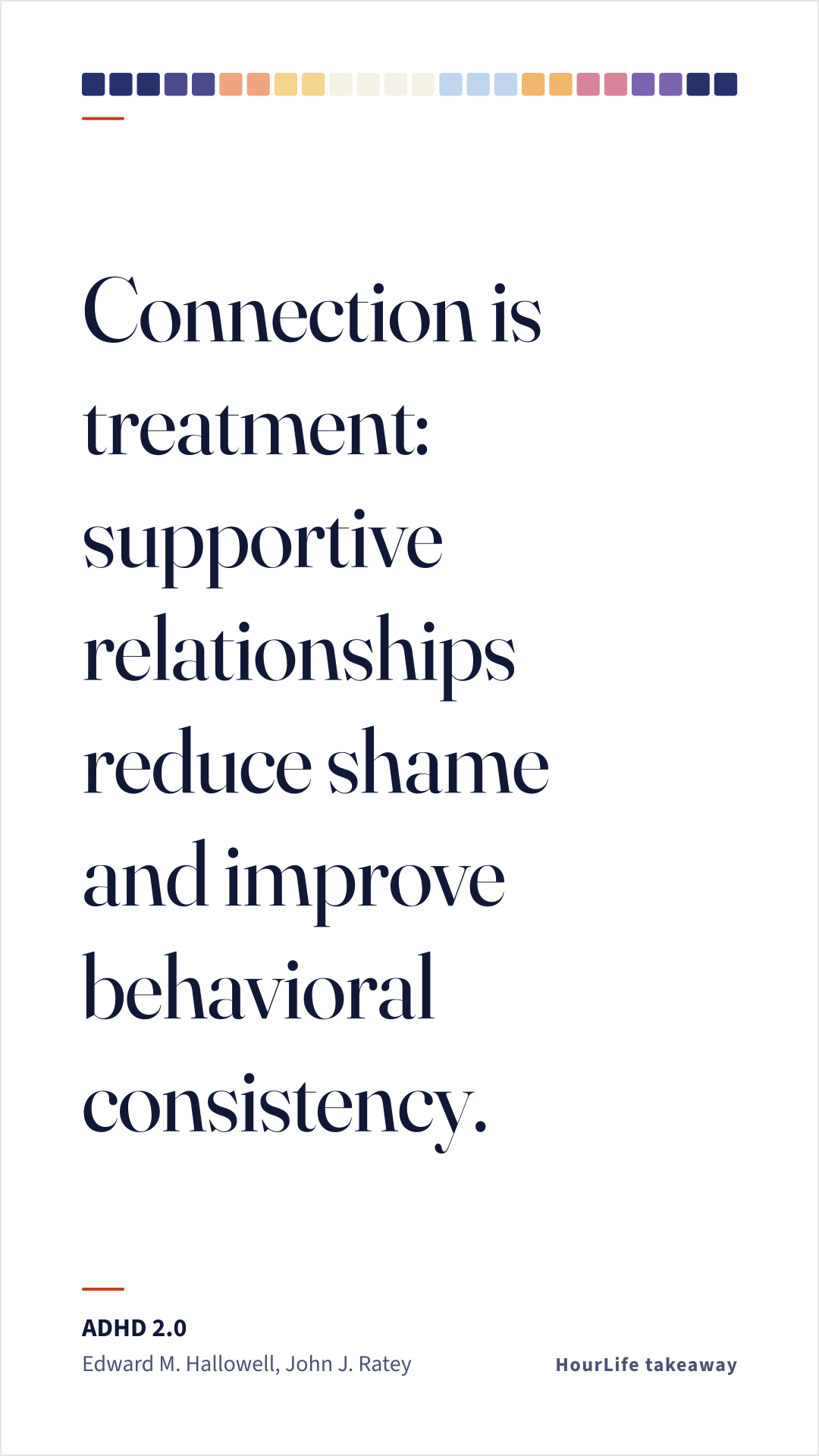
Connection is treatment: supportive relationships reduce shame and improve behavioral consistency.

ADHD 2.0 Edward M. Hallowell, John J. Ratey HourLife takeaway

Accountability plus emotional safety helps sustain routines. Isolation amplifies symptom load; structured support lowers it.

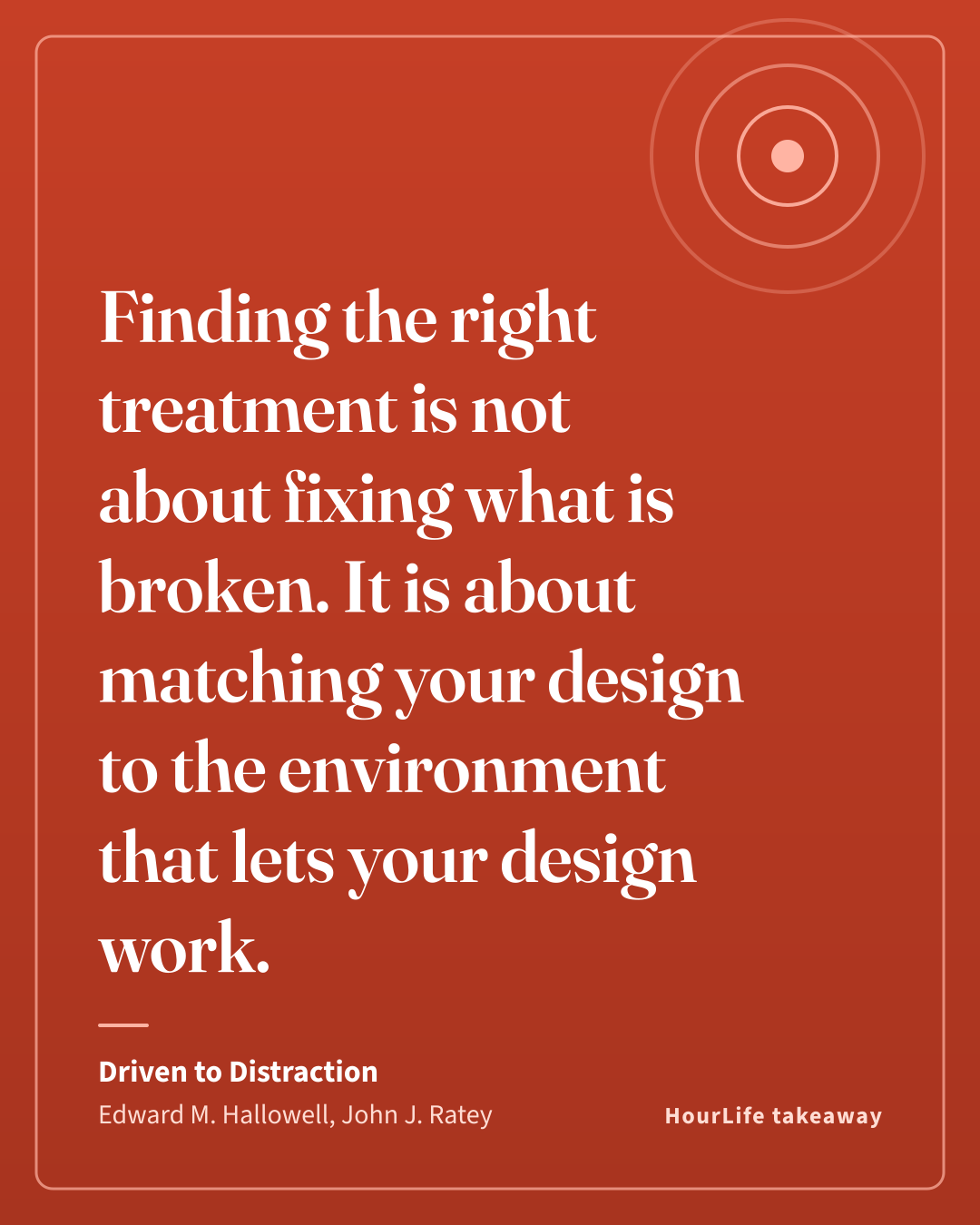
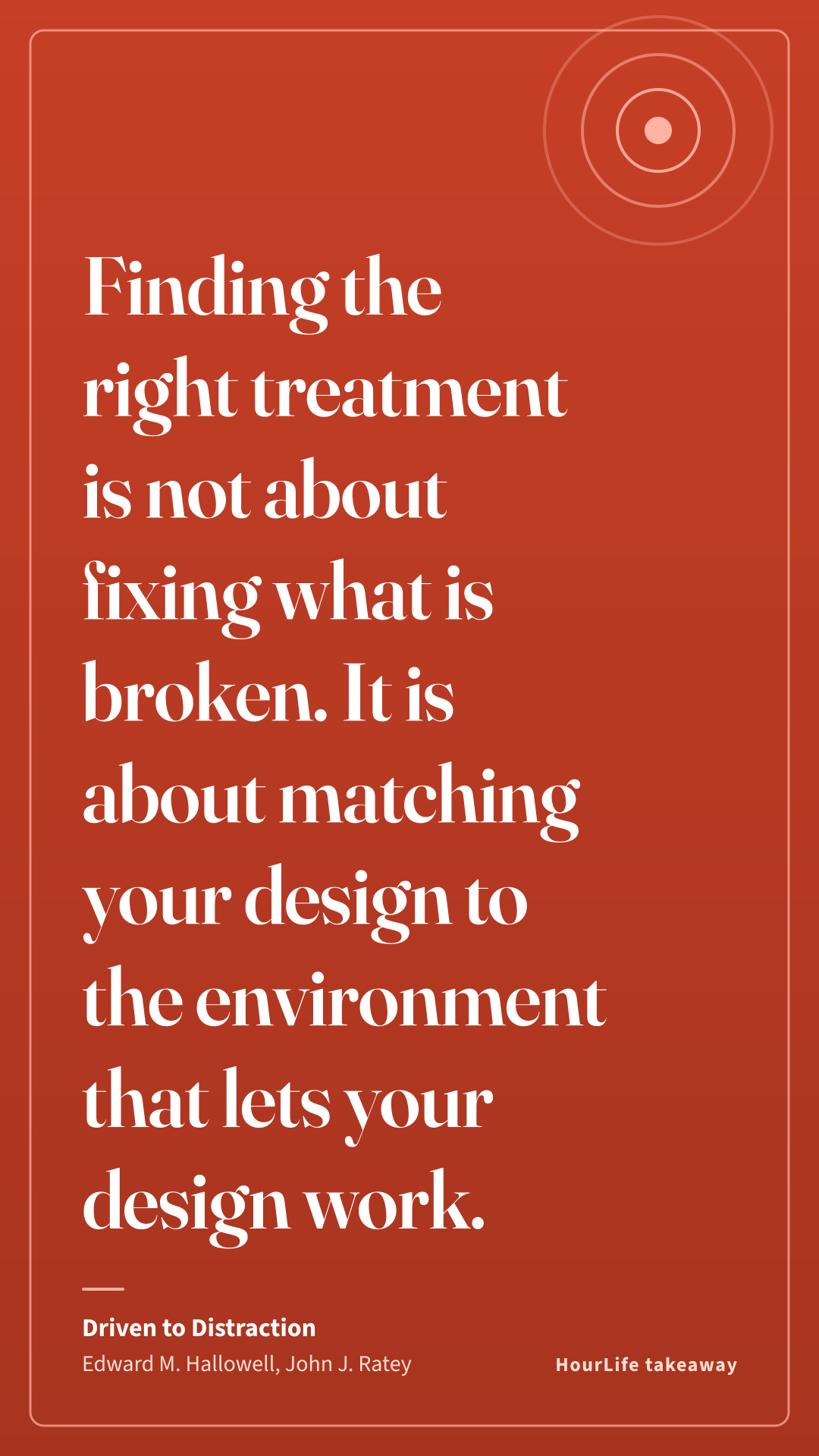
Finding the right treatment is not about fixing what is broken. It is about matching your design to the environment that lets your design work.

Driven to Distraction Edward M. Hallowell, John J. Ratey HourLife takeaway

The environmental-fit model: ADHD is not a universal dysfunction. It is a mismatch between brain design and the demands of conventional school, office, and schedule structure.

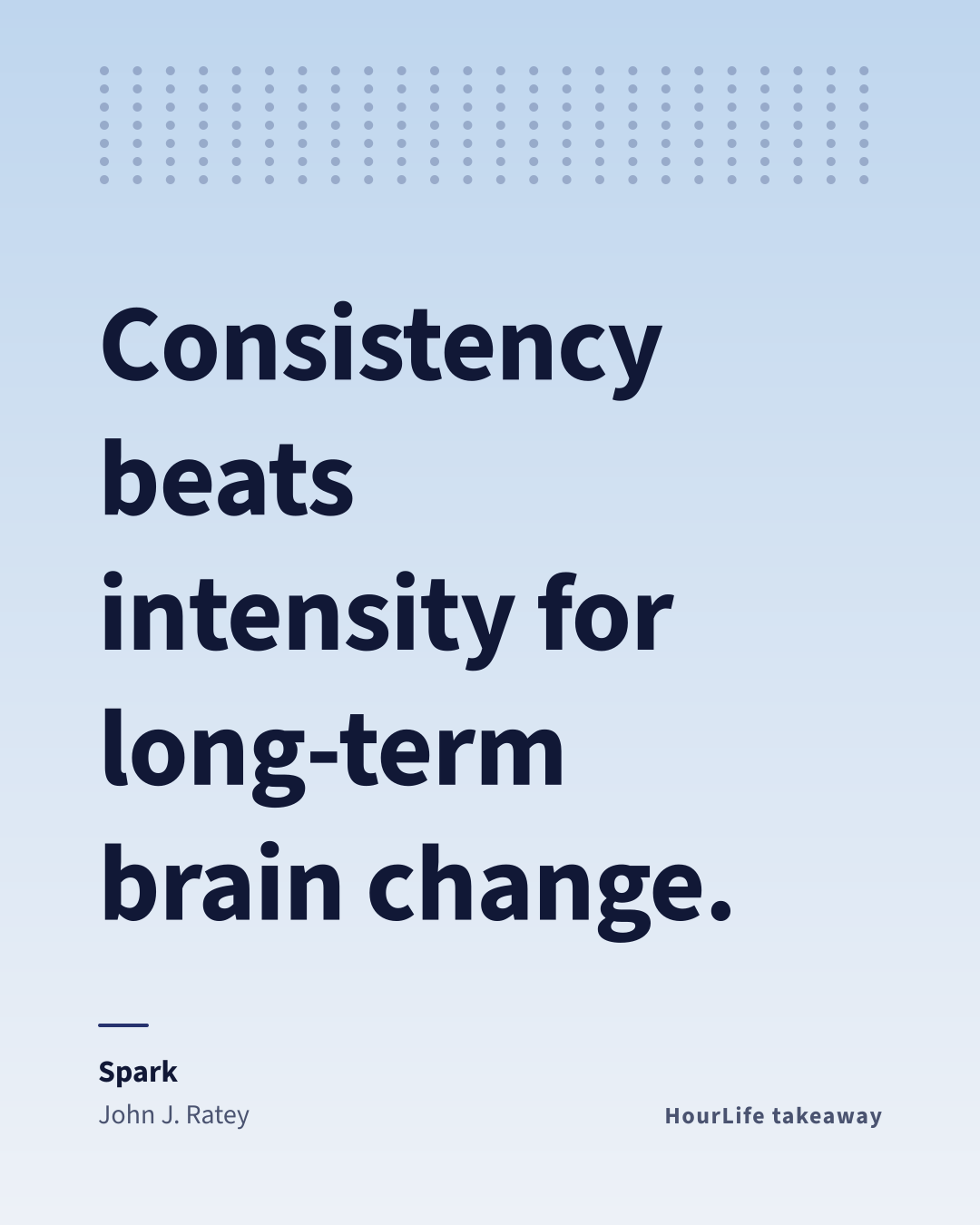
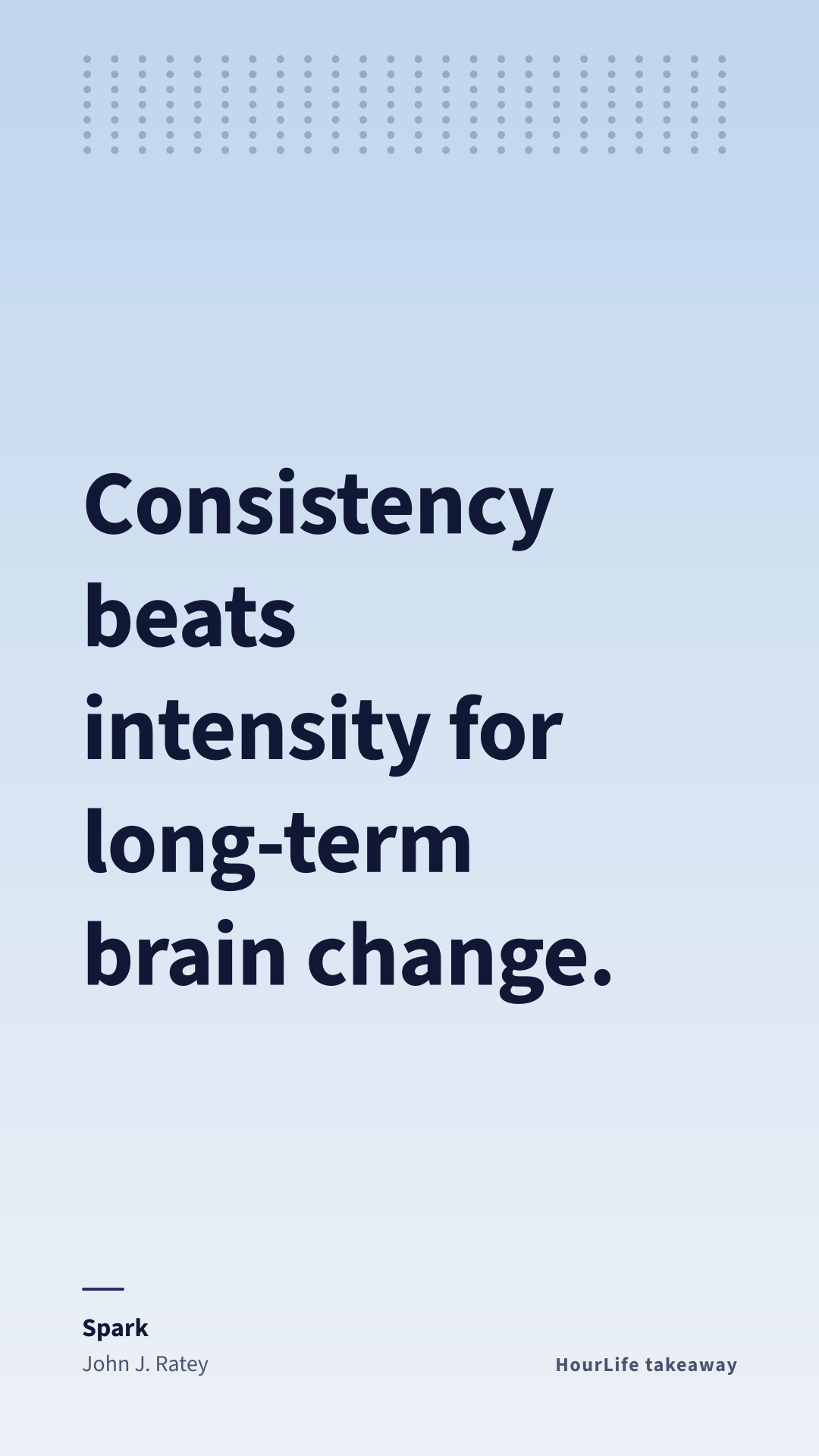
Consistency beats intensity for long-term brain change.

Spark John J. Ratey HourLife takeaway

The cognitive gains in Spark come from repeatable weekly doses of movement, not occasional extreme workouts.

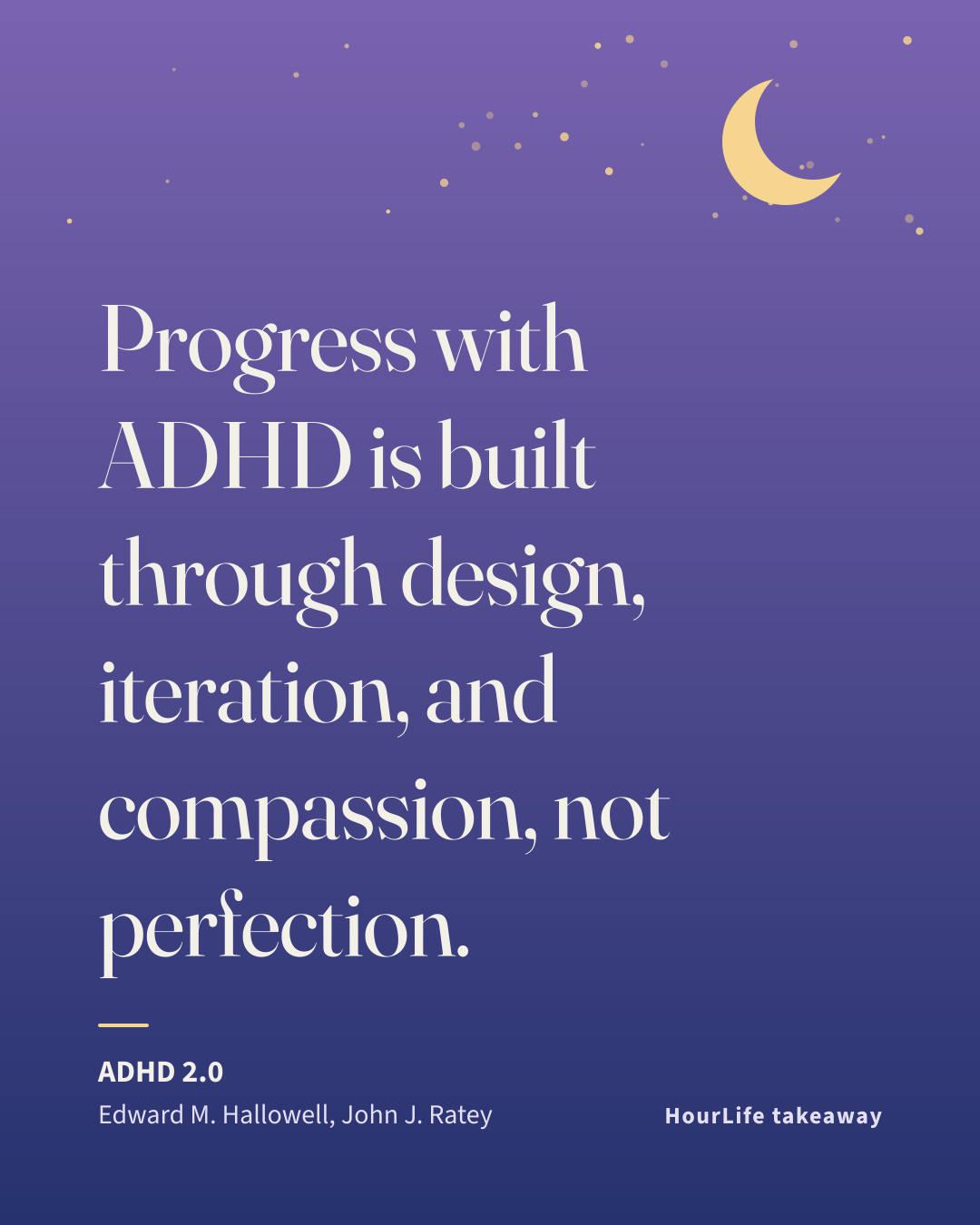
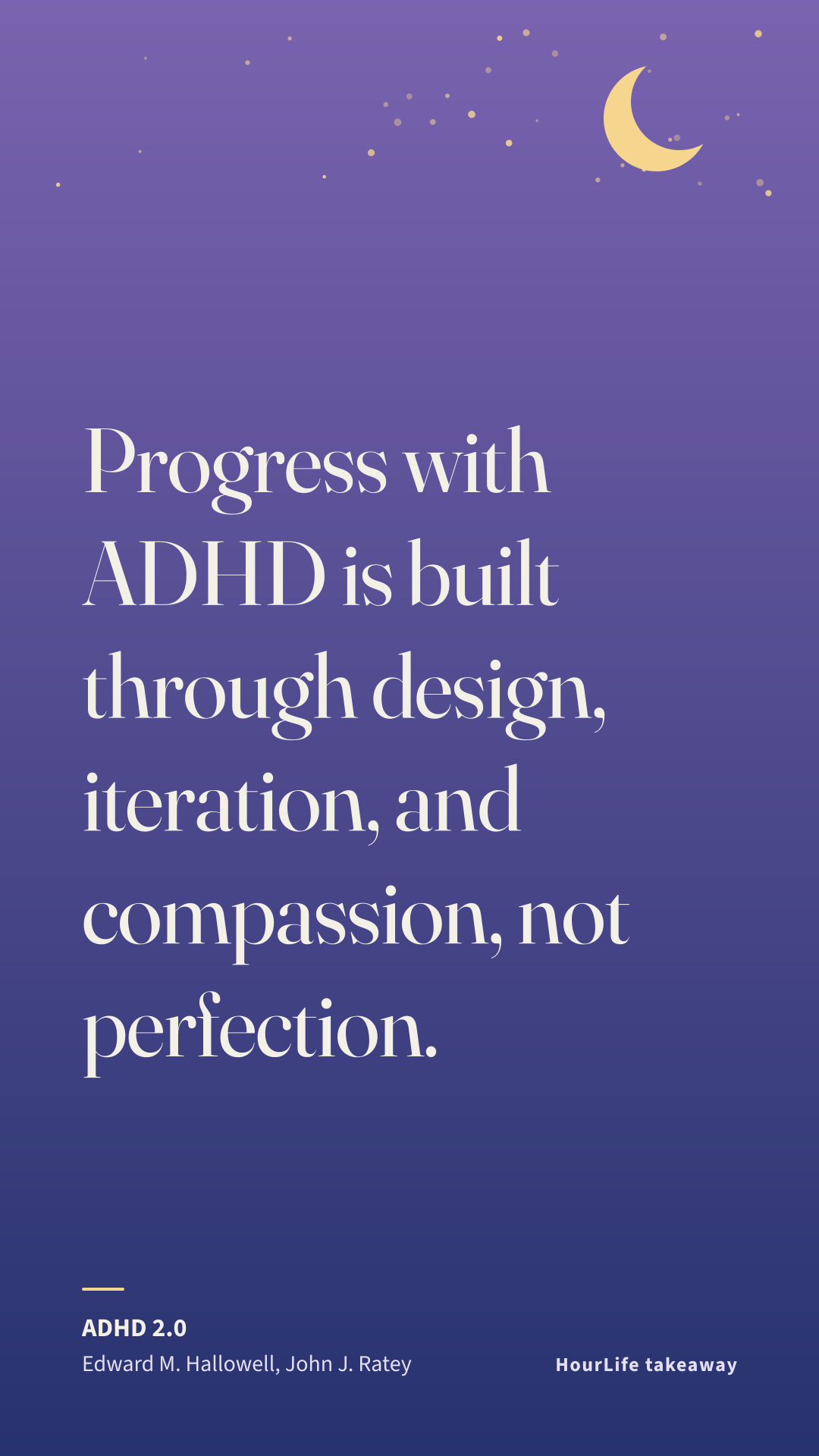
Progress with ADHD is built through design, iteration, and compassion, not perfection.

ADHD 2.0 Edward M. Hallowell, John J. Ratey HourLife takeaway

Long-term improvement comes from experimenting with systems, reviewing what works, and reducing self-attack during setbacks.

Keep this going in the app.

HourLife turns these ideas into a daily system — goals, habits, focus, and reflection in one private place.