Keep this author quotes for later
Sign in to save

Neil Howe

The most-loved lines from Neil Howe, drawn from 1 book in the library.

Lines labelled “HourLife takeaway” are our wording of the book’s ideas and may paraphrase it. Only lines in quotation marks are the author’s own words, with where they appear. Check the book for exact wording before you quote it. Spot an error?

The authors see history as a cycle of seasons, not a straight line of progress or a random string of events.

The Fourth Turning William Strauss and Neil Howe HourLife takeaway

Strauss and Howe contrast three ways of seeing time: linear, chaotic and cyclical. They argue that modern people lean on the first two and miss the third. Their cycle, the saeculum, lasts about as long as a long human life, roughly 80 to 100 years.


A turning is a mood that lasts about twenty years, and four of them make one full cycle.

The Fourth Turning William Strauss and Neil Howe HourLife takeaway

The High, the Awakening, the Unraveling and the Crisis each have a typical feel. A High trusts institutions and distrusts individualism; an Unraveling flips that around. The authors line the four up with spring, summer, autumn and winter.

In the book’s reading, a Crisis tears down the old civic order and builds a new one around a shared threat.

The Fourth Turning William Strauss and Neil Howe HourLife takeaway

The authors put the American Revolution, the Civil War, and the Depression and Second World War in this slot. Each began with a shock, deepened, and ended with institutions rebuilt. They argue the mood that follows is usually confident and collective.

The season you are born into shapes the archetype the authors assign you.

The Fourth Turning William Strauss and Neil Howe HourLife takeaway

Prophets are born in a High, Nomads in an Awakening, Heroes in an Unraveling and Artists in a Crisis. The archetypes are broad tendencies across a generation, not personality types for any one person. You can disagree with your own label and still find the frame useful.

Each generation tends to correct the excesses of the one that raised it.

The Fourth Turning William Strauss and Neil Howe HourLife takeaway

The authors argue that children raised loosely in one era tend to raise their own children more protectively, and the reverse. They point to the latchkey childhoods of Generation X and the closer supervision many Millennials grew up with. That swing, repeated, is part of what keeps the cycle turning.

The cycle is driven by people ageing into new roles, not by any single event.

The Fourth Turning William Strauss and Neil Howe HourLife takeaway

In the theory, each generation moves through four life phases of about twenty years: childhood, young adulthood, midlife and elderhood. When every generation steps up a phase at once, the mood of the whole society shifts. That is why the authors tie turnings so closely to generations.

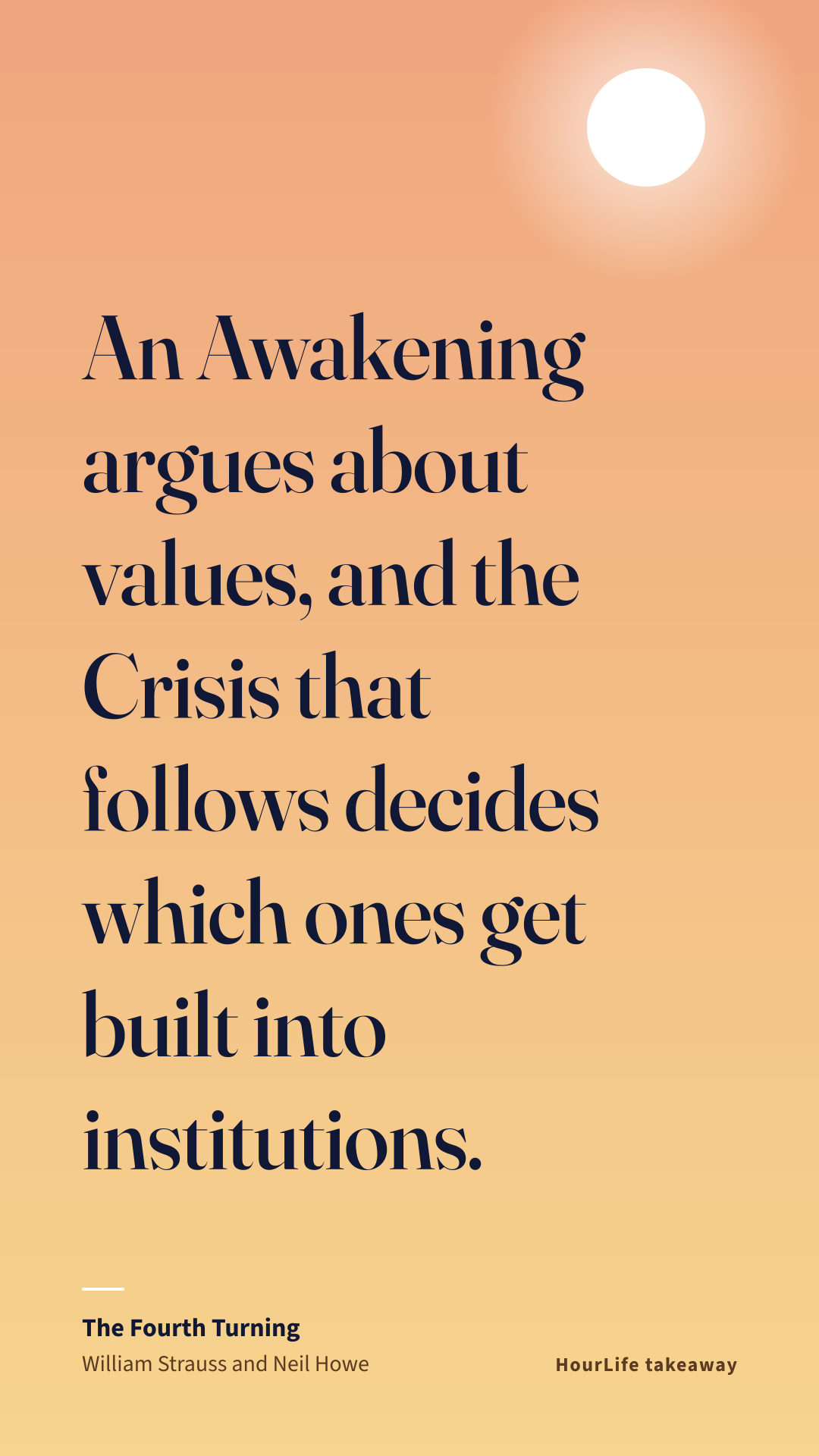
An Awakening argues about values, and the Crisis that follows decides which ones get built into institutions.

The Fourth Turning William Strauss and Neil Howe HourLife takeaway

The authors see the 1960s and 1970s as an Awakening, when young people challenged the order built after the war. They argue that the ideals argued over then become the agenda the same generation pushes as elders in the next Crisis.

You cannot skip a season, but you can prepare for it.

The Fourth Turning William Strauss and Neil Howe HourLife takeaway

The book closes with advice for households as well as nations. Its spirit is plain: keep reserves, strengthen ties with family and neighbours, and build skills that hold their value in hard years. That advice stands whether or not you accept the cycle.

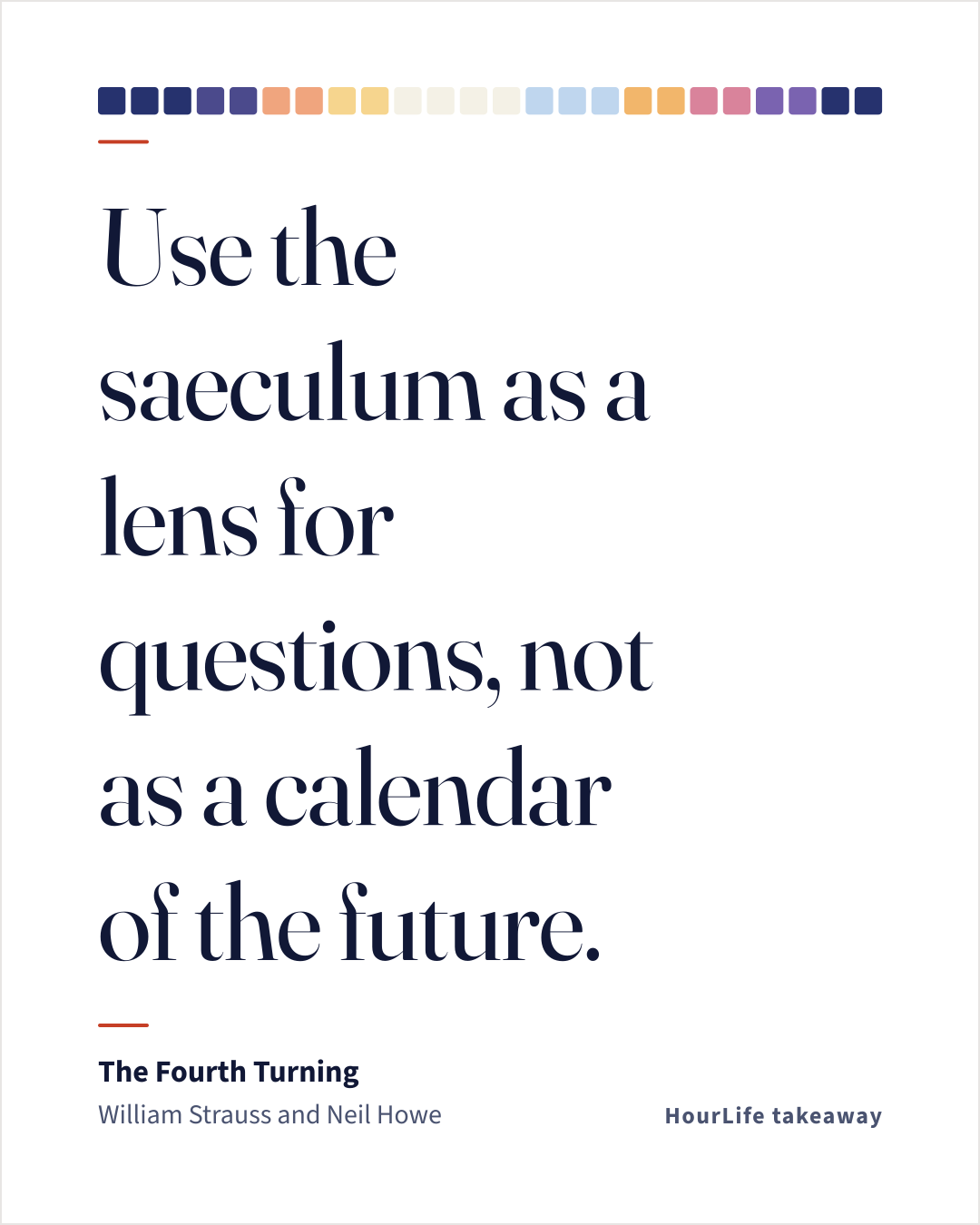
Use the saeculum as a lens for questions, not as a calendar of the future.

The Fourth Turning William Strauss and Neil Howe HourLife takeaway

Many historians criticise the theory as too neat and hard to disprove, because almost any event can be fitted into some turning. HourLife's view is that its value lies in asking how your generation's start in life shaped what feels normal to you, not in dating the next war.

Keep this going in the app.

HourLife turns these ideas into a daily system — goals, habits, focus, and reflection in one private place.