- Games
- Brain tests
- Color Blind Test
Color blind test
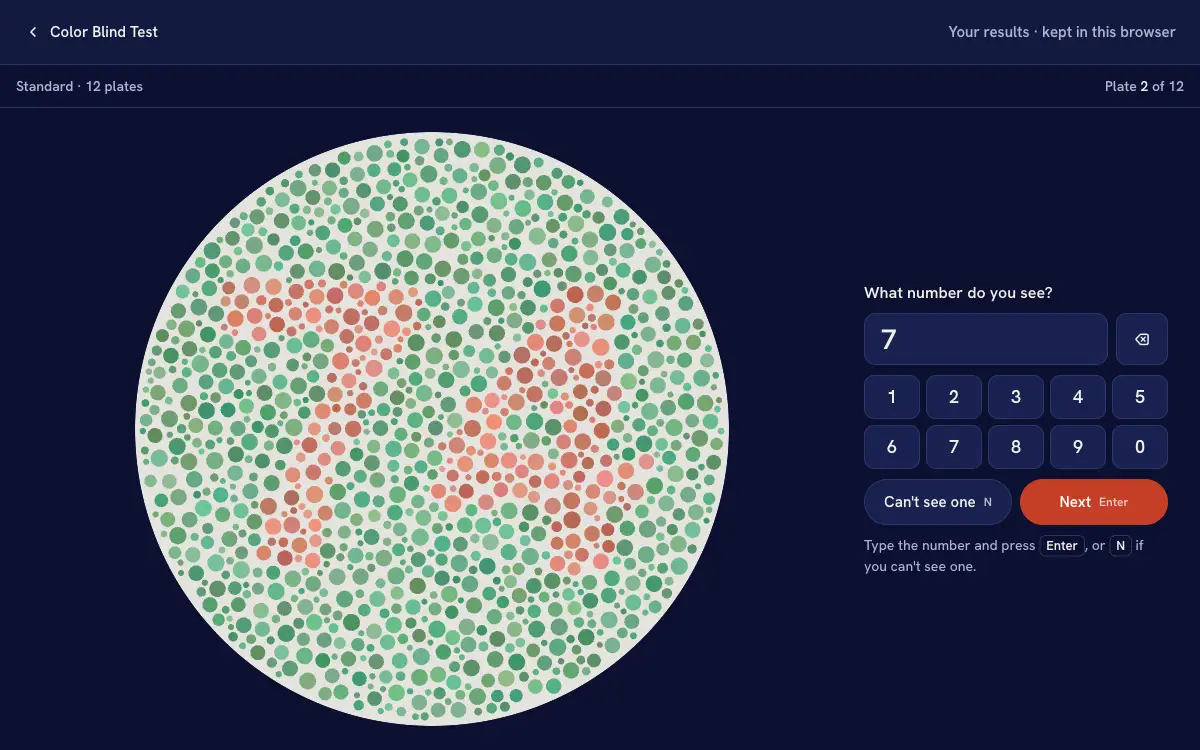
Twelve circles of colored dots, each hiding a number. Type what you see. It is a quick screen of red–green and blue–yellow color vision, and a game, not a diagnosis.
- 2 minutes for 12 plates
- Drawn fresh every plate is made by the page as you start
- No account your scores stay in this browser
Plates are drawn sharp for your screen, but their colors depend on your display and its settings. Compare runs on the same device, with color filters off.
Your results
- Latest
- Best
- Average
How it works
Set up your screen
Turn off Night Shift, True Tone and any blue-light filter, turn the brightness up, and look at the screen straight on. Those settings shift the very colors the plates depend on.
Read each plate
Each plate is a circle of dots with a one- or two-digit number in it. Type the number and press Enter, or press Can't see one. You aren't told as you go; the score comes at the end.
Read your summary
Your score is how many of the 12 you read. The summary splits it into the control plate, seven red–green plates and four blue–yellow ones, and says plainly what misses can and can't mean.
How dot plates work
Dot plates like these are called pseudoisochromatic plates, and they are a long-established way to screen color vision. A number is drawn in dots whose colors differ from the dots around it in a way some people can't see. Lightness is mixed at random across the whole plate, so brightness gives nothing away; only hue separates the number from the ground.
The plates here are not copies of any published test. The page draws every one when you press Start: it packs a circle with dots, draws a random number offscreen as a mask, and picks the number's colors and the ground's along the directions that people with red–green or blue–yellow color vision differences tend to confuse. To check the design, it uses a published model of how colors look without one kind of cone (Machado and colleagues, 2009). Under that model, number and ground come out nearly the same.
Red–green differences are the common kind. A review of large population surveys found them in about 8% of men and about 0.4% of women of European descent, and in 4% to 6.5% of men of Chinese and Japanese descent (Birch, 2012). A screen can't reproduce the colors of clinical plates, and a warm or dim display changes what you see, so this is a screening game, not a diagnosis. An optometrist can test properly.
Sources: Birch, Worldwide prevalence of red-green color deficiency, Journal of the Optical Society of America A 29(3) (2012); Machado, Oliveira & Fernandes, A physiologically-based model for simulation of color vision deficiency, IEEE Transactions on Visualization and Computer Graphics 15(6) (2009).
Questions
-
Is this a real color blindness test?
It is a screening game, not a diagnosis. It works the way printed dot plates do, but a screen can't show their exact colors, and your display settings and the light in the room change what you see. If you think your color vision differs, an optometrist can test it properly.
-
Are these Ishihara plates?
No. Every plate is drawn by this page when you press Start, from random dots and a random number, so no two runs are the same. It uses the long-established idea behind published plate tests, but none of their plates.
-
Why did I miss plates when my color vision is fine?
Night Shift, True Tone and blue-light filters warm the screen and shift exactly the colors the plates use. A dim or tilted screen, glare and a small screen make the fainter plates harder too. Turn those off, turn the brightness up and try again. The first plate is a check: it uses light and dark, so if you missed it, the screen or a setting is the likely cause.
-
What do the red–green and blue–yellow plates mean?
The seven red–green plates use colors that people with red–green color vision differences tend to confuse, and the four blue–yellow plates do the same for blue–yellow differences. Each set gets fainter as it goes. Missing several in one set is a reason to see an optometrist, not a result in itself.
-
Can I take it without seeing the screen?
No. The plates are made of color alone, so the test needs sight. A screen reader can follow the steps and read the results, but not the plates themselves.
-
Where are my results saved?
Only in this browser, in its local storage: the last 20 runs of each mode. Nothing is sent to HourLife, and clearing your browser's site data or pressing Clear removes them.
More brain tests
Time · 2 min
Time Perception Test
Hold a target length in your head, repeat a length you saw, or pick the longer of two. No clock on screen.
Take the testSpeed · 1 min
Reaction Time Test
Wait for green, then tap. One round for a quick check, five for an average.
Take the testSpeed · 1 min
Aim Trainer
Hit 30 targets as they appear. Your score is the average time per hit.
Take the testA day is easier to see than to remember
HourLife draws your day as 24 hours on your iPhone, so you can see where the time goes.

