- Games
- Brain tests
- Mental Rotation Test
Mental rotation test
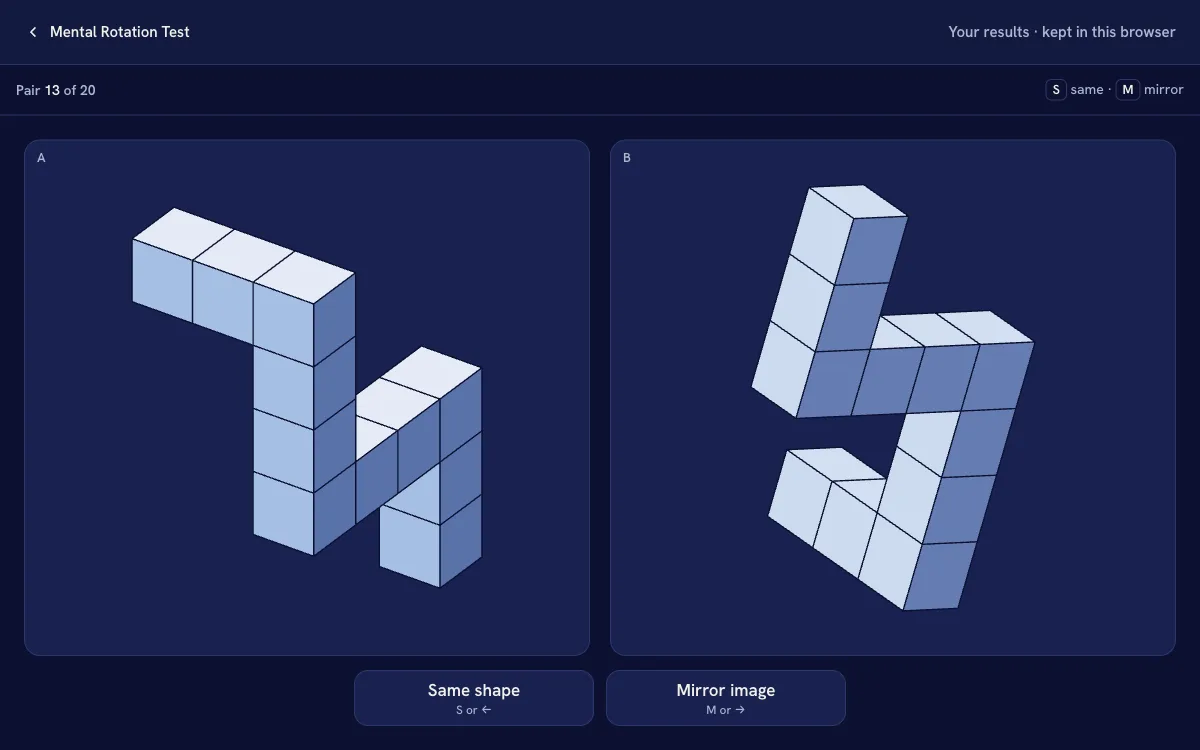
Two shapes made of cubes. Is the second one the first, turned, or is it the mirror image? Twenty pairs, and the turns get bigger and harder to follow.
- 3 minutes for twenty pairs
- Mouse, touch or keys S and M, or the arrow keys
- No account your scores stay in this browser
The shapes are drawn fresh for every run. A bigger screen makes them easier to see; on a phone they stack.
Your results
- Latest
- Best
- Average
How it works
Look at the two shapes
Each shape is about ten cubes joined in a bent rod. The second shape is the first one turned by anything from nothing to most of a half turn, or it is the first one's mirror image, turned.
Say same or mirror
Press Same shape (S or the left arrow) or Mirror image (M or the right arrow). You see at once whether you were right, then the next pair appears. The first ten pairs turn like a turntable; the last ten turn about any axis.
Read your score
Your score is how many of the twenty you got right. You also see your average time per right answer, and whether pairs that were turned further took you longer.
Why bigger turns take longer
In 1971 Roger Shepard and Jacqueline Metzler showed people pairs of drawings like these and asked the same question: one shape, or two different ones? The time it took to say they were the same grew in a straight line with the angle between the two drawings. It was as if people turned one shape in their mind, at a steady pace, until it lined up with the other.
They also found that a turn in depth, into the page, took no longer than a turn flat on the page. That suggests people were picturing the solid shape, not just the flat drawing.
This test follows the same idea with its own shapes, made fresh on every run. It compares your times on small and large turns so you can see the effect in your own answers. There is no population score behind it; the only comparison is with your earlier runs.
Sources: Shepard & Metzler, Mental rotation of three-dimensional objects, Science 171(3972) (1971).
Questions
-
How is my score worked out?
Your score is how many of the twenty pairs you got right. Each answer is also timed, from the screen frame the pair appeared on to your press, and the average over your right answers is shown with it. Speed is never part of the score, so take the time you need.
-
How does it tell whether bigger turns slowed me down?
It takes the pairs that were the same shape and that you got right, as the original study did, and compares your average time on turns of 40 degrees or less with turns of 120 degrees or more. If either group has no right answers, it says nothing.
-
Why can't I just turn the mirror image to match?
Because no turn can. A mirror image is like a left hand next to a right one: the same parts, put together the other way round. Every shape in this test is checked so that its mirror image really is a different shape.
-
Can I take it without seeing the screen?
No, and we would rather say so plainly. The pairs are drawings with no text version, because any description detailed enough to answer from would give the answer away. A screen reader can reach the buttons and your results, but the shapes themselves need sight.
-
Is this an IQ test?
No. It is a game built on a classic experiment. It doesn't measure intelligence or diagnose anything, and your result can move from day to day with practice, tiredness and the size of your screen.
-
Where are my results saved?
Only in this browser, in its local storage: the last 20 runs of each mode. Nothing is sent to HourLife, and clearing your browser's site data or pressing Clear removes them.
More brain tests
Time · 2 min
Time Perception Test
Hold a target length in your head, repeat a length you saw, or pick the longer of two. No clock on screen.
Take the testSpeed · 1 min
Reaction Time Test
Wait for green, then tap. One round for a quick check, five for an average.
Take the testSpeed · 1 min
Aim Trainer
Hit 30 targets as they appear. Your score is the average time per hit.
Take the testSome things are easier to see than to picture
HourLife draws your day as 24 hours you can look at, so you don't have to turn the week over in your head.

