- Games
- Brain tests
- Number Memory Test
Number memory test
A number shows for a moment, then hides. Type it back. It starts at three digits and grows by one each round, until one gets away.
- Starts at 3 digits one more each round
- Any keyboard the number pad opens on phones
- No account your scores stay in this browser
Only the display is timed, so your device makes little difference. On a phone, the number pad opens when the answer box appears.
Your results
- Latest
- Best
- Average
How it works
Read the number
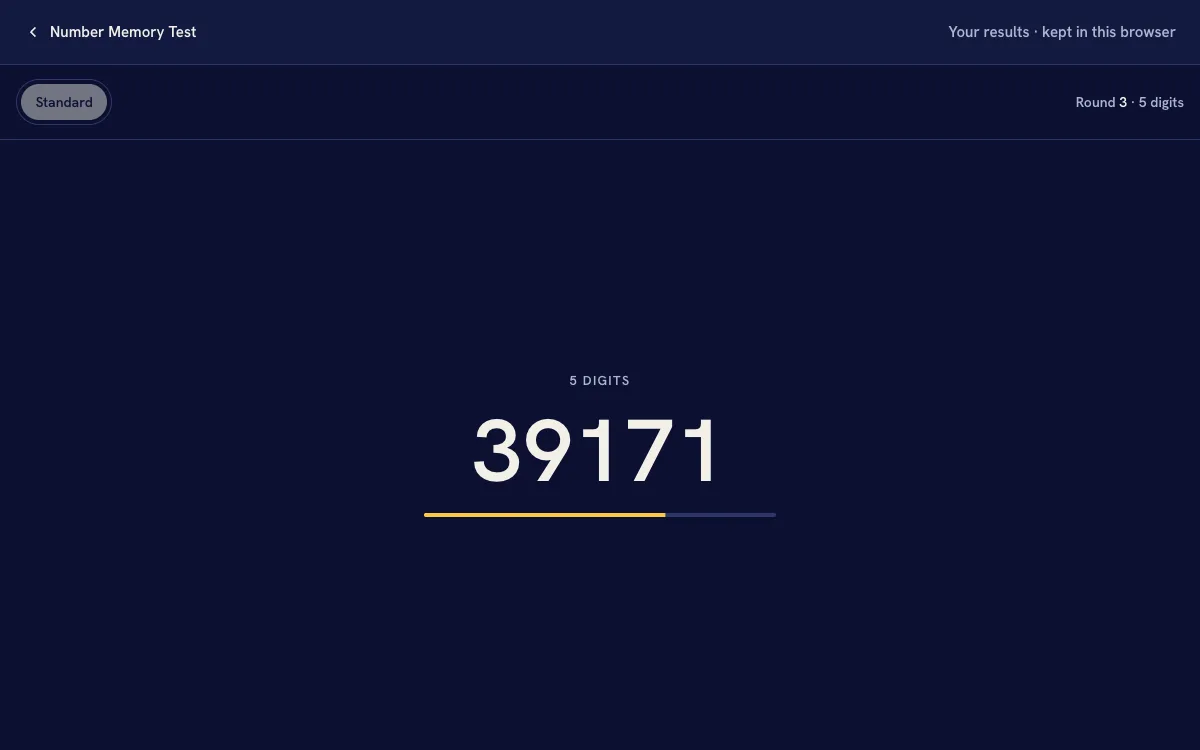
Press Play and then Start. A number appears in large digits for one second plus half a second per digit, so three digits stay up for two and a half seconds. A thin bar shrinks to show the time left.
Type it back
The number hides and an answer box appears. Type what you remember and press Enter or Submit. Spaces don't matter, so you can type it in groups.
Go until one slips
Right, and the next number is one digit longer. Wrong, and the run ends, with the number and your answer one above the other and the digits that differ underlined. Your score is the longest number you got right.
What a span of digits measures
This is a version of the digit-span task: take in a list of digits, then give it back in order. The longest list you can repeat is your span, and span tasks like it have long been used to study short-term memory.
In 1956 George Miller pointed out that, for many kinds of material, the span of immediate memory is about seven items, and that people stretch it by recoding: grouping small items into bigger chunks. Nelson Cowan later gathered the evidence that when grouping is blocked, the real limit is smaller, about three to five chunks.
That is why the way you read a number matters. Seeing 472916 as 472 and 916 turns six digits into two groups, and you're welcome to do it. It is a game, not a diagnosis, and your result moves with sleep, attention and noise around you.
Sources: Miller, The magical number seven, plus or minus two, Psychological Review 63(2) (1956); Cowan, The magical number 4 in short-term memory, Behavioral and Brain Sciences 24(1) (2001).
Questions
-
How long does each number stay on screen?
One second plus half a second for each digit, timed from the moment it is drawn. Three digits stay up for two and a half seconds, ten digits for six.
-
How is my score worked out?
It is the length of the longest number you typed back exactly. Round 1 has three digits and each round adds one. If you get the 8-digit number right and miss the 9-digit one, your score is 8. A miss in round 1 scores 0.
-
Is it cheating to split the number into groups?
No. Grouping digits into chunks is one of the main ways memory copes with long numbers, and it is how most people remember phone numbers. The test doesn't try to stop it.
-
What if I mistype?
You can fix the answer before you press Enter. Once it is submitted it counts. Spaces and any other characters that aren't digits are ignored.
-
Is this a medical test?
No. It is a game that shows how much your short-term memory holds on the day. It cannot diagnose anything, and tiredness or distraction will move your result.
-
Where are my results saved?
Only in this browser, in its local storage: the last 20 runs of each mode. Nothing is sent to HourLife, and clearing your browser's site data or pressing Clear removes them.
More brain tests
Memory · 2 min
Sequence Memory Test
Watch squares light up in order, then repeat it. Each round adds one more.
Take the testTime · 2 min
Time Perception Test
Hold a target length in your head, repeat a length you saw, or pick the longer of two. No clock on screen.
Take the testSpeed · 1 min
Reaction Time Test
Wait for green, then tap. One round for a quick check, five for an average.
Take the testHold less in your head
HourLife, an iPhone app, draws your day as 24 hours on one screen, so the plan stays in view when the numbers slip.

