- Games
- Brain tests
- Sequence Memory Test
Sequence memory test
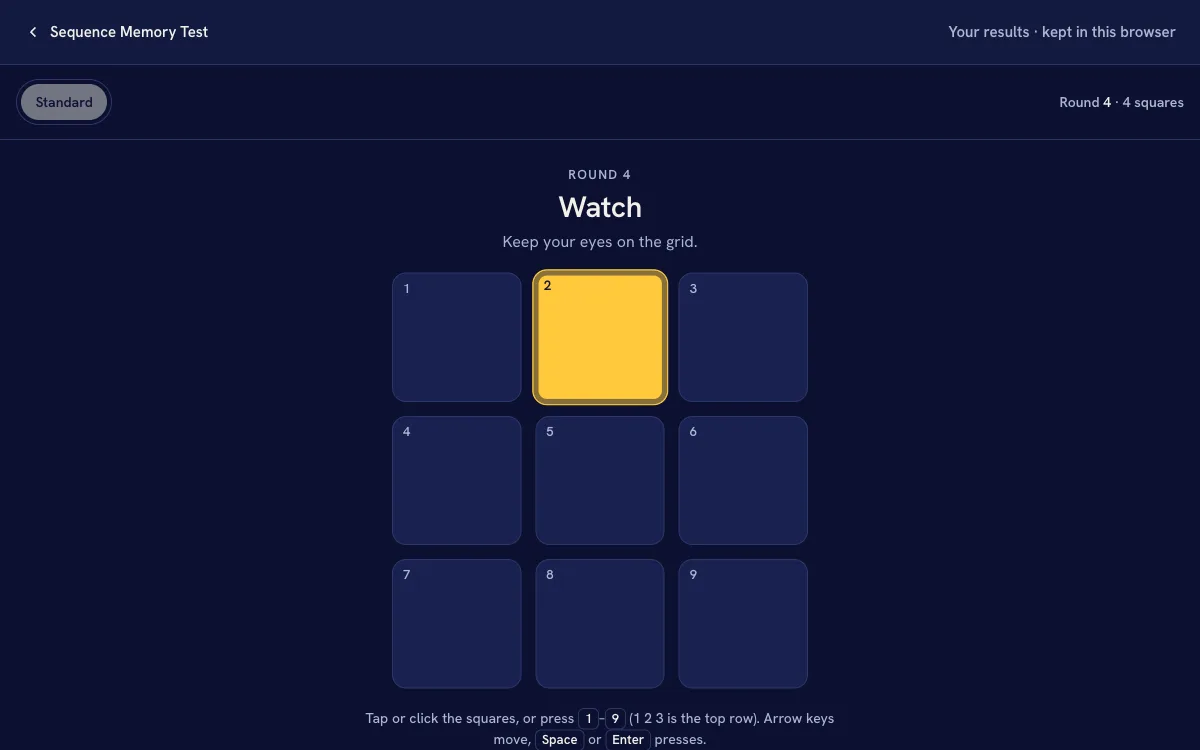
Nine squares light up one at a time. Watch the order, then press them back the same way. Each round adds one more square, and one slip ends the run.
- One more square each round
- Mouse, touch or keys 1 to 9 work like a phone keypad
- No account your scores stay in this browser
Speed doesn't count here, only order, so your device makes little difference. Each square lights for under half a second; a screen without glare helps.
Your results
- Latest
- Best
- Average
How it works
Watch
Press Play and then Start. After a short pause, squares light up one after another, each for under half a second. You can't press anything while it plays.
Repeat it
When it says Your turn, press the squares in the same order. Each right press lights the square. Get the whole sequence and the next round plays it again with one square added.
One slip ends it
A wrong press ends the run and marks the square that was next. Your score is the longest sequence you repeated in full. The last 20 runs are kept on this page.
What a sequence of squares measures
This is a version of the Corsi block-tapping task, a widely used test of visuospatial memory: holding where things were and in what order. In the classic version, someone taps blocks scattered on a board, one by one, and you tap the same blocks back. Here the blocks are nine squares and the page does the tapping.
Each round adds one square, so the test finds the length where the order stops fitting. You might help yourself by seeing the path as a shape, or by saying the square numbers under your breath. Both are fair. They show how much memory leans on grouping and on words.
It is a game, not a clinical test or a diagnosis. Clinicians give the Corsi task with set blocks, timings and scoring rules, and read it alongside other tests. A score here compares only with your own earlier runs, and it moves with sleep, attention and practice.
Questions
-
How is my score worked out?
It is the longest sequence you repeated in full. Round 1 has one square, round 2 has two, and so on. If you clear round 6 and slip in round 7, your score is 6. A slip in round 1 scores 0.
-
Can the same square come up more than once?
Yes. Each round adds one square at random, so a square can appear several times in a sequence, but never twice in a row.
-
Does it get faster?
No. Every square lights for the same time with the same gap, in every round. Only the length changes.
-
Can I use the keyboard?
Yes. The keys 1 to 9 press the squares like a phone keypad, with 1 2 3 on the top row. You can also move between the squares with the arrow keys and press one with Space or Enter. The playback itself is only visual, so the test needs you to see the grid.
-
Is this a medical test?
No. It is a game that shows how your memory for order behaves on the day. It cannot diagnose anything, and tiredness, distraction or a glare on the screen will all move your result.
-
Where are my results saved?
Only in this browser, in its local storage: the last 20 runs of each mode. Nothing is sent to HourLife, and clearing your browser's site data or pressing Clear removes them.
More brain tests
Memory · 2 min
Number Memory Test
A number shows for a moment, then you type it. It grows a digit each round.
Take the testTime · 2 min
Time Perception Test
Hold a target length in your head, repeat a length you saw, or pick the longer of two. No clock on screen.
Take the testSpeed · 1 min
Reaction Time Test
Wait for green, then tap. One round for a quick check, five for an average.
Take the testOrder is easier to see than to hold
HourLife, an iPhone app, draws your day as 24 hours you can look at, so the order of things doesn't have to live in your head.

