- Games
- Brain tests
- Multiple Object Tracking Test
Multiple object tracking test
A few dots are marked, then the marks go and every dot moves. When they stop, find the ones you were following. Each round adds dots, targets or speed.
- Up to 4 minutes for a long run
- Two modes classic and decoy
- No account your scores stay in this browser
The dots move by the frames your screen draws and scale with your window, so compare runs on the same device and window size.
Your results
- Latest
- Best
- Average
How it works
Note the marked dots
Each round starts with the dots standing still and a few of them marked for two seconds. Round 1 has 2 marked out of 8; round 16 has 7 out of 20.
Follow them as they move
The marks clear and every dot moves for six seconds, drifting and bouncing off the walls and each other. They all look the same now, so only your attention keeps them apart.
Pick them out
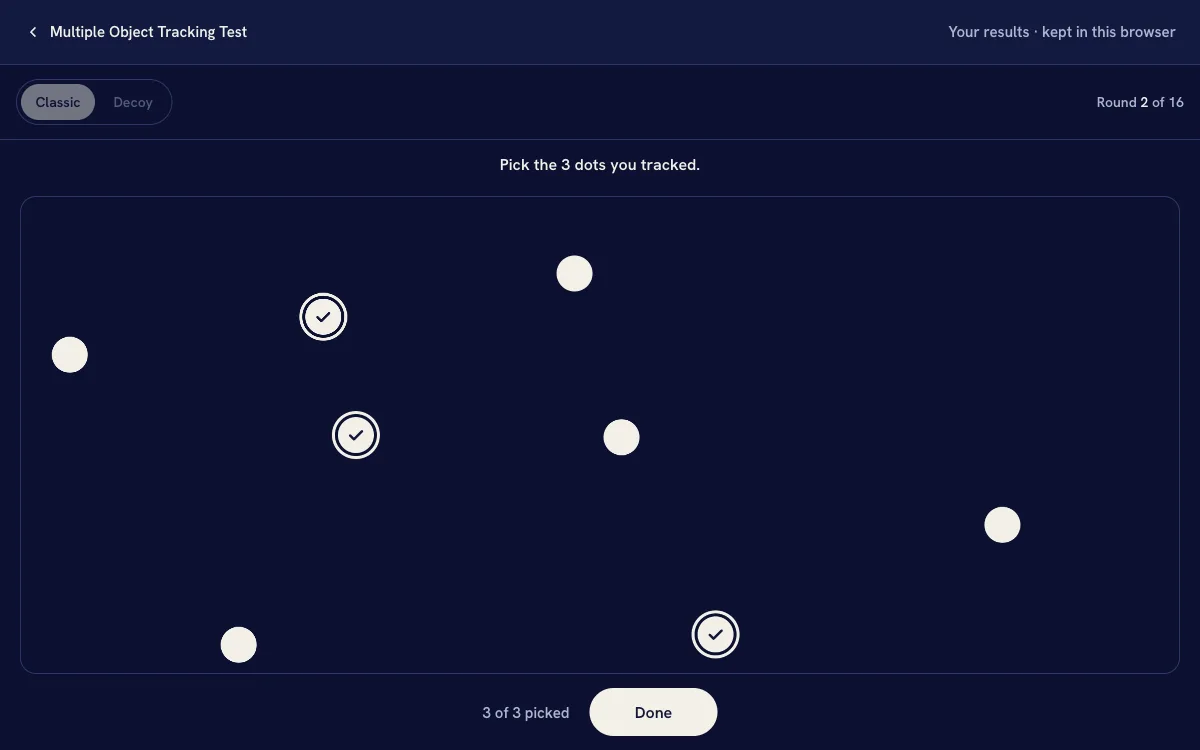
When the dots stop, pick the ones you followed and press Done. Get them all and the next round is a little harder; pick one that wasn't marked and the run ends. Your score is the number of rounds you cleared.
Following several things at once
In 1988 Zenon Pylyshyn and Ron Storm asked people to follow a few identical dots as they moved among others, and argued from the results that attention can follow several of them at the same time, rather than one spotlight hopping from dot to dot. Because the targets look exactly like the rest, the only way to know which is which is to keep following them. Their task is the one this test is built on.
Researchers still argue about how it works: whether attention keeps a few separate pointers, or spreads out as a pool that thins as you add more. Either way, tracking gets harder with more targets, faster motion and dots that crowd together, and each round of this test turns up one of those.
Decoy mode adds a pull on your attention. While the dots move, a dot that was never marked wears the mark for a moment. It asks whether you can stay with your own dots while something else asks to be looked at. This is a game, not a measure of attention for any medical purpose.
Questions
-
How is my score worked out?
It is the number of rounds you cleared, from 0 to 16. A round is cleared when every dot you pick was one of the marked ones. The first wrong pick shows you where the marked dots really were and ends the run.
-
What changes from round to round?
Three things, a little at a time: the number of dots goes from 8 to 20, the number to follow from 2 to 7, and the speed rises to a bit more than twice where it starts. Speed is measured in dot widths, so a bigger window shows bigger dots moving faster, and the test stays about as hard.
-
What does Decoy mode do?
While the dots move, about once a second a dot you are not tracking flashes the mark for a third of a second. It is there to pull your eyes away. The dots to pick are still only the ones marked at the start.
-
Can I do this with a keyboard?
Yes. Start with Space or Enter. Following the dots needs only your eyes. When they stop, Tab or the arrow keys move between them, Space or Enter picks one or unpicks it, and Enter on Done confirms. Escape stops a run.
-
What if motion makes me unwell?
This test is made of moving dots, and the motion is the test, so it can't be turned off. If motion makes you unwell, skip this one. Nothing moves until you press Start, and Escape stops a run at any time.
-
Where are my results saved?
Only in this browser, in its local storage: the last 20 runs of each mode. Nothing is sent to HourLife, and clearing your browser's site data or pressing Clear removes them.
More brain tests
Attention · 2 min
Stroop Test
Name the colour of the ink, not the word it spells. Speed counts, and so do mistakes.
Take the testAttention · 1 min
Schulte Table
Find the numbers in order on a scrambled grid, as fast as you can.
Take the testTime · 2 min
Time Perception Test
Hold a target length in your head, repeat a length you saw, or pick the longer of two. No clock on screen.
Take the testKeep track of the day, too
HourLife is an iPhone app that draws your day as 24 hours you can see, so you know where your attention went without having to follow it.

