- Games
- Brain tests
- Stroop Test
Stroop test
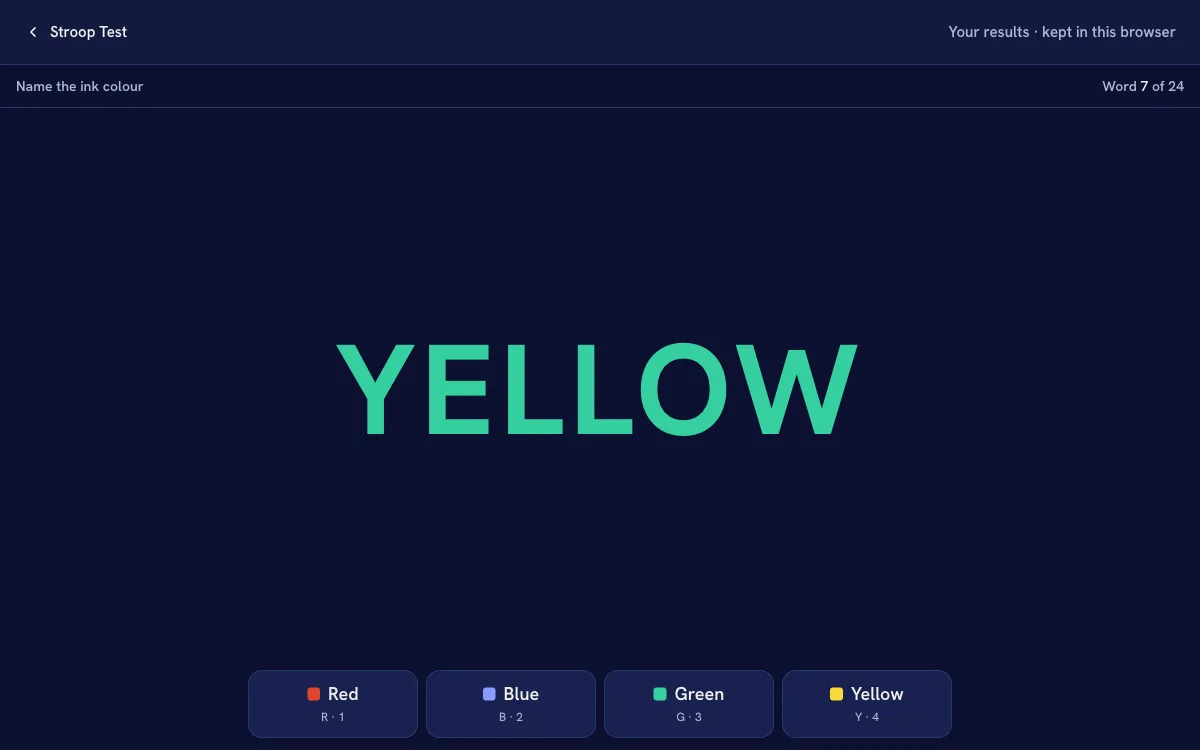
The word says BLUE and the ink is red. Name the ink. Twenty-four words, four colours, and a score in milliseconds that shows how much the word gets in your way.
- 2 minutes for 24 words
- Keys or taps R, B, G and Y, or 1 to 4
- No account your times stay in this browser
Answering by key and by tap take different times, so compare runs made the same way.
Your results
- Latest
- Best
- Average
How it works
Name the ink
A word appears in coloured ink. Press the button for the colour of the ink, whatever the word says. The buttons name the four colours in plain text: red, blue, green and yellow.
Go fast, but get it right
Each word is timed from the frame it appears to your answer. Half the words name a different colour from their ink, a quarter match it, and a quarter are a row of Xs. A wrong answer shows what the ink was and counts as a mistake.
See your Stroop effect
Your score is the average time of your correct answers. The page also shows your Stroop effect: how much longer the clashing words took you than the matching ones.
Why the word gets in the way
In 1935 John Ridley Stroop showed that naming the ink colour of a colour word is slower when the word names a different colour. Reading the words aloud was hardly slowed by clashing ink, but naming the ink was slowed a good deal by the word. The slowdown has carried his name ever since.
Why it happens is still argued over. A long-standing idea is that reading is so practised that the word arrives whether you want it or not, and has to be set aside before you can name the colour. Colin MacLeod's 1991 review gathered some 400 studies from over fifty years, set out 18 findings that any explanation has to fit, and found that neither of the two leading explanations of the time covered them all.
The original test asked people to say the colours aloud. A web page can't time your voice well, so here you press a button, which adds the time it takes to find the right one. Your number will move with your device, the way you answer and how familiar the test has become, so compare it only with your own runs.
Sources: Stroop, Studies of interference in serial verbal reactions, Journal of Experimental Psychology 18(6) (1935); MacLeod, Half a century of research on the Stroop effect: an integrative review, Psychological Bulletin 109(2) (1991).
Questions
-
How is my score worked out?
Each word is timed from the screen frame it appears on to the moment your answer arrives, using the browser's high-resolution clock. Your score is the average time of the words you got right, in milliseconds, so lower is better. Wrong answers are counted as mistakes and left out of the average.
-
What is the Stroop effect number?
It is your average time on the clashing words minus your average time on the matching ones, counting correct answers only. A positive number means the clashing words slowed you down, which is what usually happens. It can come out near zero or below on a single run, since there are only six matching words.
-
Does it work if I'm colour blind?
The test leans on colour vision, so it can't work the same way for everyone. The four inks were picked to differ in lightness as well as hue, which helps with the common red-green types, but some pairs may still look alike to you. If two inks are hard to tell apart, your score measures that as well, so compare it only with your own runs.
-
Why the rows of Xs?
They show the ink with no word to read, so there is nothing to clash with or help. Their time is shown on its own after a run: how fast you name an ink with no word in the way.
-
Is this a medical test?
No. It is a game that shows how a clashing word slows you on the day. It can't diagnose anything about attention, reading or colour vision.
-
Where are my results saved?
Only in this browser, in its local storage: the last 20 runs of each mode. Nothing is sent to HourLife, and clearing your browser's site data or pressing Clear removes them.
More brain tests
Attention · 4 min
Multiple Object Tracking Test
Keep your eyes on a few marked dots as they all move, then find them again.
Take the testAttention · 1 min
Schulte Table
Find the numbers in order on a scrambled grid, as fast as you can.
Take the testTime · 2 min
Time Perception Test
Hold a target length in your head, repeat a length you saw, or pick the longer of two. No clock on screen.
Take the testGive the next hour one thing
HourLife draws your day as 24 hours, so you can see where your attention went and choose where the next hour goes.

