Drift is the central danger.
The practical warning is passive living: moving with fear, habit, and social noise instead of chosen purpose.
The most-loved lines from Napoleon Hill, drawn from 3 books in the library.
Lines labelled “HourLife takeaway” are our wording of the book’s ideas and may paraphrase it. Only lines in quotation marks are the author’s own words, with where they appear. Check the book for exact wording before you quote it. Spot an error?
Drift is the central danger.
The practical warning is passive living: moving with fear, habit, and social noise instead of chosen purpose.
The starting point is not money. It is a desire specific enough to organize attention, tradeoffs, and courage.
Hill makes desire operational: name the result, give it a deadline, decide what you will give in return, and rehearse it until it becomes a behavioral instruction.
A definite aim gives a project something to be examined against.
Hill places a chosen purpose near the center of his course. In the original project exercise here, describe the result clearly enough to notice whether an attempt moves toward it.
Autosuggestion works best when treated as attention training, not magic.
The daily statement does not replace work. It keeps the aim present long enough for the mind to notice opportunities, contradictions, and next actions that vague wishing misses.
Definiteness disciplines attention.
A clear aim does not solve everything, but it makes distraction easier to identify.
Cooperation needs an agreement between actual people.
The course emphasizes working with others. For a practical application, clarify contributions, responsibility, time, and the way disagreement will be handled.
The mastermind principle turns private ambition into a social engine.
Hill understood that major goals need more than motivation. They need allied judgment, emotional reinforcement, specialized knowledge, and accountability from people committed to the same outcome.
Fear often borrows authority.
Many limiting beliefs feel factual because they arrive through institutions, crowds, or repetition.
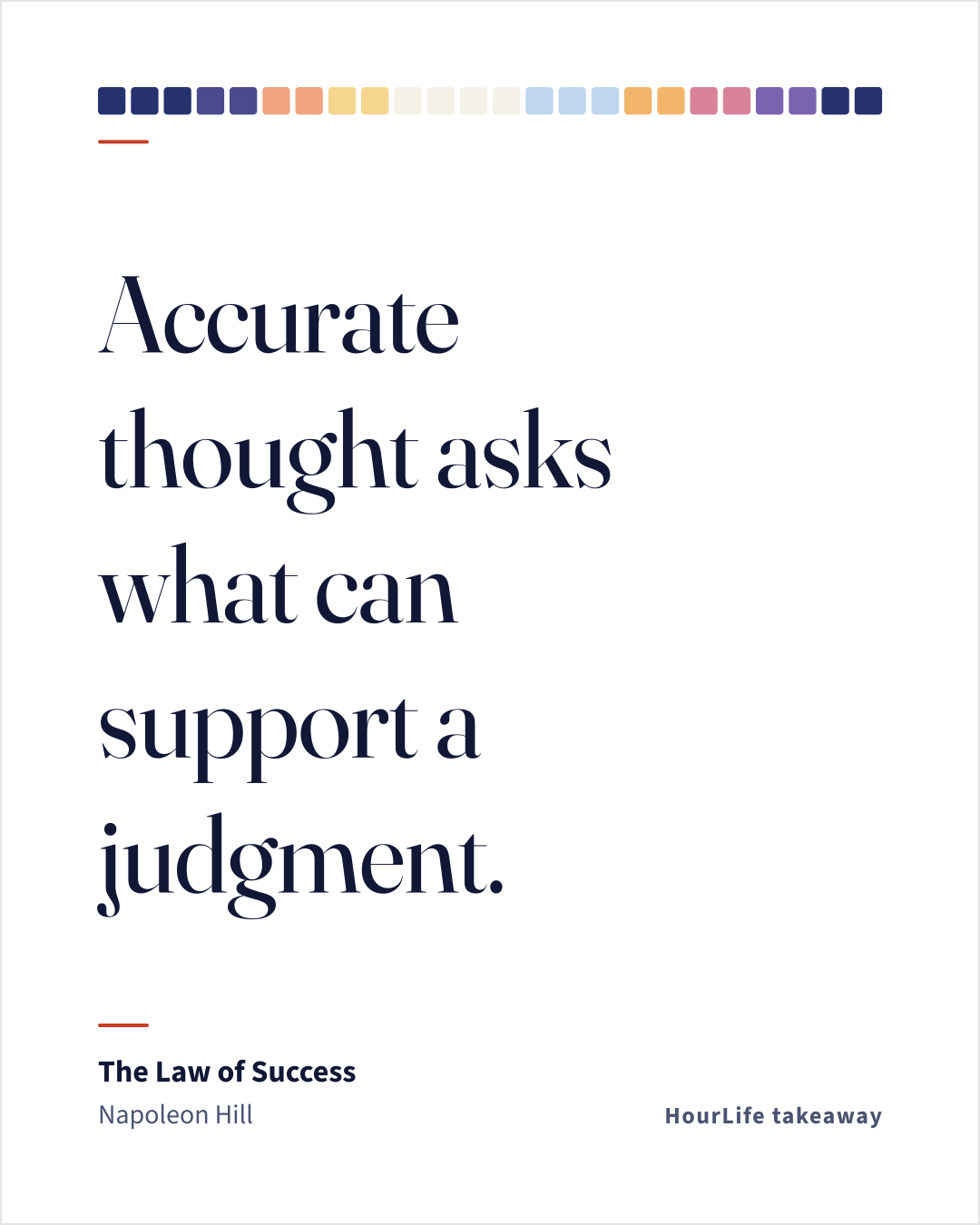
Accurate thought asks what can support a judgment.
Keep a fact separate from an assumption or a preferred conclusion. A plan is easier to revise when you can identify which statement new evidence would change.
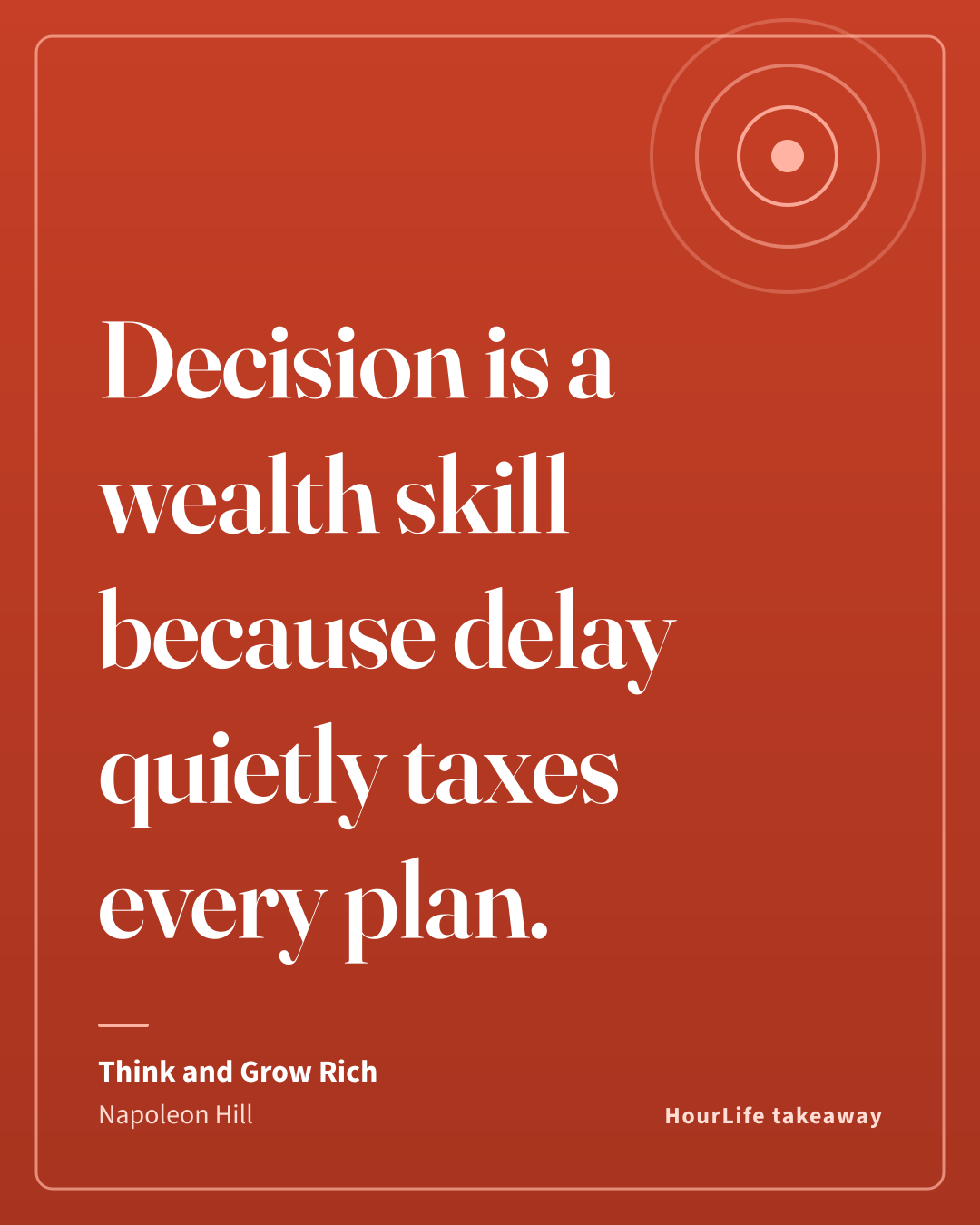
Decision is a wealth skill because delay quietly taxes every plan.
The book repeatedly contrasts decisive people with drifters. Modern readers can translate this as reducing open loops, setting constraints, and choosing the next experiment before confidence is perfect.
Independent thought needs practice.
The book keeps returning to the courage to examine inherited assumptions.
Imagination can produce an alternative you can try.
Use a possibility as the beginning of a concrete description: what would you do, with which resources, and what would you examine afterward? A vivid idea still needs an attempt.
Persistence is not stubborn repetition. It is loyalty to the aim plus flexibility about the route.
Hill's best practical point is that temporary defeat should trigger revision, not identity collapse. The goal remains; the plan goes back to the press.
Habits can imprison or free.
Daily routines become the machinery of drift or the machinery of agency.
A setback can inform a revision without settling your worth.
Examine what happened, which choices affected it, and what was outside your control. The next decision may be to revise, continue within a boundary, or stop.
Adversity can clarify purpose.
Pressure exposes whether an aim is chosen deeply enough to guide action.
Specialized knowledge beats general aspiration.
Think and Grow Rich asks readers to stop worshiping information and start assembling the exact expertise, partners, and experiments the definite aim requires.
A historical course can be read with questions about its claims.
Notice the distinction between Hill’s advice, the examples he offers, and a conclusion you can support in your own circumstances. Strong language does not remove the need for evidence.
Influence requires boundaries.
Choosing what enters the mind is part of choosing the life that follows.
HourLife turns these ideas into a daily system — goals, habits, focus, and reflection in one private place.