 Second Look
Product story
Second Look
Product story
I remember being right a lot more often than I was
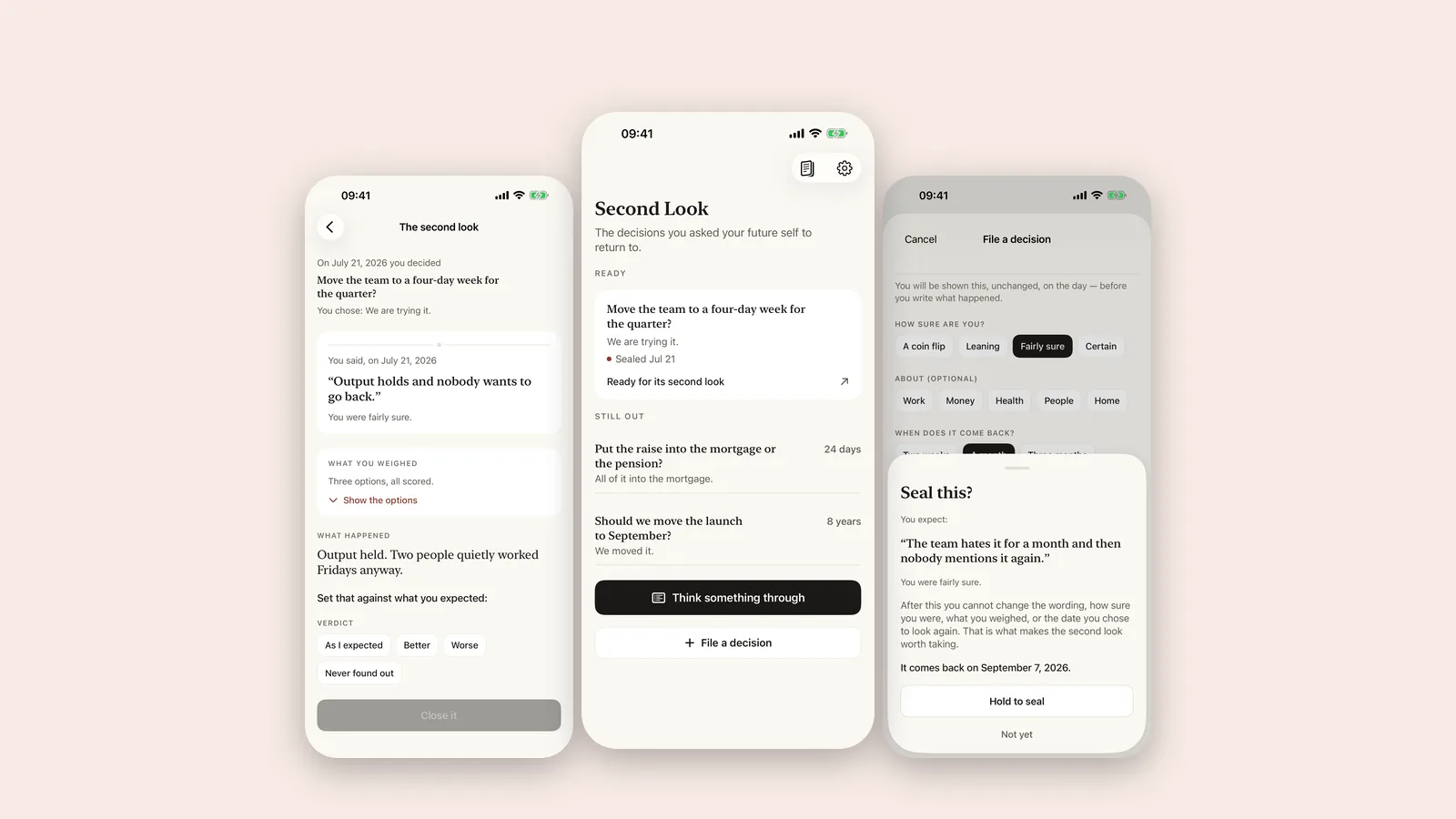
Second Look seals what you expect from a decision, then brings it back on a date you chose — and makes you write what actually happened before it shows you your prediction. Humbling. Recommended.
Memory is a defence lawyer. Every decision I've ever made gets retried in there with better arguments, softer lighting, and a version of me who basically saw it coming. Ask me how a call from last year turned out and I'll tell you a story where I was, on balance, right.
Second Look is the prosecution's filing cabinet, and I mean that as the highest compliment.
Seal it
The flow: when you make a decision that matters, you file it. Put the options down — there's a proper think-it-through mode with scoring if you want it, or you can just file a call you've already made. Then the important part: you seal what you expect to happen, in one sentence, with how sure you are. And you pick the date it comes back.
The example that sold me, from the app's own screenshots: Move the team to a four-day week for the quarter? Chose: we're trying it. Sealed expectation: "Output holds and nobody wants to go back." Fairly sure. Come back in ten weeks.
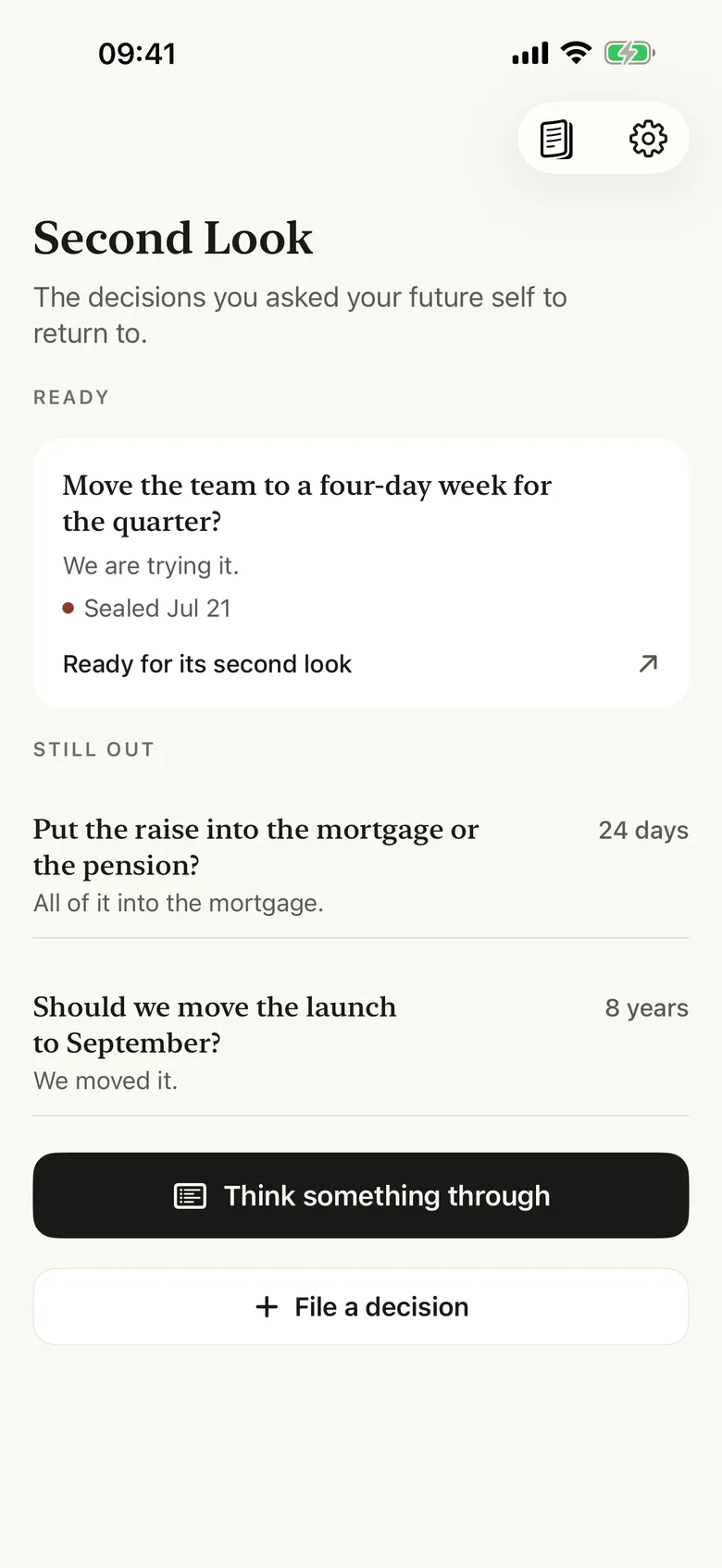
Then it disappears. No nagging, no progress bar. The home screen just keeps two quiet shelves — READY, for decisions whose day has come, and STILL OUT, for everything en route from your past. Mine currently shows one coming back in 24 days and one, cheerfully, in 8 years.
The order of operations is the whole app
When a decision comes back, Second Look asks what actually happened — before it shows you what you predicted. You write the outcome first, in ignorance of your own past confidence. Then the seal opens.
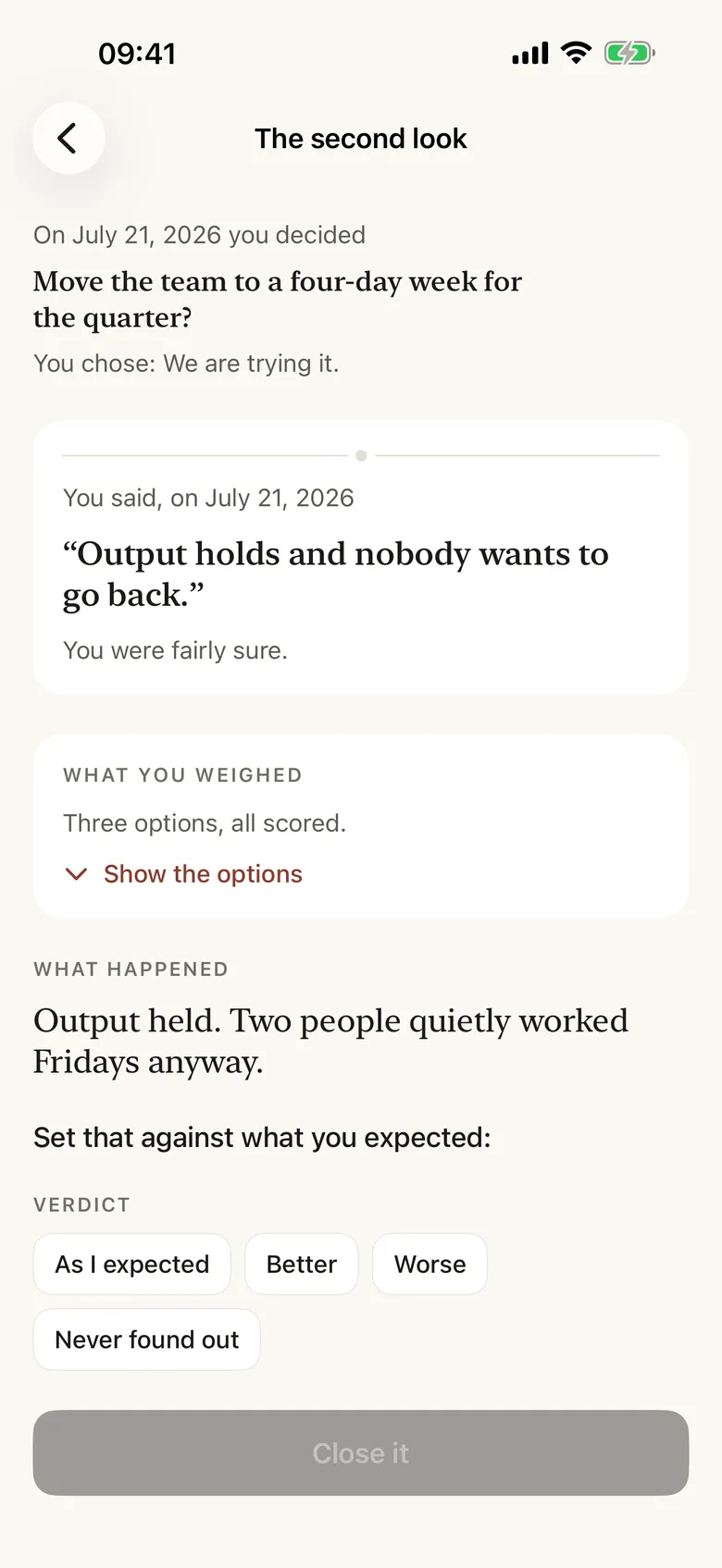
In the four-day-week example, the outcome line reads: "Output held. Two people quietly worked Fridays anyway." Set against the sealed "output holds and nobody wants to go back" — that's not a win or a loss, that's texture, the exact kind memory sands off. The verdict chips even include Never found out, which might be the most honest button in software. Some decisions never report back. Now that's data too.
My own first month: I sealed a call about moving all my writing to mornings ("I'll draft twice as much" — fairly sure). It came back, I wrote the truth — output up maybe 30%, but I'd stopped dreading it — and then the seal opened and past-me's "twice as much" sat there looking optimistic and a little sweaty. Verdict: better and worse. I filed it as "better," because the dread was the real cost all along, and I only know that because the app made me write the outcome before showing me the target.
Calibration, eventually
Do enough of these and Second Look starts drawing your calibration — when you say "fairly sure," how often are you right? I don't have enough history for mine to say much yet, and the app, in keeping with the family policy, refuses to guess early.
Private, on-device, iCloud sync, no account. In App Review as I post; days, in theory. $4.99 once, or $9.99 for the bundle with every HourLife mini app. No subscription.
File one decision tonight. Pick a return date. The person who opens that seal will know something about you that you currently, sincerely, misremember.
Both halves of the decision, kept.