The journal
Written after.
By then the outcome is known and the account has already been shaped to fit it, usually without you noticing.

Second Look · A HourLife mini app
Ask anyone why they made a decision two years ago and you get a story shaped by how it turned out. Nobody is lying. Memory simply rewrites the reasoning to fit the result.
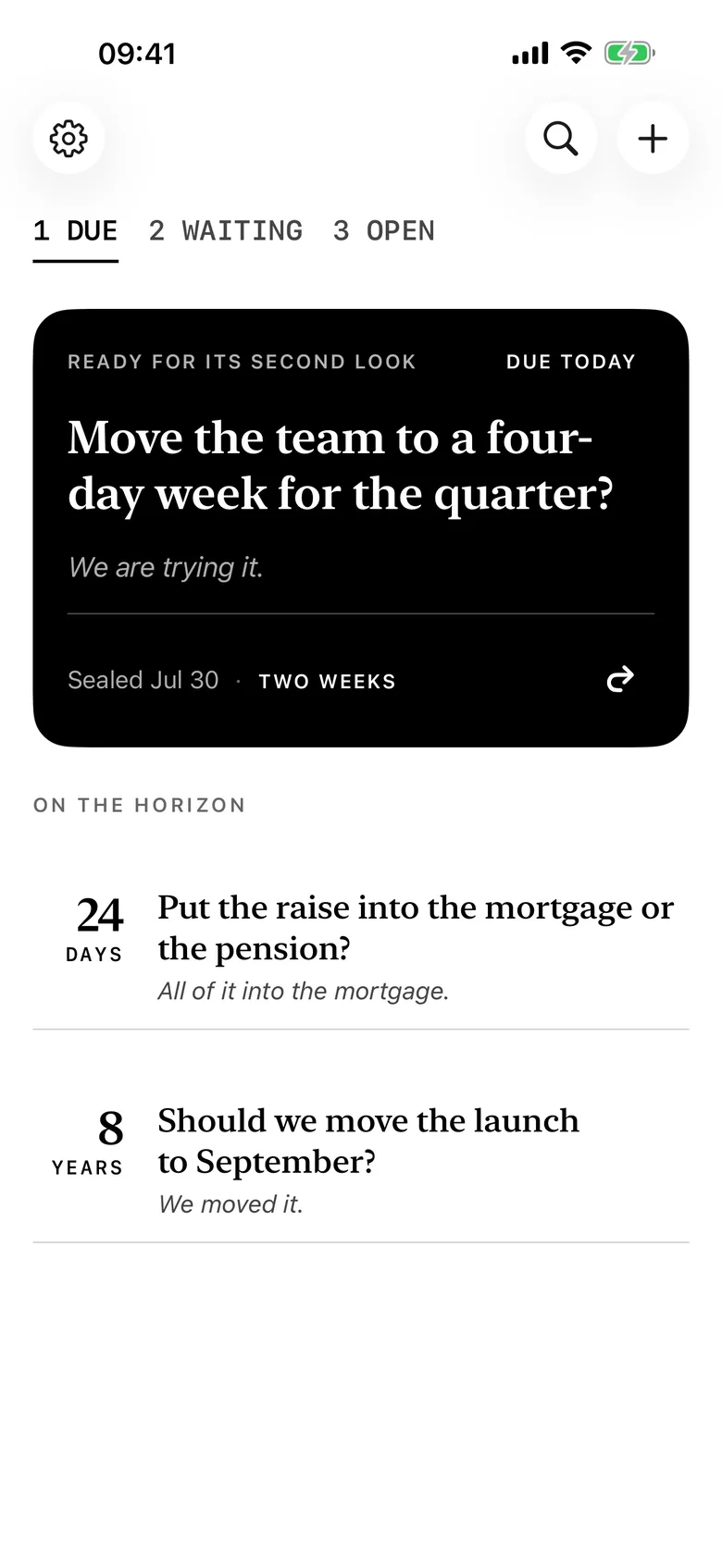
Second Look puts the options in front of you while you are still deciding, seals what you expect to happen, and brings the whole thing back on a date you choose.
iPhone · Local-first, iCloud optional · One-time purchase
Why this exists
The job offer you turned down was obviously the right call, because look how it turned out. Except that is not what you thought at the time — at the time you were 60 percent sure and it kept you up for a week. Without the original sentence, every past decision becomes evidence that you were right all along, which is the one lesson that teaches nothing.
The journal
By then the outcome is known and the account has already been shaped to fit it, usually without you noticing.
The pros-and-cons list
It did its job in the moment and then went in the bin, taking the only honest record of your reasoning with it.
Second Look
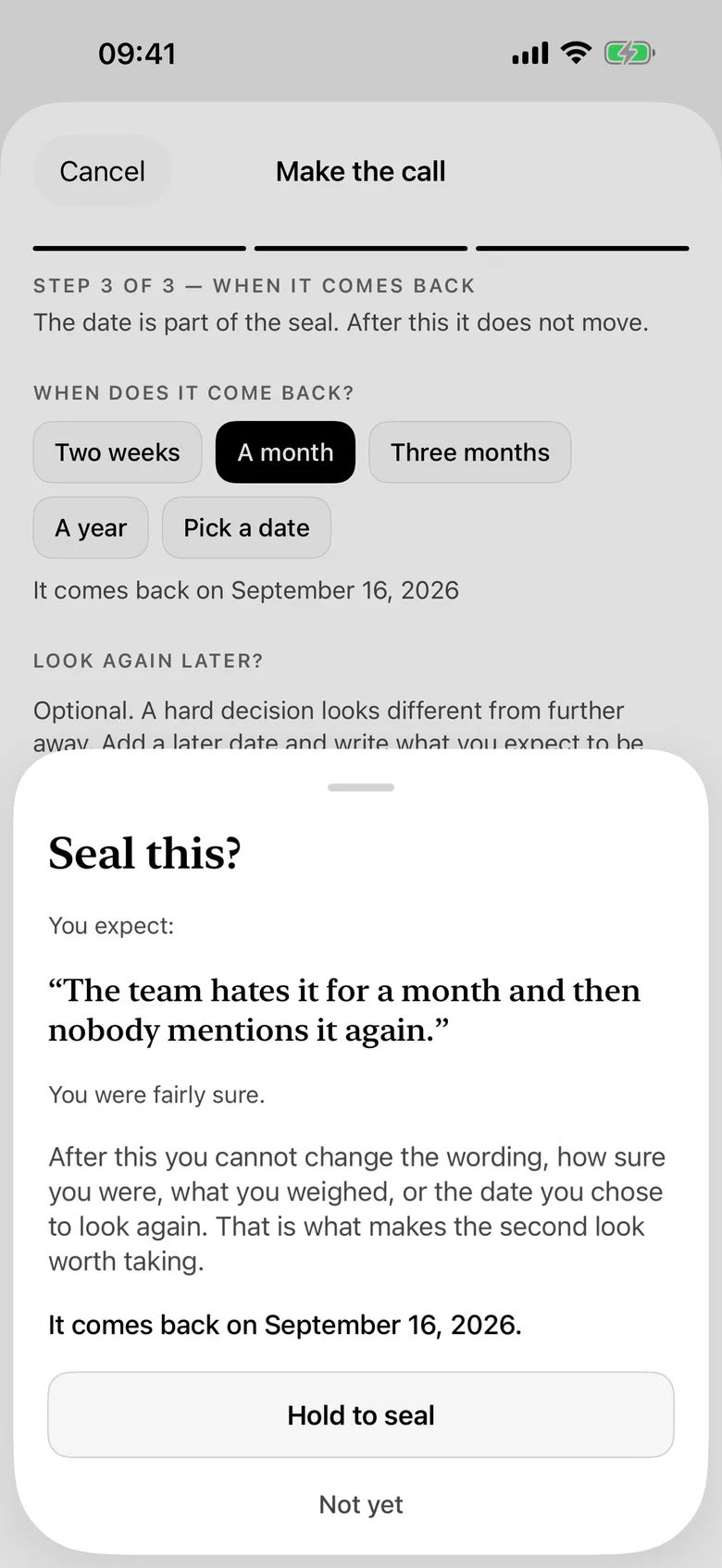
The choice, the weighing, and the expectation are closed. They cannot soften, and they cannot become whatever happened.
How it works
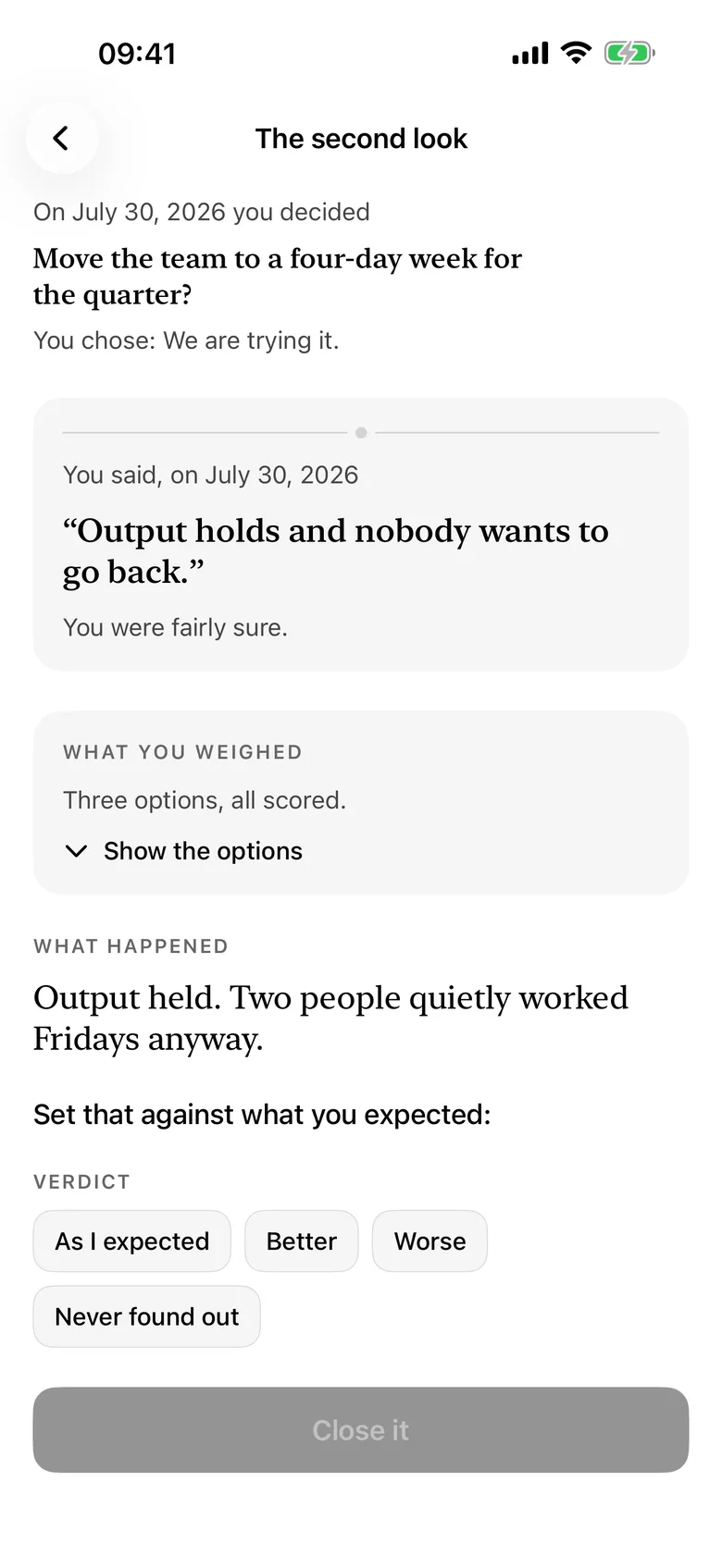
The order is the mechanism. You write what happened before the app will show you what you predicted.
Put the options beside each other. Write what is good and bad about each, and score what matters to you if that helps.
Mark the one you take. The app does not choose for you and there is no automatic winner.
Write what you chose, what you expect to happen, and how sure you are. Then seal it.
On the date you picked, the decision comes back and asks what actually happened. You write that first.
Then the seal opens and shows what you predicted, in your own words, at the size you wrote it.
You can open a seal early. It takes one deliberate tap, it is recorded, and that decision is left out of the calibration read — which the app tells you plainly rather than quietly dropping it.
The seal
Sealing is not encryption and it is not secrecy. It is a lock against you, later, when you would rather the past agreed with you.
The choice
Which option you took, and when.
The weighing
What you thought was good and bad about each.
The expectation
What you believed would happen, in your words.
The confidence
How sure you actually were at the time.
Confidence is the field that makes the rest useful. "It went badly" is a story; "I was 90 percent sure and it went badly" is a fact about your judgement.
The part that compounds
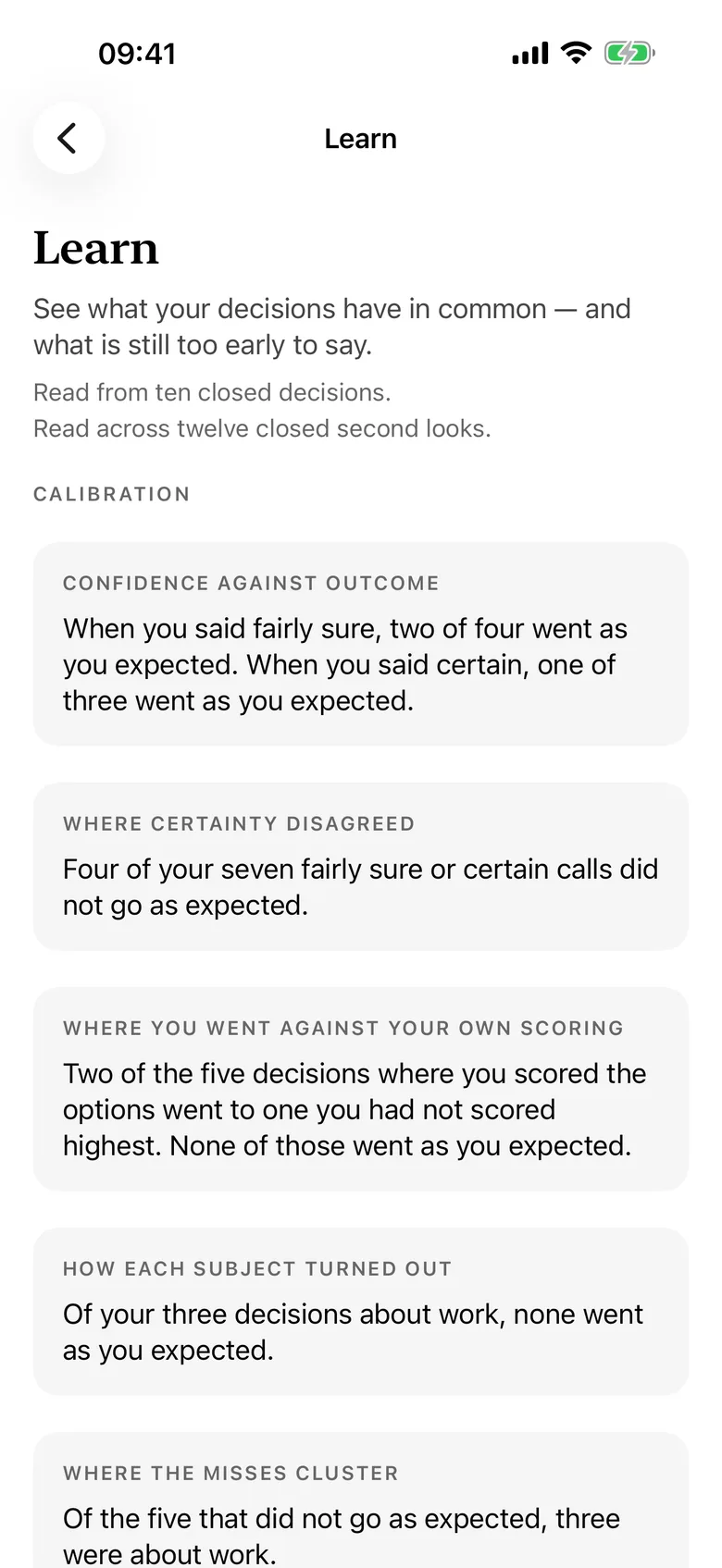
Calibration reads across every decision you have closed.
Where the misses gather. Which kinds of call you keep giving too little time. Whether your 90 percent means ninety percent or means sixty. It arrives as sentences, not a score, because a number here would just be another thing to feel bad about.
It does not grade your judgement.
No accuracy percentage, no streak, and no winner declared for you. It keeps the reasoning honest and lets the record say what it says.
Calibration
Across your closed decisions, in sentences.
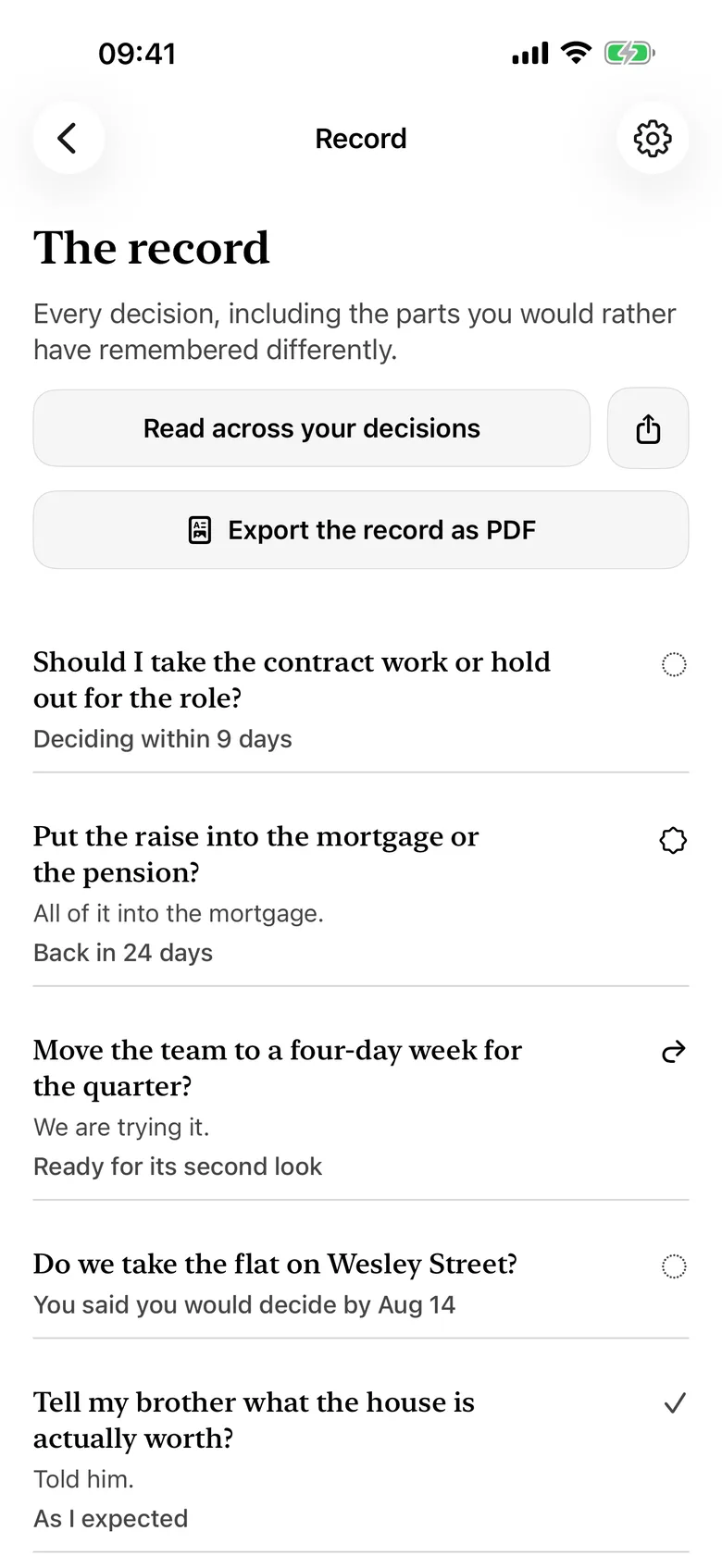
Record
Every decision, sealed and settled.
What it refuses to do
The scoring is there to help you notice what you actually care about. Second Look never treats the highest total as the choice you should make.
Private by default
There is no account, no sign-up, and no email address to hand over. Nothing is sent anywhere unless you turn on iCloud sync in Settings, which is off by default and uses your own private iCloud account.
Pricing
Comparing options, filing, sealing, the second look, the whole record, and the reminder on the day are free forever. Plain-text export of every word is free for the same reason — you wrote it.
Paid once · no subscription · nothing to renew
The decisions
Free
Unlimited decisions, the seal, the second look, the full record, the reminder, and plain-text export.
Second Look Complete
$4.99 once
The Calibration read across your closed decisions, what is still out on your Home Screen, a decision as a typeset card or the record as a document, and your record on every device through your own iCloud.
Mini app bundle
$9.99 once
Second Look, every other HourLife mini app, and every mini app added later — at no extra cost.
See everything in the bundleBoth are bought inside the app and charged once. Prices are in USD; the App Store charges Apple's regional price in your own currency. The bundle covers the mini apps — HourLife itself, the full Life OS, is a separate product and is not included.
Version 1.0 · Coming to the App Store
Second Look is built for iPhone. That one ordering rule is the reason the record stays worth anything, and it is not configurable.
The other layers
The call you made. The week you are in.
Second Look is for decisions with a horizon — a job, a move, a treatment. Time Freedom Review is for the ones that reset every seven days. One purchase covers both.
We would like to use Google Analytics to see which pages are worth keeping. It is off until you say yes, and the site works exactly the same either way. How we handle your data.