Log mood on a five-point valence scale.
Product menu +
Guide
Feature Clusters
Product Guides
Home
Capture & Process
Learn & Grow
Plan & Do
Life Design
Body & Mind
People & World
← HourLife guide
Emotional signal module
Mood
Help clients notice emotional patterns before they disappear into memory.
What it changes
Mood makes this part of life easier to see and act on.
Add notes and triggers.
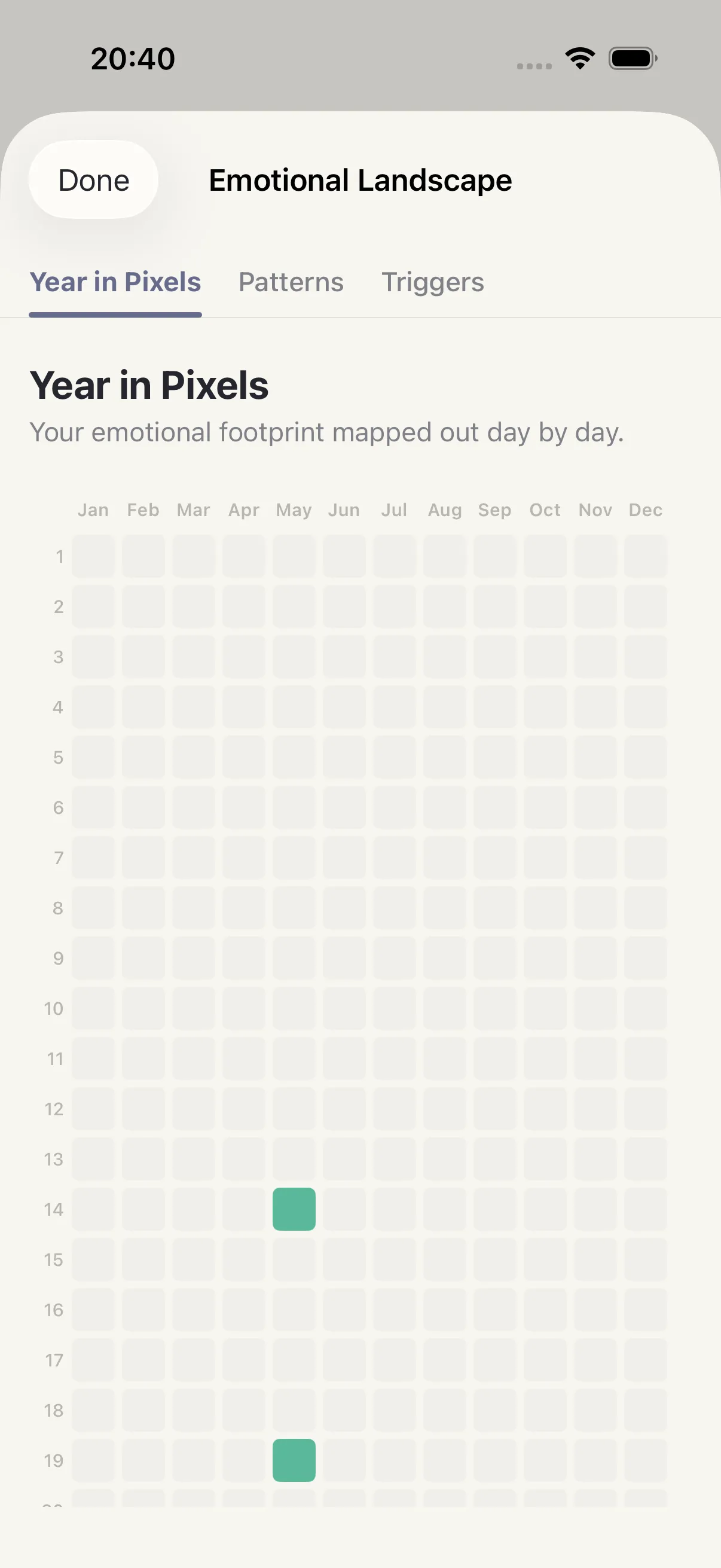
View dashboard summaries, calendar, and year pixels.
Inspect patterns over time.
Selected screenshots
The Mood module in use.
The selected Mood screenshot shows the core module surface clients will use most often.
Mood dashboard
The primary Mood screen in HourLife.
Workflows
How Mood fits into the client workflow.
Open
Start from the module when this context matters.
Use Mood when emotional context should inform planning, review, health, or recovery.
Capture
Record the important details.
Open Mood and log how you feel. Add a trigger or note when context matters, then use dashboard views to spot patterns.
Organize
Keep the record findable.
Use the module structure so the information does not disappear into memory or scattered notes.
Connect
Link the module to surrounding context.
Related goals, tasks, people, calendar dates, or review flows make the record more useful.
Review
Return when planning or reflecting.
The module becomes part of the client’s ongoing life system.
Act
Turn signal into the next useful step.
When the record implies action, send it back into Today, Tasks, Goals, or the relevant module.
How I use it
How a client uses Mood.
Mood gives clients a dedicated place to manage this part of life without scattering it across memory, notes, and unrelated tools.
- 1 Open Mood when this part of life needs attention.
- 2 Open Mood and log how you feel. Add a trigger or note when context matters, then use dashboard views to spot patterns.
- 3 Add the important context while it is fresh.
- 4 Review the module when planning or closing the loop.
- 5 Connect the record to the wider HourLife system when it matters.
Features
What Mood includes.
Log mood on a five-point valence scale
Log mood on a five-point valence scale.
Add notes and triggers
Add notes and triggers.
View dashboard summaries, calendar, and year pixels
View dashboard summaries, calendar, and year pixels.
Inspect patterns over time
Inspect patterns over time.
Connected system
Mood connects to the rest of HourLife.
The module is strongest when its records can inform Today, reviews, and the surrounding life system.
Today
Journal
Energy
Health
Gratitude
Compass
Next step
Use Mood as part of the Life OS.
It gives clients a focused module that still connects to the wider HourLife system.

Help us explain it better
What would you like to know?
Ask a question about this feature or tell us what’s missing.